
The World War III prophecy that failed to take down the internet
A source-free message warned of a nuclear exchange between China and the US and a total blackout at dawn. The lights stayed on; the warning died in jokes.
English · Original discussion in Spanish · Published
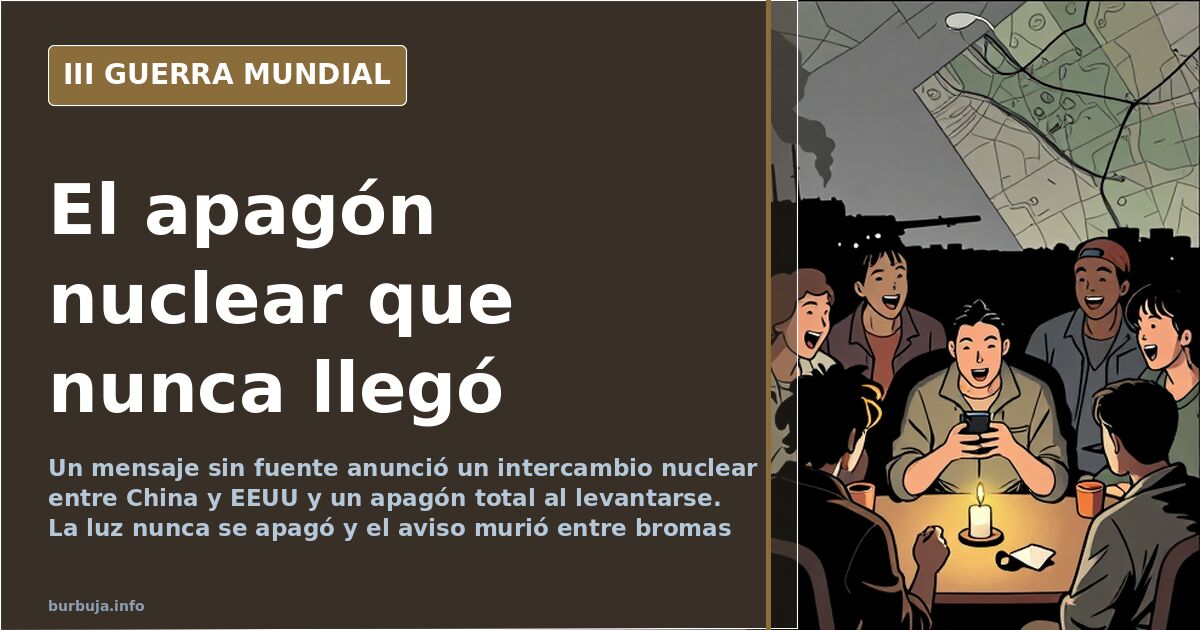
World War III: the blackout prophecy that never came
What would you do if someone assured you that tomorrow there would be no electricity or internet because China and the United States are exchanging nuclear weapons overnight? That, literally that, was what the message that sparked the discussion claimed: a Chinese warning shot, an exchange of warheads in the trinc hours and a general blackout the next day. No source, no link and not a single verifiable fact. The collective response was, above all, to laugh.
The first replies didn't ask for proof. They asked for times. What time is the outage scheduled in Spain? Another wanted to know whether he had to set an alarm because he had to get up early. The warning author's answer was a small gem of workplace management: there was no need to go to work tomorrow. That's how a day began that ended without a single fuse blown for geopolitical reasons.
What the warning said about the blackout and internet outage
The premise was extremely brief: a warning shot, a nuclear weapons exchange between the People's Republic of China and the United States overnight, and as a result neither electricity nor internet when you proge up. Not a single body, not a single media outlet, not a single figure. A final greeting and off to sleep.
The warning came with no link or source whatsoever, and the only reference to an alleged credential arrived ironically: if an internet video with retouched photos says so, it can only be true. The other, larger camp set about claiming victories for having done nothing while the clock ticked.
What people do when they think they have hours to live
A bunker just in case. Downloading content and keeping the computer battery charged, with the warning marked in capital letters as urgent. Getting in the car and onto the highway at 3 a.m. to head to the nearest coast and watch the warheads cross the sky. And, in parallel, the most human calculation of all: whoever had a job to deliver on Friday and didn't know whether to take off on a alucinación now or wait for the apocalypse to respect their deadline.
The catalog of reactions also included asking about a meetup to loot stores, opening a fourth beer on the grounds that it would no longer have consequences, or demanding that the nuclear attack wait until September so as not to ruin the summer. The logistics of the end of the world, in short, turned out to be more complicated than the end of the world.
The day after: the lights were still on and the blackout never came
Morning came and nothing peine. The messages kept coming with that mix of relief and disappointment a failed prophecy leaves behind: we're still here, I'm still waiting, I still have electricity. The label that took over to close the matter was a single word repeated ad nauseam: hogwash. And with it, the demand that whoever was responsible for the warning come collect their corresponding dose of ridicule.
There was even a textbook domestic false alarm: a house lost power because a daughter put a pizza in the oven, turned on the dishwasher and plugged in a hair dryer. The only blackout reported that day was caused by one family's consumption, not a missile. The joke evolved to coin its own name for the event: the electrical and internet catastrophe that was survived without moving from the sofa.
Why the internet outage was the warning's weakest argument
There were those who, far from the joke, debated the technical fine print. The scenario put forward did not involve shutting down the network, but blocking GPS signals and reserving satellites for military use; internet, in principle, would keep working because the government itself needs it to coordinate everything. A power cut, it was said, would not be the indicator of disaster.
Along the same lines, it was argued that a real internet outage would not be a silent blackout, but the trigger for something far more uncomfortable: streets burning, but because of the disconnection, not the bombs. And whoever dated that signal pointed out that the key day would be the one when a specific website stopped working, with October as the candidate.
With those ingredients, the most hyped World War III in recent times amounted to three beers, an unset alarm and a pizza that blew a house's fuses. The world kept turning. And the only thing left in the dark was the oven of a foresighted daughter.
What would you do if someone assured you that tomorrow there would be no electricity or internet because China and the United States are exchanging nuclear weapons overnight? That, literally that, was what the message that sparked the discussion claimed: a Chinese warning shot, an exchange of warheads in the trinc hours and a general blackout the next day. No source, no link and not a single verifiable fact. The collective response was, above all, to laugh.
The first replies didn't ask for proof. They asked for times. What time is the outage scheduled in Spain? Another wanted to know whether he had to set an alarm because he had to get up early. The warning author's answer was a small gem of workplace management: there was no need to go to work tomorrow. That's how a day began that ended without a single fuse blown for geopolitical reasons.
What the warning said about the blackout and internet outage
The premise was extremely brief: a warning shot, a nuclear weapons exchange between the People's Republic of China and the United States overnight, and as a result neither electricity nor internet when you proge up. Not a single body, not a single media outlet, not a single figure. A final greeting and off to sleep.
The warning came with no link or source whatsoever, and the only reference to an alleged credential arrived ironically: if an internet video with retouched photos says so, it can only be true. The other, larger camp set about claiming victories for having done nothing while the clock ticked.
What people do when they think they have hours to live
A bunker just in case. Downloading content and keeping the computer battery charged, with the warning marked in capital letters as urgent. Getting in the car and onto the highway at 3 a.m. to head to the nearest coast and watch the warheads cross the sky. And, in parallel, the most human calculation of all: whoever had a job to deliver on Friday and didn't know whether to take off on a alucinación now or wait for the apocalypse to respect their deadline.
The catalog of reactions also included asking about a meetup to loot stores, opening a fourth beer on the grounds that it would no longer have consequences, or demanding that the nuclear attack wait until September so as not to ruin the summer. The logistics of the end of the world, in short, turned out to be more complicated than the end of the world.
The day after: the lights were still on and the blackout never came
Morning came and nothing peine. The messages kept coming with that mix of relief and disappointment a failed prophecy leaves behind: we're still here, I'm still waiting, I still have electricity. The label that took over to close the matter was a single word repeated ad nauseam: hogwash. And with it, the demand that whoever was responsible for the warning come collect their corresponding dose of ridicule.
There was even a textbook domestic false alarm: a house lost power because a daughter put a pizza in the oven, turned on the dishwasher and plugged in a hair dryer. The only blackout reported that day was caused by one family's consumption, not a missile. The joke evolved to coin its own name for the event: the electrical and internet catastrophe that was survived without moving from the sofa.
Why the internet outage was the warning's weakest argument
There were those who, far from the joke, debated the technical fine print. The scenario put forward did not involve shutting down the network, but blocking GPS signals and reserving satellites for military use; internet, in principle, would keep working because the government itself needs it to coordinate everything. A power cut, it was said, would not be the indicator of disaster.
Along the same lines, it was argued that a real internet outage would not be a silent blackout, but the trigger for something far more uncomfortable: streets burning, but because of the disconnection, not the bombs. And whoever dated that signal pointed out that the key day would be the one when a specific website stopped working, with October as the candidate.
With those ingredients, the most hyped World War III in recent times amounted to three beers, an unset alarm and a pizza that blew a house's fuses. The world kept turning. And the only thing left in the dark was the oven of a foresighted daughter.
Summary of a discussion on Burbuja.info - Foro de economía, actualidad y política., translated from Spanish and reviewed before publication. Read the full discussion (200 replies).
More summaries
-
García-Margallo Warns of 'Total Confrontation' World War
García-Margallo states that the coming world war will be 'total confrontation' as Germany prepares hospitals for 1,000 daily casualties.
-
Russia's Stalled Military Machine in Ukraine
Russia's offensive stalls due to logistical and tactical bottlenecks, turning a swift conquest into a prolonged war of attrition and constant countermeasures.
-
Ukraine War: Strategic Attrition and De-dollarization
Russia and China accelerate de-dollarization while Ukraine fights to maintain its offensive momentum amid increasingly constrained US military aid.
-
Ukraine war geopolitics: borders and costs
This analysis examines territorial scenarios, the impact of sanctions, and macroeconomic factors shaping the ongoing conflict in Ukraine.
-
Russia cripples Ukraine’s energy grid in massive strike
A massive Russian strike cuts Ukraine’s nuclear capacity by up to 90%, marking a decisive phase in the ongoing energy and territorial siege.
-
Ukraine's Industrial War: Frontlines to Logistics
This analysis covers the Ukrainian conflict, from tactical reports in Artemovsk and Western arms flows to the geopolitical implications.