
The way women hold their phones reignites the gender debate
Nail length and wrist angle are at the centre of a debate over how people grip their phones. The subconscious theory doesn't convince everyone.
English · Original discussion in Spanish · Published
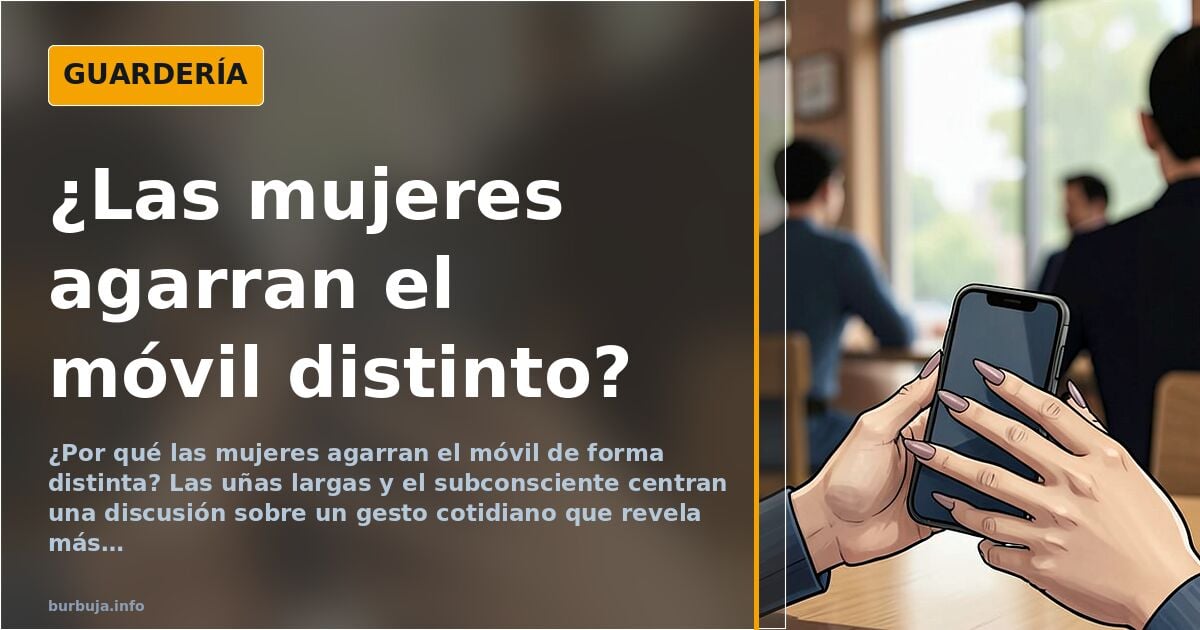
The way women hold their phones reignites the gender debate
Why do women hold their phones in such a distinctive way, with long nails and the device almost pinched between their fingers? The seemingly trivial question has been enough to reopen a classic debate: the suspicion that men and women do the same thing differently, and that behind a tiny gesture lies a whole world. The discussion started with images showing several women holding their phones with a pronounced wrist twist, nails taking centre stage. From there, the matter drifted into less technological territory.
Nails as explanation and as excuse
The first hypothesis doing the rounds is mechanical: someone with long nails can't press the pad of their thumb against the screen the way someone with trimmed nails can, so the phone is held differently, with more of a pinch and less palm. It's a reasonable explanation, almost a matter of household ergonomics, and it accounts for why the gesture appears in so many photos. But not everyone buys it. Some argue that nails are merely the visible excuse for something deeper: the phone would be a prized possession, and the grip an unconscious way of protecting it.
The counterargument comes quickly: if the gesture depended on sens, we'd have to explain how men hold their phones. And that's where the theory frays. It's pointed out that many men hold their phones with four fingers underneath and the thumb at the side, just like women. The difference, where it exists, isn't about gender but about nail length and hand size.
The wrist twist nobody disputes
Where most people agree isn't on the grip but on the angle. That ninety-degree wrist turn also shows up when holding a handbag, smoking, or holding a phone while doing other things. The everyday scene that generates the most irritation is a different one, though: driving with the hand tucked inside the steering wheel, as if the car were a truck. There the criticism doesn't distinguish between sens, only between reckless drivers.
From gesture to generic blame
What begins as curiosity about nails and thumbs ends, like almost everything, in an exchange of recriminations. Some question whether it makes sense to talk about "women" as a bloc when the photos show only a few, and the reply is that generalisation is the original sin of the whole premise. The conversation heats up and loses track of the phone. The initial question — why that gesture — is left unanswered, which is exactly where everything about how we use objects usually ends up.
In the end, the most solid explanation remains the most boring one: the nail rules, the hand adapts, and the rest is interpretation. A fine irony for an object that, depending on how you hold it, seems to say so much about us.
Also available in: Deutsch
Summary of a discussion on Burbuja.info - Foro de economía, actualidad y política., translated from Spanish and reviewed before publication. Read the full discussion (37 replies).
More summaries
-
Online community ban exposes harassment that spread to phone and email
A veteran of an online community was expelled: some attribute it to spam, others to harassment that allegedly spread to personal phone and email.
-
Why three beautiful women remain single after 35
Three cases of attractive women aged 35 to 42 without a partner or children spark a debate on hypergamy and unrealistic expectations.
-
Spain's Forgotten Fame Economy: From Vedettes to OnlyFans
From mobile discos to OnlyFans: the business of forgotten celebrities in Spain, between nostalgia and reinvention. Data and anecdotes of an invisible economy.
-
Nicknames for Spain's Pedro Sánchez: from 'Perro' to 'Quinquilino'
An open collection of more than twenty nicknames for Spanish Prime Minister Pedro Sánchez, from 'Perro' to 'Quinquilino de la Moncloa'. The list keeps growing with contributions and no clear favorite.
-
City centre: stunning architecture, unbearable streets
The architecture of the centre is a delight, but walking through it is exasperating: a debate on why historic districts become unlivable for those who walk them.
-
Ultravox: the synth band that split eighties music fans
Midge Ure and the viola solo in Vienna reopen the debate over Ultravox: musical tastes, genre labels and prejudices that don't fit the band.