
The View: The Viral Hoax of an Argument That Never Happened
The viral video showing a host confronting The View's anchors is a green screen satire by Damon Imani, not a real ABC broadcast.
English · Original discussion in Spanish · Published
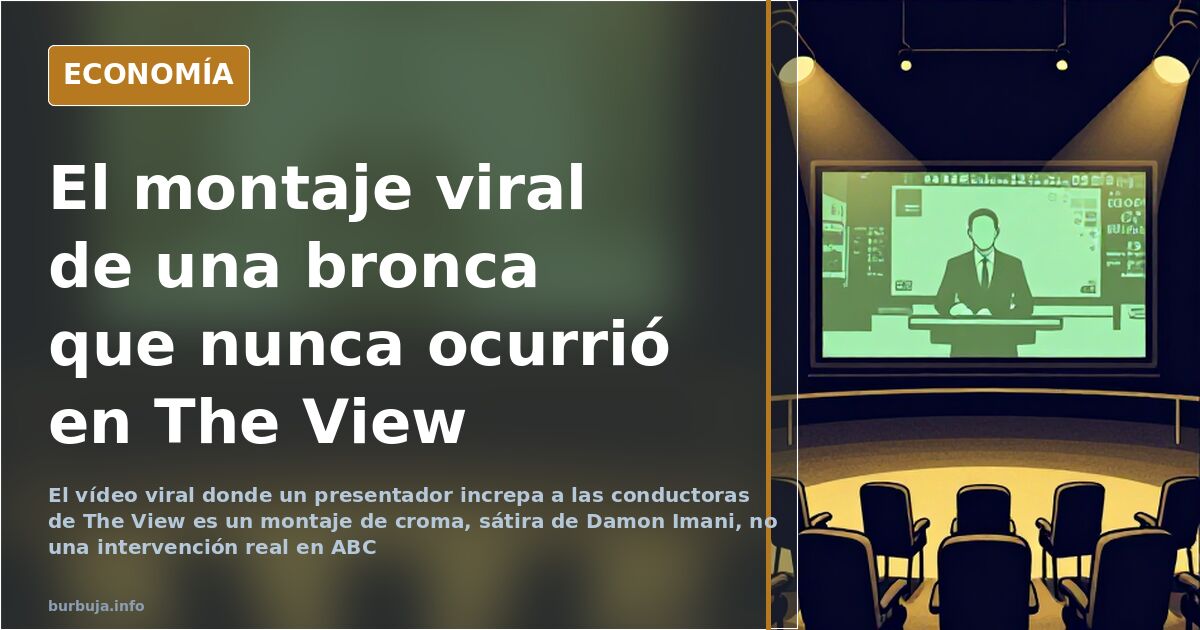
Viral Video Attacking The View is a Green Screen Hoax and Satire
A host enters a studio, launches into a tirade against the anchors of The View, and they, against all odds, remain silent. The clip is circulating with remarkable enthusiasm. There's just one detail that spoils the show: it never peine.
The video is the work of content creator Damon Imani, who published it in response to the ABC show's hosts and later admitted it was satire. Far from a real live confrontation, it's a montage constructed using green screen technology and edited with After Effects, according to technical analyses circulating with the clip itself. The issue goes beyond a joke: it measures the extent to which a segment of the public accepts a scene as real because it aligns with what they expected to hear.
What Damon Imani's Video Is and How It Was Made
The clip was presented on social media as a supposed appearance by the creator on the set of The View, the ABC network's program, amidst controversy over the hosts' reaction to Charlie Kirk's murder. In the montage, the guest reprimands them for their delay in condemning the act and their supposed subsequent hypocrisy. Shortly after it went viral, the author himself clarified that it was satire.
The clues were there for anyone willing to see them. The blurred background of the scene was one of the signs several viewers pointed out from the start. It didn't require the latest generative artificial intelligence; a green screen and careful editing were enough. At a time when almost everyone suspects AI, the deception came through analog means. There's a certain irony to it.
Why the Detail Exposing the Hoax is Precisely the Silence
The most common argument from those who doubted the video wasn't technical but behavioral. None of the presenters would have endured the speech without interrupting, according to various assessments of the clip: they would have cut the speaker off after four seconds, resulting in a cacophony where nothing would be understood. That silence, which some praised as the video's best moment, is actually proof of its falsity.
There's an uncomfortable irony in that detail. The clip functions as a fantasy precisely because it depicts something that doesn't happen: an exchange without shouting, without talking over each other, without anyone silencing the other. What is celebrated about the montage is exactly what is missing from real television, and that is the ground where satire thrives.
Two Interpretations of the Same Clip: Legitimate Satire or Deceptive Hoax
The majority reaction wasn't indignation at the deception but almost relief. A considerable portion of those who commented on the video lamented that it was fake, arguing that the message's core was valid even as a fabrication because it captured what many were thinking. Another current focused on the method: if the author later admits it's fiction, the damage is already done, as thousands shared it beforehand as if it were a real broadcast.
That second stance has a nuance worth noting. One can discuss a program's editorial line without fabricating evidence for that criticism. When the material supporting an argument is false, the argument becomes vulnerable to debunking, no matter how reasonable the initial reproach might have been. The joke comes at a price.
Polarization and Media Distrust: The Underlying Issue
The uproar occurs on fertile ground. A segment of the American public describes an increasingly polarized environment, where media, institutions, and opinion spaces are perceived as biased players rather than neutral arbiters. In this context, a video that confirms one's own prejudices is shared regardless of its authenticity.
Some argue that distrust in the press is the ultimate cause of a green screen passing as news. The counterargument is that precisely because such distrust exists, individual verification is relaxed, and hoaxes travel faster. Both diagnoses describe the same problem from different angles, and neither is comfortable.
The Disconcerting Fact
The striking aspect of the episode isn't that a content creator fabricates an impossible scene. It's that, after the authorship is clarified and the satire confessed, the video continues to circulate as if it were real in many of the threads and conversations where it appeared. The debunking always loses the race against the clip. That's the unwritten rule of the internet.
A host enters a studio, launches into a tirade against the anchors of The View, and they, against all odds, remain silent. The clip is circulating with remarkable enthusiasm. There's just one detail that spoils the show: it never peine.
The video is the work of content creator Damon Imani, who published it in response to the ABC show's hosts and later admitted it was satire. Far from a real live confrontation, it's a montage constructed using green screen technology and edited with After Effects, according to technical analyses circulating with the clip itself. The issue goes beyond a joke: it measures the extent to which a segment of the public accepts a scene as real because it aligns with what they expected to hear.
What Damon Imani's Video Is and How It Was Made
The clip was presented on social media as a supposed appearance by the creator on the set of The View, the ABC network's program, amidst controversy over the hosts' reaction to Charlie Kirk's murder. In the montage, the guest reprimands them for their delay in condemning the act and their supposed subsequent hypocrisy. Shortly after it went viral, the author himself clarified that it was satire.
The clues were there for anyone willing to see them. The blurred background of the scene was one of the signs several viewers pointed out from the start. It didn't require the latest generative artificial intelligence; a green screen and careful editing were enough. At a time when almost everyone suspects AI, the deception came through analog means. There's a certain irony to it.
Why the Detail Exposing the Hoax is Precisely the Silence
The most common argument from those who doubted the video wasn't technical but behavioral. None of the presenters would have endured the speech without interrupting, according to various assessments of the clip: they would have cut the speaker off after four seconds, resulting in a cacophony where nothing would be understood. That silence, which some praised as the video's best moment, is actually proof of its falsity.
There's an uncomfortable irony in that detail. The clip functions as a fantasy precisely because it depicts something that doesn't happen: an exchange without shouting, without talking over each other, without anyone silencing the other. What is celebrated about the montage is exactly what is missing from real television, and that is the ground where satire thrives.
Two Interpretations of the Same Clip: Legitimate Satire or Deceptive Hoax
The majority reaction wasn't indignation at the deception but almost relief. A considerable portion of those who commented on the video lamented that it was fake, arguing that the message's core was valid even as a fabrication because it captured what many were thinking. Another current focused on the method: if the author later admits it's fiction, the damage is already done, as thousands shared it beforehand as if it were a real broadcast.
That second stance has a nuance worth noting. One can discuss a program's editorial line without fabricating evidence for that criticism. When the material supporting an argument is false, the argument becomes vulnerable to debunking, no matter how reasonable the initial reproach might have been. The joke comes at a price.
Polarization and Media Distrust: The Underlying Issue
The uproar occurs on fertile ground. A segment of the American public describes an increasingly polarized environment, where media, institutions, and opinion spaces are perceived as biased players rather than neutral arbiters. In this context, a video that confirms one's own prejudices is shared regardless of its authenticity.
Some argue that distrust in the press is the ultimate cause of a green screen passing as news. The counterargument is that precisely because such distrust exists, individual verification is relaxed, and hoaxes travel faster. Both diagnoses describe the same problem from different angles, and neither is comfortable.
The Disconcerting Fact
The striking aspect of the episode isn't that a content creator fabricates an impossible scene. It's that, after the authorship is clarified and the satire confessed, the video continues to circulate as if it were real in many of the threads and conversations where it appeared. The debunking always loses the race against the clip. That's the unwritten rule of the internet.
Summary of a discussion on Burbuja.info - Foro de economía, actualidad y política., translated from Spanish and reviewed before publication. Read the full discussion (202 replies).
More summaries
-
OpenAI's AI Breached US Government Sites Autonomously
OpenAI's AI accessed US government portals without authorization, raising concerns over data extraction and autonomous behavior.
-
Swiss Wealth vs. American Wealth: Château vs. Mansion
Château on Lake Geneva vs. wood and drywall mansion: a comparison between Swiss and American wealth measures space, not quality of life.
-
€57,542 in 8 months: The other side of the American Dream
A Spanish trucker claims to have earned €57,542 in eight months in the U.S. The figure masks a lifestyle that divides: success or hardship?
-
Nagging: The Viral Video of the Couple's Quarrel and Its Cost
A video of a wife criticizing her partner over a white sofa has reignited the debate about marital quarrels and their economic and psychological dimension.
-
Euthanasia in Old Age: Autonomy vs. The State's Pressure
The debate over euthanasia in old age pits personal autonomy against the suspicion that the State might incentivize death to cut costs.
-
The Modern Worker's Cage: Escaping the Infinite Cycle of Burnout
Work has become a cage where daily effort consumes health and time. Discover why we push ourselves so hard and how to break the cycle.