
The True Cost of Commuting to Barcelona
Five lanes toward Barcelona at 7:30 on a rainy Monday reveal the hidden costs of early starts, car expenses, and lost life hours.
English · Original discussion in Spanish · Published
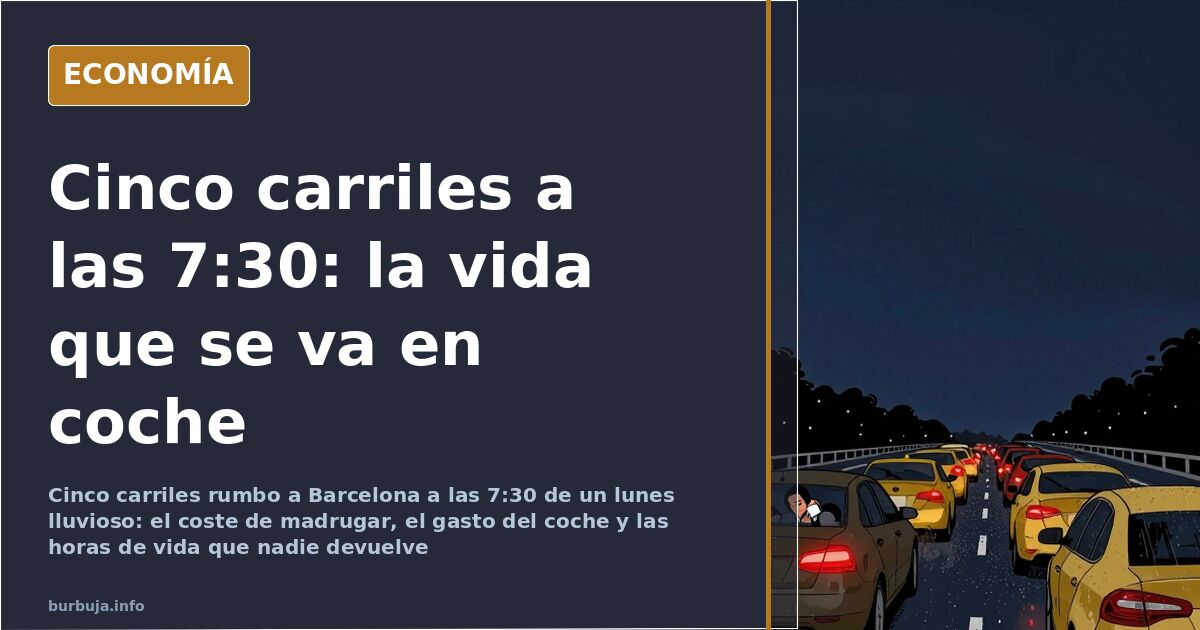
7:30 on a rainy Monday in five lanes toward Barcelona
A rainy Monday morning at 7:30. Five lanes entering Barcelona are gridlocked with cars. This is not an exception; it is the routine for eleven months a year, Monday through Friday, for those who leave home before dawn and return in the afternoon. The image, unadorned, reopens the uncomfortable question: how much life is surrendered for a salary that barely covers the month?
The most common answer is not a percentage. It is one hour. A user mentions a worker who died during his commute at 5:47 AM, cited as proof of how far the real workday extends. The vehicle does not pay for that time. Early risers losing their lives, summarizes this sentiment.
How much does driving to work cost monthly on a €1,300 salary?
A user calculates that an industrial estate worker earning €1,300 spends about €300 monthly on the car between fuel, insurance, ITV (vehicle inspection), loan payments, and maintenance. Plus, one hour daily round alucinación. The itemized breakdown yields a result many take for granted: the workday is not eight hours long; it lasts all the hours spent behind the wheel without pay.
Some take the reasoning further. If that commute disappears—working from home, even for less money—the balance, they argue, is five extra years of life and better health. The saved hour can be spent napping at zero cost while others burn fuel in traffic.
From shelf-stocker to head surgeon: same traffic, different car
Traffic does not distinguish by salary. The most supported idea is that a sports store stocker and a hospital head surgeon are essentially equally poor: one drives a compact car, the other a luxury sedan, but both share the lane and the clock. The same applies to the clerk earning €1,000 versus the doctor earning thousands.
Hence arises the formulation repeated in bitter moments: the only truly rich person is the one who doesn't have to watch the clock. It is not data; it is a diagnosis. And it admits no income nuances: it affects the low-income clerk and the high-earning doctor alike.
Why work from 7 to 19 until age 70?
This question hangs over the entire issue. Leaving at seven in the morning, returning at seven in the evening, eleven months a year, until age 70. The comparison launched is direct: better to live until 70 with your own free time than until 85 full of pain having never lived. In more acidic tones, there is irony about retirement at 75 years as a supposed welfare state achievement. No one signs off on that figure; it is used as a caricature of where the trend pushes.
Added to this is the feeling of permanent debt. It is argued that many drivers are paying installments for vehicles presented as solutions but which became another fixed quota. The wheel, they say, is not just working: it is working to pay for the instrument with which one works.
Working from home: the exit not available to all
A user claims to work from home and bill €10,000 monthly. It is not representative, and the teller admits it, but it serves to anchor the argument. The gap is not between effort or lack thereof, but between being able to choose where that effort is made.
The most repeated proposal is reducing working hours: four hours daily would suffice, they claim, without detailing how salaries would be sustained. Others warn that remote work is not universal. Not all jobs can be done at home, and not everyone can afford connectivity, energy, or personal space. The distribution of this exit—who has it and who doesn't—is exactly what the conversation leaves unresolved.
The detour: estimulante ilegal, taxes, and public spending
Here the discussion splits. One branch debates efficiency: recalling that the limit was once 130 km/h and is now 120, defending that real savings lie in constant driving at 90 or 100, not in speeding. Another, louder branch abandons calculation and drifts into taxes, public spending, and immigration, with hostile statements toward migrants that this analysis does not endorse but attributes to those who voice them. When venting replaces numbers, the diagnosis is lost.
Where the analysis stalls
No figure resolves whether waking up early pays off. Each person calculates based on their salary, mortgage, and car, and the result changes depending on who signs it. The only broad agreement is that commute time is unpaid, unrecoverable, and absent from any labor statistics. The rest remains in limbo: reduced hours, remote work, or simply accepting the traffic jam. With these elements, the fundamental question has no technical answer. It has a political one, and no one is providing it.
A rainy Monday morning at 7:30. Five lanes entering Barcelona are gridlocked with cars. This is not an exception; it is the routine for eleven months a year, Monday through Friday, for those who leave home before dawn and return in the afternoon. The image, unadorned, reopens the uncomfortable question: how much life is surrendered for a salary that barely covers the month?
The most common answer is not a percentage. It is one hour. A user mentions a worker who died during his commute at 5:47 AM, cited as proof of how far the real workday extends. The vehicle does not pay for that time. Early risers losing their lives, summarizes this sentiment.
How much does driving to work cost monthly on a €1,300 salary?
A user calculates that an industrial estate worker earning €1,300 spends about €300 monthly on the car between fuel, insurance, ITV (vehicle inspection), loan payments, and maintenance. Plus, one hour daily round alucinación. The itemized breakdown yields a result many take for granted: the workday is not eight hours long; it lasts all the hours spent behind the wheel without pay.
Some take the reasoning further. If that commute disappears—working from home, even for less money—the balance, they argue, is five extra years of life and better health. The saved hour can be spent napping at zero cost while others burn fuel in traffic.
From shelf-stocker to head surgeon: same traffic, different car
Traffic does not distinguish by salary. The most supported idea is that a sports store stocker and a hospital head surgeon are essentially equally poor: one drives a compact car, the other a luxury sedan, but both share the lane and the clock. The same applies to the clerk earning €1,000 versus the doctor earning thousands.
Hence arises the formulation repeated in bitter moments: the only truly rich person is the one who doesn't have to watch the clock. It is not data; it is a diagnosis. And it admits no income nuances: it affects the low-income clerk and the high-earning doctor alike.
Why work from 7 to 19 until age 70?
This question hangs over the entire issue. Leaving at seven in the morning, returning at seven in the evening, eleven months a year, until age 70. The comparison launched is direct: better to live until 70 with your own free time than until 85 full of pain having never lived. In more acidic tones, there is irony about retirement at 75 years as a supposed welfare state achievement. No one signs off on that figure; it is used as a caricature of where the trend pushes.
Added to this is the feeling of permanent debt. It is argued that many drivers are paying installments for vehicles presented as solutions but which became another fixed quota. The wheel, they say, is not just working: it is working to pay for the instrument with which one works.
Working from home: the exit not available to all
A user claims to work from home and bill €10,000 monthly. It is not representative, and the teller admits it, but it serves to anchor the argument. The gap is not between effort or lack thereof, but between being able to choose where that effort is made.
The most repeated proposal is reducing working hours: four hours daily would suffice, they claim, without detailing how salaries would be sustained. Others warn that remote work is not universal. Not all jobs can be done at home, and not everyone can afford connectivity, energy, or personal space. The distribution of this exit—who has it and who doesn't—is exactly what the conversation leaves unresolved.
The detour: estimulante ilegal, taxes, and public spending
Here the discussion splits. One branch debates efficiency: recalling that the limit was once 130 km/h and is now 120, defending that real savings lie in constant driving at 90 or 100, not in speeding. Another, louder branch abandons calculation and drifts into taxes, public spending, and immigration, with hostile statements toward migrants that this analysis does not endorse but attributes to those who voice them. When venting replaces numbers, the diagnosis is lost.
Where the analysis stalls
No figure resolves whether waking up early pays off. Each person calculates based on their salary, mortgage, and car, and the result changes depending on who signs it. The only broad agreement is that commute time is unpaid, unrecoverable, and absent from any labor statistics. The rest remains in limbo: reduced hours, remote work, or simply accepting the traffic jam. With these elements, the fundamental question has no technical answer. It has a political one, and no one is providing it.
Also available in: Deutsch
Summary of a discussion on Burbuja.info - Foro de economía, actualidad y política., translated from Spanish and reviewed before publication. Read the full discussion (136 replies).
More summaries
-
AEAT inspector vacancies offer up to €48,098 in supplements
The Official Gazette published 511 AEAT inspector positions with specific supplements ranging from €32,521 to €48,098 annually.
-
Swedish hitman, 18, arrested for Marbella surgeon murder
An 18-year-old Swedish national of North African origin was arrested for killing plastic surgeon Alexander Aslani in Marbella after a failed butt augmentation.
-
Gunpoint jewelry heist in front of Madrid's regional assembly as stabbings top one per day
The gunpoint robbery in Vallecas is the tip of the iceberg: Madrid now records more than one stabbing victim a day. Figures, causes and the debate over the city's security future.
-
Korean streamer goes to France to praise immigration and gets robbed on camera
A Korean streamer traveled to France to praise immigration and had his camera snatched at the 2:30 mark. The video that dismantles the multicultural narrative.
-
Is China still communist? ChatGPT weighs in
Is China still communist? We examine the gap between the CCP's dogma and economic reality: state ownership, state capitalism and the pragmatism behind it.
-
England riots: the price of a crisis nobody wants to pay
An analysis of the economic and social cost of the riots sweeping England, a revolt pitting the working class against itself while the elite looks on. Who ends up paying the bill?