
The Russian woman's name the internet spent days hunting for
A physiotherapy video, a crescent moon tattoo and thousands of strangers piecing together data to put a name to a woman. The search led to Kazan.
English · Original discussion in Spanish · Published
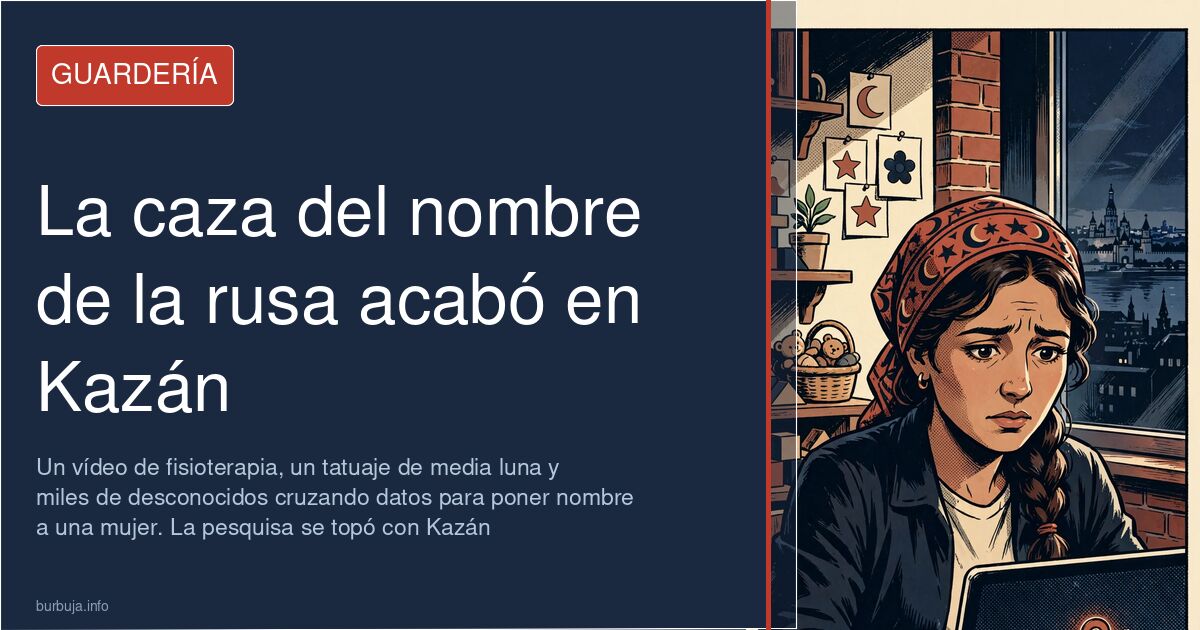
Ruslan Masgutov, Kazan and the nameless woman in the viral video
A woman with back pain lies down on a physiotherapist's table. Someone films it. Hours later, thousands of strangers are cross-referencing data as if they had a court order: enlarged screenshots, the detail of the tattoo, reverse image searches, and a question repeated like a refrain: what is the Russian woman's name? The search was not looking for a incivil. It was looking for a label. And in that gap, where there was no information, everyone filled in their own story.
Kazan, Tatarstan and the ethnicity no one could place on the map
The most solid finding was the professional's: a physiotherapist identified as Ruslan Masgutov, linked to Kazan, the capital of Tatarstan. The geographical clue upends everything, because Tatarstan is a republic of the Russian Federation where the Tatar, Muslim-majority population exceeds 50%. Suddenly, the "Russian" label that had led the search no longer fit. The hypothesis that gained traction was another one: a Tatar woman, a Muslim ethnic group which, it is argued, was never particularly strict and never adopted the veil, not even in regional dress.
On top of that came the most cited detail of all: a crescent moon and star tattoo, read by much of the search effort as unmistakably Turkish. The combination —a Muslim-majority region, an Ottoman symbol, modelling work— set off theories about what a woman can or cannot do with her own body depending on the imam of her village. Armchair sociology, version 3.0.
From parlour game to everyday doxxing
It is worth separating two things. One is curiosity, legitimate and as old as the world. The other is what happens when hundreds of people decide that a woman's anonymity is a problem that needs solving. Among the most repeated answers are made-up names, wordplay, none of them verifiable: the joke as a substitute for the fact. And alongside it, sarracena judgements about her private life, her mouth or her supposed profession, thrown out without a shred of proof. One argument even cited the case of a relative who had been married for twenty years to a Russian model and had three children. That is the level of evidence.
The phenomenon is not new, but it is getting cheaper all the time: a face, an approximate geolocation and a community ready to fill the gaps with prejudice. Neither the woman in the video nor the physiotherapist asked to be found. Nor did they commit any crime. The only excess, if any, is believing that the right to know kicks in because something went viral.
The only thing actually verified
Of the entire search, what is verifiable fits in two lines: a tattoo and the name of a doctor. The rest was an invention machine. And there is one detail that throws everything off: the "solutions" that circulated with the most confidence were not identifications, they were jokes. No one found anyone. And yet, the collective certainty that an answer existed lasted exactly as long as it took the video to stop being recommended.
Also available in: Deutsch
Summary of a discussion on Burbuja.info - Foro de economía, actualidad y política., translated from Spanish and reviewed before publication. Read the full discussion (29 replies).
More summaries
-
A name search is no longer enough to trust a photo
AI has reversed the burden of proof: an ordinary photo of two women from Madrid is no longer believed without evidence.
-
Necroporra 2026: Betting on who won't make it to year-end
Clint Eastwood, Jordi Pujol, and Sophia Loren lead the Necroporra 2026 bets, a game blending dark humor and demographics. Discover the most discussed names.
-
DJ Mario names his son Irai: Basque name sparks controversy
DJ Mario has named his son Irai, a Basque name that has drawn criticism over its authenticity and the burden it may place on the child.
-
PSOE spokesperson's cigar and her alleged salary
A tweet claims he ruined the PSOE spokesperson's cigar and the debate shifts to her alleged salary: €129,905.02 gross per year
-
Fixing old gadgets: the hobby of those who no longer go out
Buying broken consoles and repairing them is taking hold as a home refuge. Social isolation is growing, and the hobby doesn't always fill what's missing.
-
Van life invite turns into insults and adult links
An invitation to travel the world in a van has racked up 246,000 views and 2,800 reactions. The replies have descended into insults and links to adult content.