
The Routine Loop: Why Each Year Feels Like a Photocopy
Traffic jams, MOT tests, work, and starting over: daily routine seen as a systemic loop or a personal story we repeat annually.
English · Original discussion in Spanish · Published
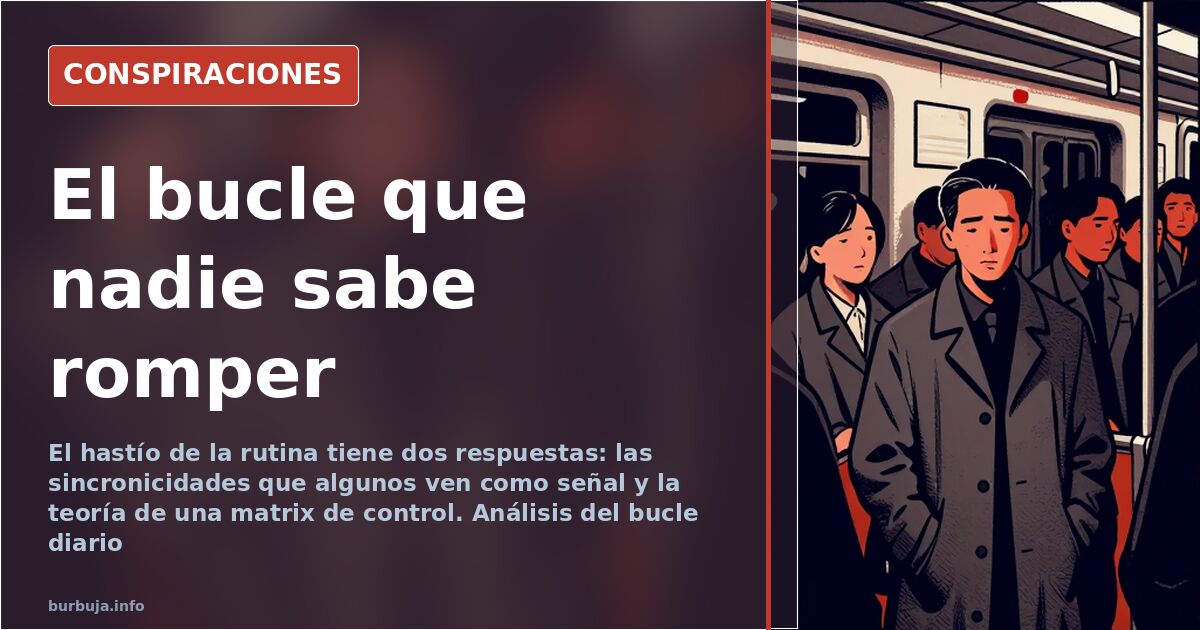
The Daily Loop: Why Routine Accelerates With Age
How many years have you felt like you're repeating the exact same year? This isn't a rhetorical question. The person asking it speaks of traffic jams, MOT tests, a society "worse and more expensive," comparing their daily life to that of Groundhog Day. They aren't seeking sympathy: they argue there's a control matrix keeping us in a constant loop until death, running the rat race. Strikingly, after dozens of replies, the loop remains intact. Not even the debate itself has escaped it.
Why Do We Feel Like We're Always Living the Same Year?
Some answers point to something more prosaic than conspiracy: time, they say, is speeding up. "The loop accelerates, and each year passes faster," summarizes a participant. Another qualifies that routine has an objective part—work, the mortgage, children—but the rest is a story we tell ourselves: we've repeated it so much that we've accepted it as unquestionable truth. Hence, "as you think it, so it will be." The contradiction is served: if the loop is real, there's no escape; if it's a narrative, the escape would be within each person's mind.
The Matrix, Elbichito, and Synchronicities
Elbichito appears as the only recent sustancia ilegal: a pause that broke inertia and, incidentally, plunged everyone into what's described here as a dystopia. Faced with weariness, another current argues that life is already sending signals. They recount four synchronicities in six months, another at work during 2025, and one more weeks ago. The reasoning is textbook: if something statistically almost impossible repeats, there's something behind it. Although the same author adds a caveat: no religions or gurus selling vibrations. The Bonoloto lottery remains as final proof. Skeptics respond with a single line: everyone deceives themselves as they wish, or as they can.
How to Break the Routine Loop?
Recipes range from hobbies and short trips to falling in love, to turning off the television and building one's own reality. One participant broke it radically—with a dating period and then traveling—confessing that, two years later, they returned to the same starting point of tedium. Others take the matter to a transcendental level: life as a spiral that ascends even while revolving around the same point, with God as the ultimate meaning. The secular answer is harsh: without palpable evidence of the afterlife, all that is "blah, blah, blah," and the existential void remains.
The Parable of the Three Stonecutters
To illustrate the distance between suffering routine and inhabiting it, someone resorts to the old quarry parable: three men chipping the same stone under the same sun. One sees only the hammer and the day's wage. The second sees his family eating. The third, with the same tired look, says he's building a cathedral. Same day, same work, three worlds in their heads. The Monopoly comparison closes the circle: each lap around the "Go" square demands more houses and more money than the last.
So, the thread has been discussing for a while whether life is a loop, whether it's broken by faith or Friday plans, or if it's just a story. Tomorrow is another day. And the stone is still there, waiting for the hammer.
How many years have you felt like you're repeating the exact same year? This isn't a rhetorical question. The person asking it speaks of traffic jams, MOT tests, a society "worse and more expensive," comparing their daily life to that of Groundhog Day. They aren't seeking sympathy: they argue there's a control matrix keeping us in a constant loop until death, running the rat race. Strikingly, after dozens of replies, the loop remains intact. Not even the debate itself has escaped it.
Why Do We Feel Like We're Always Living the Same Year?
Some answers point to something more prosaic than conspiracy: time, they say, is speeding up. "The loop accelerates, and each year passes faster," summarizes a participant. Another qualifies that routine has an objective part—work, the mortgage, children—but the rest is a story we tell ourselves: we've repeated it so much that we've accepted it as unquestionable truth. Hence, "as you think it, so it will be." The contradiction is served: if the loop is real, there's no escape; if it's a narrative, the escape would be within each person's mind.
The Matrix, Elbichito, and Synchronicities
Elbichito appears as the only recent sustancia ilegal: a pause that broke inertia and, incidentally, plunged everyone into what's described here as a dystopia. Faced with weariness, another current argues that life is already sending signals. They recount four synchronicities in six months, another at work during 2025, and one more weeks ago. The reasoning is textbook: if something statistically almost impossible repeats, there's something behind it. Although the same author adds a caveat: no religions or gurus selling vibrations. The Bonoloto lottery remains as final proof. Skeptics respond with a single line: everyone deceives themselves as they wish, or as they can.
How to Break the Routine Loop?
Recipes range from hobbies and short trips to falling in love, to turning off the television and building one's own reality. One participant broke it radically—with a dating period and then traveling—confessing that, two years later, they returned to the same starting point of tedium. Others take the matter to a transcendental level: life as a spiral that ascends even while revolving around the same point, with God as the ultimate meaning. The secular answer is harsh: without palpable evidence of the afterlife, all that is "blah, blah, blah," and the existential void remains.
The Parable of the Three Stonecutters
To illustrate the distance between suffering routine and inhabiting it, someone resorts to the old quarry parable: three men chipping the same stone under the same sun. One sees only the hammer and the day's wage. The second sees his family eating. The third, with the same tired look, says he's building a cathedral. Same day, same work, three worlds in their heads. The Monopoly comparison closes the circle: each lap around the "Go" square demands more houses and more money than the last.
So, the thread has been discussing for a while whether life is a loop, whether it's broken by faith or Friday plans, or if it's just a story. Tomorrow is another day. And the stone is still there, waiting for the hammer.
Summary of a discussion on Burbuja.info - Foro de economía, actualidad y política., translated from Spanish and reviewed before publication. Read the full discussion (56 replies).
More summaries
-
Dreaming of Cockroaches: From Accumulated Stress to the 'Beautiful Bug'
Dreaming of cockroaches is often attributed to accumulated stress, hidden guilt, or alcohol consumption. Interpretations vary widely and none are scientifically proven.
-
New World Order conspiracy theory: global control roadmap
A persistent conspiracy theory claims a 2014 roadmap predicts a pandemic, forced vaccines, and global control. We examine the evidence and context.
-
Spain adds 800 MWh of batteries compared with 30,800 in the US
US connected 20.2 GWh of batteries in Q2; Spain adds 800 MWh. Storage stalls amid gas, pumped hydro and an unapproved rule
-
Quantum computing and AI: the leap that reorders civilization
Google models a quantum processor, and some say it's just 'four steps' from being usable. Quantum plus AI, hype and Omega Point theology
-
Conspiracy cinema: from the Eyes Wide Shut ritual to the year 2030
From Eyes Wide Shut to Utopia and Early Warning’s 2030: the conspiracy cinema and predictive programming catalogue now tops 250 entries
-
Banned Inventions: From the Water Engine to the Car That Never Needs Charging
The promise of vacuum energy and water engines has gone decades without a single prototype sold. The recurring cases, and why they never reach stores