
The rise of Hispano-Latin couples: Love or business?
A look into a phenomenon that has been growing for decades: older men with assets and South American women seeking economic stability. The analysis of a...
English · Original discussion in Spanish · Published
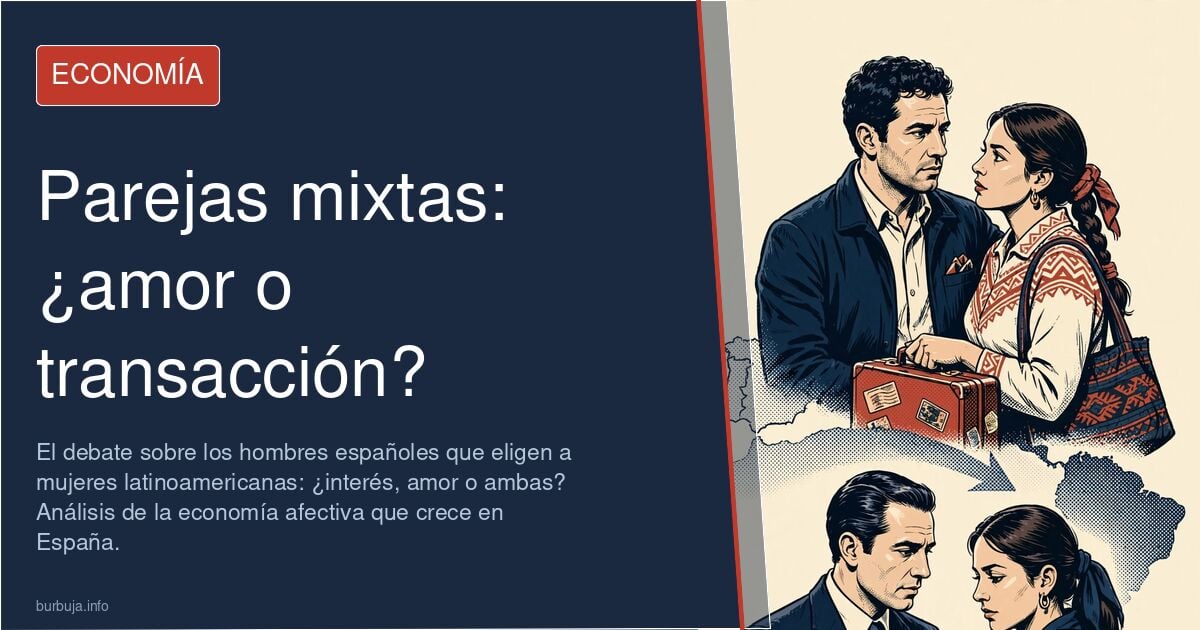
The business of loneliness: older Spaniards and Latinas, love or interest?
A phenomenon that has been expanding through rural Spain for two decades is now at the center of debate. It is not new: it has been going on for at least twenty years, but controversy continues.
Older men, often landowners or those with decent pensions, form couples with much younger South American women. Society wonders whether it is genuine love or an economic transaction.
The profile of unequal exchange
In most cases, the man is a bachelor or widower who has spent his life working. He may not be wealthy, but he owns a house, land, or a guaranteed pension. The woman, on the other hand, comes from countries with fragile economies and sees in this man an opportunity for stability. This has been argued quite frankly: they seek the man's wealth. But some maintain that it is a mutually beneficial arrangement: he receives companionship and care; she receives financial security. The phenomenon intersects with immigration and family reunification: in some cases, the women legalize their status through marriage and then bring their relatives, which is seen as an economic burden on the man.
The case of the Galician farmer
A story that circulates persistently is that of a farmer over 50 years old, owner of a Galician farm. Four years ago, he partnered with a Colombian woman who made the winters more pleasant. Today, the woman has brought two children, a sister, and a cousin to his side. They all live in an apartment the man inherited in the capital. The couple only appears in town occasionally. This case, whether real or fabricated, illustrates many people's antiestéticar: that the relationship will turn into a maintenance chain. In discussions, it is insisted that the women leave their families behind only to bring them later, taking advantage of the man's resources.
The other side: male frustration
The phenomenon also reflects a recurring complaint: the lack of appreciation from Spanish women for ordinary men. Some hold that a Spanish woman would not look twice at a 50-year-old bald man, while a Latina treats him like a king. This perception, although subjective, fuels resentment and explains much of the attraction. However, reality is more nuanced. Some maintain that South American women are more affectionate and less complicated than Spanish ones, and that money is just one factor. The personal experience of someone who was married to a Spanish woman and then to a Latina: “they are a thousand times happier and less complicated; they treat you much better, but it always comes down to money, and you pay for everything.” This quote summarizes the ambivalence: between apparent affection and real cost.
A historical paradox
The parallel with the conquest of America is inevitable. If then it was gold and silks in exchange for territory, now it is pensions and visas in exchange for companionship. Some see it as the revenge of colonization: “We colonized them centuries ago, and now they are making us pay for it with the same currency.” No one escapes the irony, but the economic issue remains the same: unequal exchange.
Nonetheless, the discussion does not come to a conclusion. The available data is anecdotal, and there are no official figures measuring the scope of the phenomenon. What is certain is that Spanish society is aging, and loneliness has become a market. Transnational couples, with all their controversies, are just another symptom of this reality.
A phenomenon that has been expanding through rural Spain for two decades is now at the center of debate. It is not new: it has been going on for at least twenty years, but controversy continues.
Older men, often landowners or those with decent pensions, form couples with much younger South American women. Society wonders whether it is genuine love or an economic transaction.
The profile of unequal exchange
In most cases, the man is a bachelor or widower who has spent his life working. He may not be wealthy, but he owns a house, land, or a guaranteed pension. The woman, on the other hand, comes from countries with fragile economies and sees in this man an opportunity for stability. This has been argued quite frankly: they seek the man's wealth. But some maintain that it is a mutually beneficial arrangement: he receives companionship and care; she receives financial security. The phenomenon intersects with immigration and family reunification: in some cases, the women legalize their status through marriage and then bring their relatives, which is seen as an economic burden on the man.
The case of the Galician farmer
A story that circulates persistently is that of a farmer over 50 years old, owner of a Galician farm. Four years ago, he partnered with a Colombian woman who made the winters more pleasant. Today, the woman has brought two children, a sister, and a cousin to his side. They all live in an apartment the man inherited in the capital. The couple only appears in town occasionally. This case, whether real or fabricated, illustrates many people's antiestéticar: that the relationship will turn into a maintenance chain. In discussions, it is insisted that the women leave their families behind only to bring them later, taking advantage of the man's resources.
The other side: male frustration
The phenomenon also reflects a recurring complaint: the lack of appreciation from Spanish women for ordinary men. Some hold that a Spanish woman would not look twice at a 50-year-old bald man, while a Latina treats him like a king. This perception, although subjective, fuels resentment and explains much of the attraction. However, reality is more nuanced. Some maintain that South American women are more affectionate and less complicated than Spanish ones, and that money is just one factor. The personal experience of someone who was married to a Spanish woman and then to a Latina: “they are a thousand times happier and less complicated; they treat you much better, but it always comes down to money, and you pay for everything.” This quote summarizes the ambivalence: between apparent affection and real cost.
A historical paradox
The parallel with the conquest of America is inevitable. If then it was gold and silks in exchange for territory, now it is pensions and visas in exchange for companionship. Some see it as the revenge of colonization: “We colonized them centuries ago, and now they are making us pay for it with the same currency.” No one escapes the irony, but the economic issue remains the same: unequal exchange.
Nonetheless, the discussion does not come to a conclusion. The available data is anecdotal, and there are no official figures measuring the scope of the phenomenon. What is certain is that Spanish society is aging, and loneliness has become a market. Transnational couples, with all their controversies, are just another symptom of this reality.
Summary of a discussion on Burbuja.info - Foro de economía, actualidad y política., translated from Spanish and reviewed before publication. Read the full discussion (202 replies).
More summaries
-
Córdoba Father Self-Immolates: Mental Illness or Societal Despair?
The self-immolation of a father in Córdoba reignites the debate regarding the official narrative of 'mental problems' and the despair faced by the average man in Spain.
-
Euthanasia in Old Age: Autonomy vs. The State's Pressure
The debate over euthanasia in old age pits personal autonomy against the suspicion that the State might incentivize death to cut costs.
-
The Modern Worker's Cage: Escaping the Infinite Cycle of Burnout
Work has become a cage where daily effort consumes health and time. Discover why we push ourselves so hard and how to break the cycle.
-
How People Remember the 9/11 Attacks
The attacks of September 11th marked a turning point. Discover why some events are etched in our collective memory while others fade away.
-
Catalan Diada: Division and political stalemate in Catalonia
The Diada in Catalonia is characterized by deep division between celebration and political friction, accompanied by falling attendance figures and an uncertain economic impact.
-
Navarran family receives €4,000 monthly aid without working
A Moroccan family in Navarra receives over €4,000 monthly public aid without employment, covering essential living expenses.