
The Peaceful Protest Myth: Why It Fails to Force Government Change in Spain
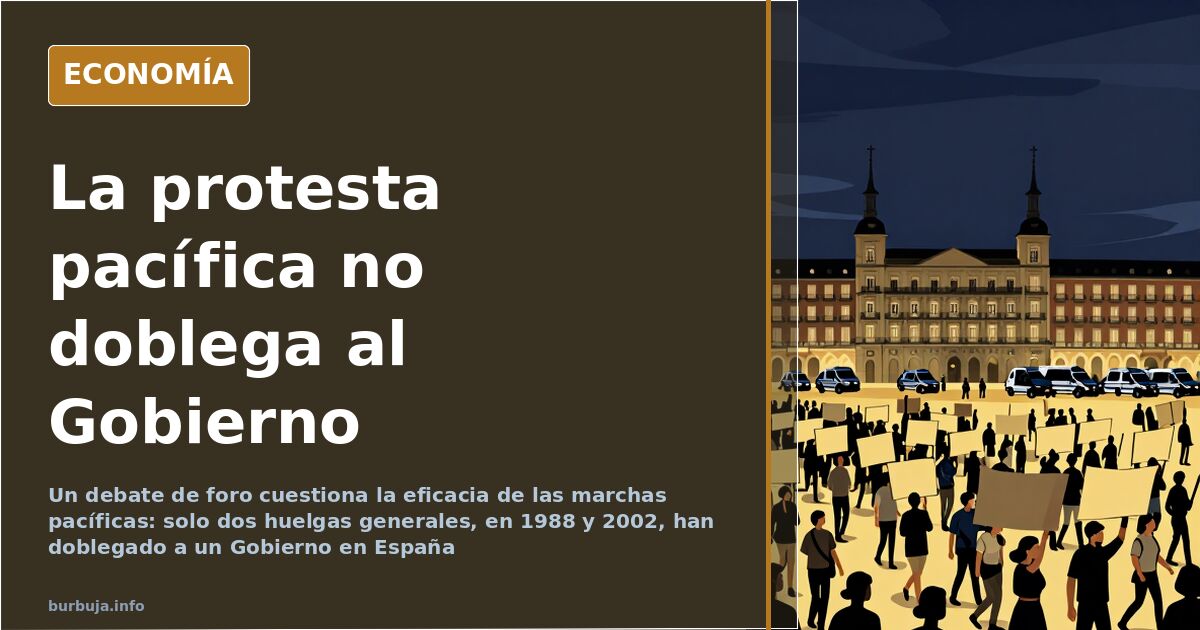
A forum debate questions the efficacy of peaceful marches, noting only two general strikes in 1988 and 2002 successfully forced a Spanish government to back down.
English · Original discussion in Spanish · Published
The Peaceful Protest Myth: Why It Fails to Force Government Change in Spain
What is the point of a demonstration if it changes nothing? This question drives a forum debate built on an uncomfortable thesis: authorized, planned, and incident-free rallies have never forced a Spanish government to yield. The initial argument states bluntly that official propaganda will always find an excuse to discredit them, and the only real lever is street pressure—paralyzing the country until nothing else matters. From there, the discussion splits into two fronts: the effectiveness of protest and the rejection of those who occupy the streets.
What Is Discussed When Discussing Demonstrations
The starting point is a comparison with France. It is argued that sustained street pressure works better there than here, and that excluding violent participants is a tactical error. In response, another school of thought argues the issue is not violence itself, but who commits it: a protest with gang-like appearances and Nancy salutes is not the same as a civic march. The discussion quickly turns to symmetry: it is argued that left-wing marches end in brawls without scandal, while right-wing ones are civic, and if an extremist sneaks in, clothes are torn. The conclusion of this line is that there are two distinct natures, and one is allowed everything.
The General Strike as the Only Real Lever
The strongest argument in the exchange is not violence, but the strike. It is recalled that the only two times the will of a government under the 1978 regime was forced to back down was through major general strikes: the one in 1988 against labor reform and the one in 2002 against the decree-law. The conclusion is that power only antiestéticars the worker letting go of the oar. Neither mass demonstrations outside working hours, nor peaceful ones, nor violent ones, have achieved anything comparable. It is the argument that disconcerts those who trust in the Sunday march.
Contempt for the Sunday Protester
A part of the exchange targets the profile of those who demand streets burn online while staying home. They are described with sarcasm as those who call for violence from a gaming chair while their mother prepares dinner. The accusation is cowardice: demanding of others what one does not do. Meanwhile, the Sunday morning demonstration with a full square listening to speeches with background music is ridiculed, compared to the image of thousands surrounding a party headquarters at night. The thesis is that the former projects no pressure, while the latter does.
The Trap of Provocation
Here appears the most repeated argument: every peaceful demonstration risks being sabotaged from within. It is argued that there are agent provocateurs and infiltrated extremists whose sole goal is to delegitimize the protest. From this comes the question hovering over the exchange: if you know it will be sabotaged, why call it? The response from another school is that precisely for that reason, the violent must be isolated, not embraced. A third path proposes large-scale consumer boycott as a form of pressure that may or may not incorporate violence.
The Undisputed Context: Prior Passivity
The harshest criticism is not against the government, but against the base itself. It lists the occasions when people did not take to the streets: closures and health restrictions, fiscal pressure, the real estate bubble, the gender violence law. The argument is that selective indignation reveals the problem is not the effectiveness of protest, but the lack of consistency. Orderly people, it is said, perceive disorder as something alien and delegate violence to police and military, failing to realize these bodies are paid by the power they seek to pressure.
The Catalan Laboratory and the Double Standard
The comparison with Catalonia closes the circle. It is argued that the separatist right did take to the streets with force, while the Madrid right calls the police when seeing someone with an extremist appearance. The conclusion is that the asymmetry is not of principle, but of courage. And the idea hovers that peace is only achieved after war, except in very cohesive and small societies.
In the end, the initial question remains unanswered. Some call for organization and clear objectives before taking the step; others warn that violence has no turning back. And meanwhile, the square fills up every Sunday morning. Something must have been achieved, I suppose.
What is the point of a demonstration if it changes nothing? This question drives a forum debate built on an uncomfortable thesis: authorized, planned, and incident-free rallies have never forced a Spanish government to yield. The initial argument states bluntly that official propaganda will always find an excuse to discredit them, and the only real lever is street pressure—paralyzing the country until nothing else matters. From there, the discussion splits into two fronts: the effectiveness of protest and the rejection of those who occupy the streets.
What Is Discussed When Discussing Demonstrations
The starting point is a comparison with France. It is argued that sustained street pressure works better there than here, and that excluding violent participants is a tactical error. In response, another school of thought argues the issue is not violence itself, but who commits it: a protest with gang-like appearances and Nancy salutes is not the same as a civic march. The discussion quickly turns to symmetry: it is argued that left-wing marches end in brawls without scandal, while right-wing ones are civic, and if an extremist sneaks in, clothes are torn. The conclusion of this line is that there are two distinct natures, and one is allowed everything.
The General Strike as the Only Real Lever
The strongest argument in the exchange is not violence, but the strike. It is recalled that the only two times the will of a government under the 1978 regime was forced to back down was through major general strikes: the one in 1988 against labor reform and the one in 2002 against the decree-law. The conclusion is that power only antiestéticars the worker letting go of the oar. Neither mass demonstrations outside working hours, nor peaceful ones, nor violent ones, have achieved anything comparable. It is the argument that disconcerts those who trust in the Sunday march.
Contempt for the Sunday Protester
A part of the exchange targets the profile of those who demand streets burn online while staying home. They are described with sarcasm as those who call for violence from a gaming chair while their mother prepares dinner. The accusation is cowardice: demanding of others what one does not do. Meanwhile, the Sunday morning demonstration with a full square listening to speeches with background music is ridiculed, compared to the image of thousands surrounding a party headquarters at night. The thesis is that the former projects no pressure, while the latter does.
The Trap of Provocation
Here appears the most repeated argument: every peaceful demonstration risks being sabotaged from within. It is argued that there are agent provocateurs and infiltrated extremists whose sole goal is to delegitimize the protest. From this comes the question hovering over the exchange: if you know it will be sabotaged, why call it? The response from another school is that precisely for that reason, the violent must be isolated, not embraced. A third path proposes large-scale consumer boycott as a form of pressure that may or may not incorporate violence.
The Undisputed Context: Prior Passivity
The harshest criticism is not against the government, but against the base itself. It lists the occasions when people did not take to the streets: closures and health restrictions, fiscal pressure, the real estate bubble, the gender violence law. The argument is that selective indignation reveals the problem is not the effectiveness of protest, but the lack of consistency. Orderly people, it is said, perceive disorder as something alien and delegate violence to police and military, failing to realize these bodies are paid by the power they seek to pressure.
The Catalan Laboratory and the Double Standard
The comparison with Catalonia closes the circle. It is argued that the separatist right did take to the streets with force, while the Madrid right calls the police when seeing someone with an extremist appearance. The conclusion is that the asymmetry is not of principle, but of courage. And the idea hovers that peace is only achieved after war, except in very cohesive and small societies.
In the end, the initial question remains unanswered. Some call for organization and clear objectives before taking the step; others warn that violence has no turning back. And meanwhile, the square fills up every Sunday morning. Something must have been achieved, I suppose.
Summary of a discussion on Burbuja.info - Foro de economía, actualidad y política., translated from Spanish and reviewed before publication. Read the full discussion (233 replies).
More summaries
-
Government brands small firm 'vulture fund' after it received digital grant
Urbagestión, a Madrid-based SME, received €6,000 from the Kit Digital scheme in 2023; the government has labelled it a 'vulture fund'.
-
Inside Spain's Wealthiest Neighborhood: The La Moraleja Report
A report on La Moraleja, Spain's richest district, reveals 13 euro menus and 1,700 sqm plots, sparking debate over Madrid's bourgeois lifestyle.
-
Male Beauty and Genetic Capital in Social Dynamics
Analysis of how extreme physical appeal acts as genetic capital in contemporary social interactions and relationship markets.
-
Money and Age: The Controversial Couple Equation
Analysis of the controversy between an 18-year-old woman and a 40-year-old man. Is it love or a purely economic transaction in today's context?
-
Gold Hits Record Highs as Japan's Debt Crisis and US Deficits Spark Global Alarm
Gold nears $2,400 and silver surges 215% annually. Japan's carry trade trap and global debt loom like a sword of Damocles, raising fears of a systemic collapse.
-
Gallows Graffiti on Spanish Highway Sparks Debate on Corruption and Economic Frustration
A gallows sign on Spain's A-4 highway has ignited a fierce debate on systemic corruption, economic stagnation, and social frustration across the country.