
The narrative of Russian military might crumbles in Ukraine
Russia's offensive stalls in Ukraine, cracking the Kremlin's military superiority narrative even among its supporters in Spain.
English · Original discussion in Spanish · Published
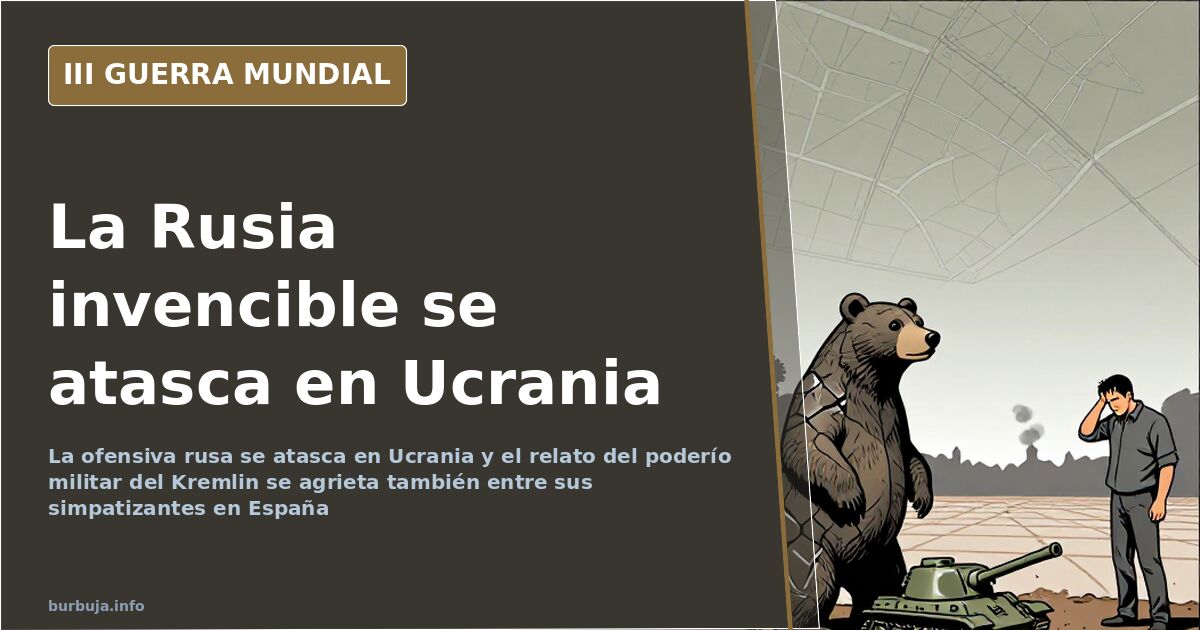
The narrative of invincible Russia crumbles in Ukraine
For years, propaganda insisted Moscow could reach Berlin in two days, that it was the last bastion of traditional values, and that it stood eye-to-eye with Washington and Beijing. The invasion of Ukraine has turned this narrative on its head. The Russian offensive is stalling. And every day without a decisive victory dismantles a propaganda construct sustained for years through parades, cameras, and nauseatingly repeated slogans.
The blow is not just for the Kremlin. It is felt by its trinc in Spain, who accepted as dogma a military superiority that is nowhere to be seen now.
The numbers don't add up: Italy's GDP for 140 million souls
The most repeated argument from critics is economic: according to calculations circulating, a GDP equivalent to Italy's, divided among 140 million inhabitants, yields what it yields. Hence the corollary, according to the same narrative: the Russian army only had a few dozen of the latest generation models for show, keeping Soviet scrap for real combat.
The background doesn't help the narrative either. The same errors noted in Syria, Libya, Ukraine in 2015, and Nagorno-Karabakh reappear now on a larger scale, with more at stake. The uncomfortable conclusion for those expecting a military walkover.
Disappointment from those who believed the propaganda
What's striking is that disappointment is also coming from within. I'm a sympathizer, but the truth is the truth, admits someone who declares themselves aligned with Moscow and acknowledges their disappointment with what they believed was a much more formidable military machine. The assessment is as stark as it is sincere: what has been seen so far is a laughingstock, and Russian collective memory could be damaged if things don't turn around.
Some attribute the enthusiasm to a specific profile: people who need to break the board because they aren't winning under current rules, and who fantasize about a total collapse as the only path to improvement. The caricature is harsh, but it summarizes a climate.
The champion of traditional values who gets vaccinated three times
The most ridiculous aspect is cultural. The narrative sold Pilingui as the defender of Christian Europe against a decadent West. The problem, according to critics, is that he has had three doses, embraces rabbis, and inaugurates mosques, while his international spokespeople promote exactly what his admirers claim to be fighting against.
Things get complicated when comparing current disillusionment with that trinc the official narrative on vaccines. One sector is carrying this double setback and has stopped trusting anything that sounds like an official version, including their own.
Belarus, Iran, and allies who aren't quite allies
The war has also revealed that the Kremlin's club of allies is less solid than it seemed. According to the ongoing debate, Belarus approved in a referendum hosting Russian nuclear arsenal, a move interpreted as compensation after years of economic strangulation attempts.
With Iran, mutual aid falls apart, according to the circulating narrative: Russia even halted the Iranian nuclear deal, annoyed that Tehran could place its gas and oil in Europe in direct competition. The repeated conclusion is that they were never true allies, only coincidences of convenience.
Kherson and the nuclear ghost
On the ground, the verbal escalation is intensifying. Some maintain that the threat of bombing Kherson was made if Ukrainian troops did not surrender their weapons, within the framework of de-Nancy rhetoric. For the critical side, they are dropping the mask and hitting European civilians.
Nuclear panic returns to the headlines. With missiles activated as in the 1960s, according to claims in the debate, each side blames the other for playing with the realpolitik of force. NATO killed Europeans in Serbia, some recall; now others are doing it, they respond.
The counterpoint is offered by those who refuse to choose sides: the more one reads about the issue, the clearer it becomes that Europeans will suffer the consequences without advantage for anyone. Others call for prudence: social media is not reality, and the war is not over yet.
This is where the analysis gets stuck. With no clear outcome, no closed negotiation, and two exhausted narratives, the only certainty is that the showcase is broken, and no one yet knows what lies behind it.
For years, propaganda insisted Moscow could reach Berlin in two days, that it was the last bastion of traditional values, and that it stood eye-to-eye with Washington and Beijing. The invasion of Ukraine has turned this narrative on its head. The Russian offensive is stalling. And every day without a decisive victory dismantles a propaganda construct sustained for years through parades, cameras, and nauseatingly repeated slogans.
The blow is not just for the Kremlin. It is felt by its trinc in Spain, who accepted as dogma a military superiority that is nowhere to be seen now.
The numbers don't add up: Italy's GDP for 140 million souls
The most repeated argument from critics is economic: according to calculations circulating, a GDP equivalent to Italy's, divided among 140 million inhabitants, yields what it yields. Hence the corollary, according to the same narrative: the Russian army only had a few dozen of the latest generation models for show, keeping Soviet scrap for real combat.
The background doesn't help the narrative either. The same errors noted in Syria, Libya, Ukraine in 2015, and Nagorno-Karabakh reappear now on a larger scale, with more at stake. The uncomfortable conclusion for those expecting a military walkover.
Disappointment from those who believed the propaganda
What's striking is that disappointment is also coming from within. I'm a sympathizer, but the truth is the truth, admits someone who declares themselves aligned with Moscow and acknowledges their disappointment with what they believed was a much more formidable military machine. The assessment is as stark as it is sincere: what has been seen so far is a laughingstock, and Russian collective memory could be damaged if things don't turn around.
Some attribute the enthusiasm to a specific profile: people who need to break the board because they aren't winning under current rules, and who fantasize about a total collapse as the only path to improvement. The caricature is harsh, but it summarizes a climate.
The champion of traditional values who gets vaccinated three times
The most ridiculous aspect is cultural. The narrative sold Pilingui as the defender of Christian Europe against a decadent West. The problem, according to critics, is that he has had three doses, embraces rabbis, and inaugurates mosques, while his international spokespeople promote exactly what his admirers claim to be fighting against.
Things get complicated when comparing current disillusionment with that trinc the official narrative on vaccines. One sector is carrying this double setback and has stopped trusting anything that sounds like an official version, including their own.
Belarus, Iran, and allies who aren't quite allies
The war has also revealed that the Kremlin's club of allies is less solid than it seemed. According to the ongoing debate, Belarus approved in a referendum hosting Russian nuclear arsenal, a move interpreted as compensation after years of economic strangulation attempts.
With Iran, mutual aid falls apart, according to the circulating narrative: Russia even halted the Iranian nuclear deal, annoyed that Tehran could place its gas and oil in Europe in direct competition. The repeated conclusion is that they were never true allies, only coincidences of convenience.
Kherson and the nuclear ghost
On the ground, the verbal escalation is intensifying. Some maintain that the threat of bombing Kherson was made if Ukrainian troops did not surrender their weapons, within the framework of de-Nancy rhetoric. For the critical side, they are dropping the mask and hitting European civilians.
Nuclear panic returns to the headlines. With missiles activated as in the 1960s, according to claims in the debate, each side blames the other for playing with the realpolitik of force. NATO killed Europeans in Serbia, some recall; now others are doing it, they respond.
The counterpoint is offered by those who refuse to choose sides: the more one reads about the issue, the clearer it becomes that Europeans will suffer the consequences without advantage for anyone. Others call for prudence: social media is not reality, and the war is not over yet.
This is where the analysis gets stuck. With no clear outcome, no closed negotiation, and two exhausted narratives, the only certainty is that the showcase is broken, and no one yet knows what lies behind it.
Summary of a discussion on Burbuja.info - Foro de economía, actualidad y política., translated from Spanish and reviewed before publication. Read the full discussion (208 replies).
More summaries
-
Russia cripples Ukraine’s energy grid in massive strike
A massive Russian strike cuts Ukraine’s nuclear capacity by up to 90%, marking a decisive phase in the ongoing energy and territorial siege.
-
Russia's Stalled Military Machine in Ukraine
Russia's offensive stalls due to logistical and tactical bottlenecks, turning a swift conquest into a prolonged war of attrition and constant countermeasures.
-
Ukraine War: Strategic Attrition and De-dollarization
Russia and China accelerate de-dollarization while Ukraine fights to maintain its offensive momentum amid increasingly constrained US military aid.
-
Ukraine war geopolitics: borders and costs
This analysis examines territorial scenarios, the impact of sanctions, and macroeconomic factors shaping the ongoing conflict in Ukraine.
-
Ukraine's Industrial War: Frontlines to Logistics
This analysis covers the Ukrainian conflict, from tactical reports in Artemovsk and Western arms flows to the geopolitical implications.
-
Ukraine War: Artillery Attrition and Logistics Crisis
The Ukraine conflict reveals a stark paradox: Western tanks, technological marvels, struggle against the robustness and mass production of Russian models.