
The meat smell no one can explain: not vegans, not tumors
A consumer notices an intense barn-like smell in pork and chicken that he never detected before. Phantosmia, product quality and sensory adaptation are among the possible explanations.
English · Original discussion in Spanish · Published
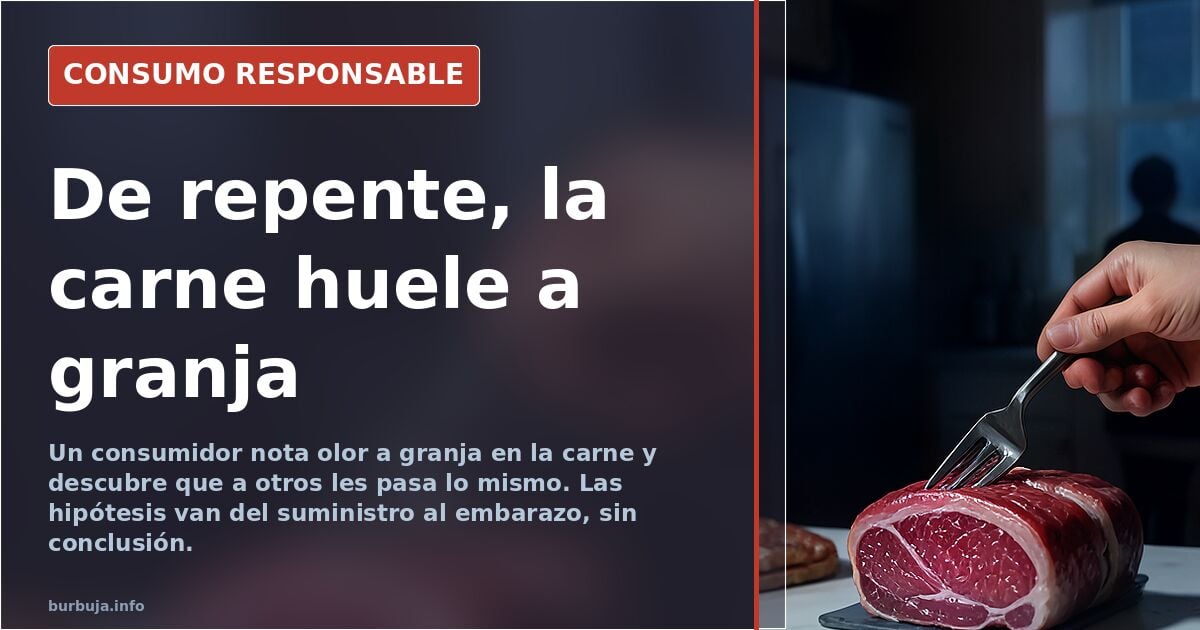
He is repulsed by the smell of pork and chicken, and no one knows why
There comes a moment when the smell of a pork chop stops being appetizing and turns into a barn stench that won't go away. It happens to a consumer who describes it like this: "I notice a brutal stink of pigsty and henhouse, or of the cow — it only happens to me with meat." It is not a metaphor. It is a perception that, according to his account, repeats itself every time he sits down to eat animal protein, while the rest of his food tastes the same as always.
Anyone's first reaction to such a case is a joke. And there were jokes: from male pregnancy to involuntary religious conversion. But beneath the humor lies an uncomfortable question: what if the problem is not in the nose of the person eating, but in what is being sold to them?
What science says about smells that appear out of nowhere
Olfactory dysfunction has a name, and it is not an internet invention. Phantosmia — perceiving a smell that is not there — and parosmia — a distortion of real smells — are recognized conditions that can appear after respiratory infections, head injuries or neurological disorders. The material consulted points directly to the possibility of "olfactory hallucinations" and recommends seeing a doctor. It is the only sensible piece of advice in the bunch.
That said, the person telling the story insists there is no hallucination: the smell is there, it is real and it is intense. And that is where another hypothesis comes in, less clinical and more prosaic: the quality of the product.
Is it the meat or is it the butcher?
The most repeated piece of advice is to change shops and try again. If the stench persists with another source, the problem lies with the eater. If it disappears, the problem was with the seller. A simple line of reasoning that, however, no one has actually carried out in the case described.
The meat supply chain in Spain operates on tight margins and irregular stock rotation. A product that has spent too long in cold storage, or that has been thawed and chilled again, develops volatile compounds that a trained palate detects immediately. No intoxication is needed to notice it: it is enough for the meat to have lost freshness. Consumers do not always distinguish between "it has gone bad" and "it tastes like animal."
The explanation nobody wants to hear: sensory adaptation
There is a third possibility raised in the conversation, and it is the most uncomfortable one: perhaps before, the person was simply unable to tell the difference. Olfactory perception is not fixed; it can be trained or it can atrophy. Someone who has eaten processed meat for years may have normalized an aromatic profile that, once sensitivity returns, becomes unbearable.
The detection threshold for skatole and other nitrogen compounds varies enormously between people. What is a nuance for one person is a wall for another. There is no single answer because there is no single nose.
One unsettling fact remains: throughout the entire conversation, no one has proposed an objective test. No blood work, no blind tasting, no comparison between two butcher shops. Just smell, memory and suspicion. That will not solve a mystery, but it does fill a conversation.
Summary of a discussion on Burbuja.info - Foro de economía, actualidad y política., translated from Spanish and reviewed before publication. Read the full discussion (14 replies).
More summaries
-
Pork sales drop 20% in Soria as lamb demand rises
A Soria farmer reports a 20% decline in pork sales and a surge in lamb, citing medical advice and demographic shifts.
-
Raising meat chickens: homegrown birds cost more per kilo than supermarket ones
Cereal at €0.30/kg and free-range birds needing 5-6 kg of feed per kilo of meat: raising chickens for meat costs more than buying it, even though the product is nothing alike
-
Homemade burger costs €1.50 using Mercadona bread
A homemade burger with Mercadona buns, butcher meat and cheese costs €1.50, reportedly indistinguishable from a Whopper.
-
Hussars: quality menswear or just posturing?
Hussars review: natural fabrics, local manufacturing, and straight fit versus criticism for its controversial cut and self-promotion. Is it worth the price?
-
Charging an EV at €0.068/kWh: what the math leaves out
Charging an electric car at €0.068/kWh costs about €4 per battery, but the rest of the home pays a different rate that can eat up the savings
-
MacBook battery swap: €50 at home, €200 at the shop for the 12-inch
Replacing a MacBook Air battery costs under €50 if you do it yourself; for the 12-inch MacBook, one user was quoted €200 at a repair shop.