
The Louvre's 'Russian Passport' Fuels Skepticism
A 'Russian passport' found near the Louvre after a theft, according to unconfirmed unofficial reports, is raising doubts and fueling skepticism.
English · Original discussion in Spanish · Published
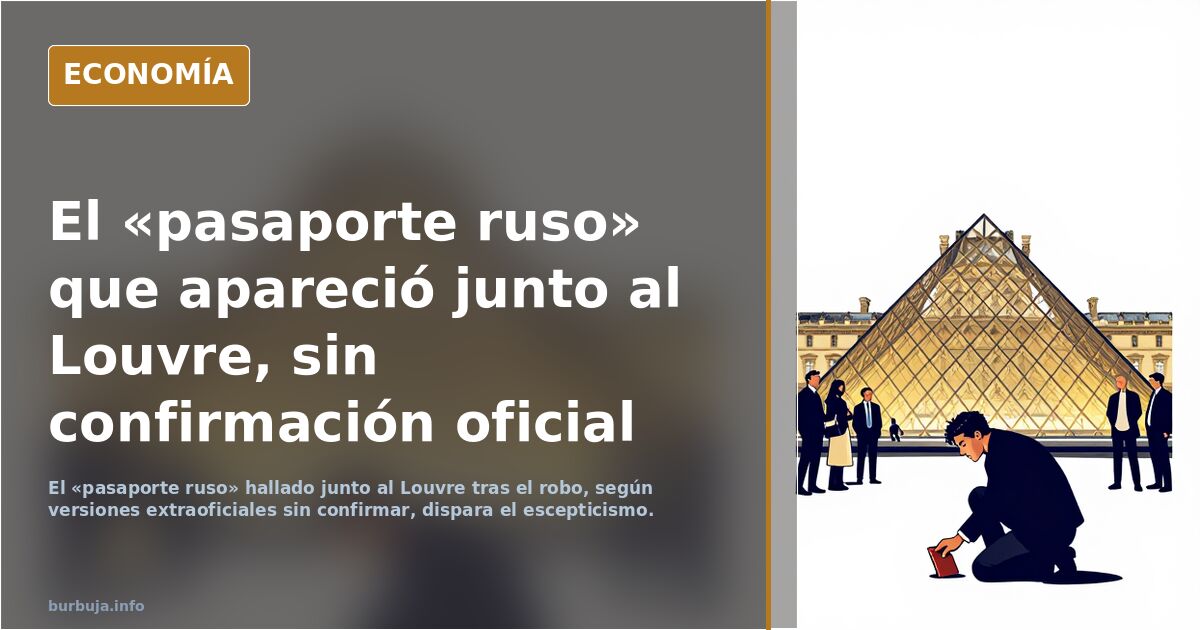
Russian Passport Near the Louvre: The Heist That Smells of Staging
A thief capable of orchestrating the year's most talked-about heist at the Louvre Museum, and who also happens to carry their passport in their pocket just in case. It sounds like a joke, and most of the commentary surrounding the case treats it as such. The disseminated version attributes to unofficial French sources the discovery of a Russian passport near the museum after jewels from the Parisian collection were stolen. The personal document, identifiable and perfectly useless to someone who has just pulled off a major crime, has turned a police matter into a dispute over who is writing the script. And there's one thing almost all interpretations agree on: nobody believes the clumsiness.
What is Known About the Heist and the Russian Passport
The sequence, as it circulated: jewels were stolen from the Parisian museum, and in the trinc hours, it emerged that very close to the building—in one of the repeated versions, in a restroom—a Russian passport was found. None of this came through official channels. The information spread as unofficial, attributed to French authorities by publications that provided neither an image of the document, nor a number, nor institutional confirmation.
That gap is precisely what fuels everything else. When hard data is missing, interpretation fills the void, and in this case, the dominant interpretation is that the discovery is too convenient. It's possible for a passport to survive a getaway; for it to survive and also point to a suspect who fits the narrative of the moment is what's unsettling.
From 9/11 to Alcàsser: The Document That Always Survives
The most repeated comparison is to the passport attributed to one of the 9/11 pilots, which is said to have appeared among the rubble of the Twin Towers as everything else burned. These kinds of stories have circulated for years without documentary verification to support them, and precisely because of that, they function as cultural references: they are the textbook example of data appearing exactly where it's convenient.
The second precedent that comes to light is the Social Security card linked to the Alcàsser girls case, another document that rumor has pointed to for decades as inexplicable. It's important to be clear: these are comparisons made to underscore an intuition, not proof of anything. That people use them doesn't demonstrate a conspiracy; it demonstrates the extent to which credulity is exhausted by narratives with improbable coincidences.
Why Half the Conversation Points to the Élysée
The second target is political and has a name: the French president. The most repeated suspicion doesn't accuse the thief, but the context. It's argued that the discovery fits the need to sustain a narrative of Russian threat and, incidentally, any subsequent justification for military spending.
Here emerges the most cynical and also the most difficult argument to refute: a jewel heist doesn't change any balance of power, but a Russian lead does serve a narrative. The existence of the narrative doesn't prove the discovery is false; the lack of verification of the discovery doesn't prove it's true. It's the kind of issue where each side places its burden of proof where it suits them.
The Lada Van and the CD: When Mockery Replaces Analysis
In the absence of data, inventiveness. In the realm of humor, a Soviet-brand van parked two blocks away, bottles of vodka, a scarf from a railway club, a CD by an 80s Spanish band, and even a three-word graffiti in the bathrooms appear. The list of irrefutable evidence grows with each message and serves as a thermometer of general skepticism.
Opposing this is the contrary stance, much less visible: finding documentation on a perpetrator is not unusual at all. In attacks and robberies of various kinds, mobile phones, papers, and personal items have appeared, and from that, a staged event is not automatically deduced. This is the serious argument from the side that asks not to turn everything into a conspiracy, and it gets lost among the jokes because it lacks epic flair.
The Hypothesis of Calculated Humiliation
There is a third, more uncomfortable path, which neither denies the discovery nor attributes it to an error: if someone designed a humiliation operation, perhaps they wanted it to be known that it was them, even if it could never be legally confirmed. From this perspective, leaving an identifiable clue is not clumsiness, it's a message.
The most twisted variant of the argument adds that the humiliation would be greater if the pieces eventually returned: playing with the adversary, letting them see it coming and be unable to do anything. This is speculation without evidentiary basis, but it well describes the state of mind: a part of the public is no longer discussing who stole, but who wants us to believe who stole.
The Spanish Angle That Almost No One Has Read
Amidst the noise, a different line of information emerged, with a Spanish accent. According to what was reported, French police had requested collaboration from Spanish authorities, and it is suspected that a known incivil nicknamed 'el niño Juan' might be behind the matter, due to similarities with a similar operation that was aborted in 2019.
The detail is interesting because it breaks the dominant hypothesis in the conversation. If the trail leads to a specialist with a record and not a foreign service, all the geopolitical burden collapses. None of these suspicions are established facts, and the case remains: open, with competing versions and no verified document on the table.
With the passport unconfirmed and the jewels unfound, the question floating is no longer who stole. It's how much longer an investigation recounted through anonymous leaks can be sustained without anyone showing the paper.
A thief capable of orchestrating the year's most talked-about heist at the Louvre Museum, and who also happens to carry their passport in their pocket just in case. It sounds like a joke, and most of the commentary surrounding the case treats it as such. The disseminated version attributes to unofficial French sources the discovery of a Russian passport near the museum after jewels from the Parisian collection were stolen. The personal document, identifiable and perfectly useless to someone who has just pulled off a major crime, has turned a police matter into a dispute over who is writing the script. And there's one thing almost all interpretations agree on: nobody believes the clumsiness.
What is Known About the Heist and the Russian Passport
The sequence, as it circulated: jewels were stolen from the Parisian museum, and in the trinc hours, it emerged that very close to the building—in one of the repeated versions, in a restroom—a Russian passport was found. None of this came through official channels. The information spread as unofficial, attributed to French authorities by publications that provided neither an image of the document, nor a number, nor institutional confirmation.
That gap is precisely what fuels everything else. When hard data is missing, interpretation fills the void, and in this case, the dominant interpretation is that the discovery is too convenient. It's possible for a passport to survive a getaway; for it to survive and also point to a suspect who fits the narrative of the moment is what's unsettling.
From 9/11 to Alcàsser: The Document That Always Survives
The most repeated comparison is to the passport attributed to one of the 9/11 pilots, which is said to have appeared among the rubble of the Twin Towers as everything else burned. These kinds of stories have circulated for years without documentary verification to support them, and precisely because of that, they function as cultural references: they are the textbook example of data appearing exactly where it's convenient.
The second precedent that comes to light is the Social Security card linked to the Alcàsser girls case, another document that rumor has pointed to for decades as inexplicable. It's important to be clear: these are comparisons made to underscore an intuition, not proof of anything. That people use them doesn't demonstrate a conspiracy; it demonstrates the extent to which credulity is exhausted by narratives with improbable coincidences.
Why Half the Conversation Points to the Élysée
The second target is political and has a name: the French president. The most repeated suspicion doesn't accuse the thief, but the context. It's argued that the discovery fits the need to sustain a narrative of Russian threat and, incidentally, any subsequent justification for military spending.
Here emerges the most cynical and also the most difficult argument to refute: a jewel heist doesn't change any balance of power, but a Russian lead does serve a narrative. The existence of the narrative doesn't prove the discovery is false; the lack of verification of the discovery doesn't prove it's true. It's the kind of issue where each side places its burden of proof where it suits them.
The Lada Van and the CD: When Mockery Replaces Analysis
In the absence of data, inventiveness. In the realm of humor, a Soviet-brand van parked two blocks away, bottles of vodka, a scarf from a railway club, a CD by an 80s Spanish band, and even a three-word graffiti in the bathrooms appear. The list of irrefutable evidence grows with each message and serves as a thermometer of general skepticism.
Opposing this is the contrary stance, much less visible: finding documentation on a perpetrator is not unusual at all. In attacks and robberies of various kinds, mobile phones, papers, and personal items have appeared, and from that, a staged event is not automatically deduced. This is the serious argument from the side that asks not to turn everything into a conspiracy, and it gets lost among the jokes because it lacks epic flair.
The Hypothesis of Calculated Humiliation
There is a third, more uncomfortable path, which neither denies the discovery nor attributes it to an error: if someone designed a humiliation operation, perhaps they wanted it to be known that it was them, even if it could never be legally confirmed. From this perspective, leaving an identifiable clue is not clumsiness, it's a message.
The most twisted variant of the argument adds that the humiliation would be greater if the pieces eventually returned: playing with the adversary, letting them see it coming and be unable to do anything. This is speculation without evidentiary basis, but it well describes the state of mind: a part of the public is no longer discussing who stole, but who wants us to believe who stole.
The Spanish Angle That Almost No One Has Read
Amidst the noise, a different line of information emerged, with a Spanish accent. According to what was reported, French police had requested collaboration from Spanish authorities, and it is suspected that a known incivil nicknamed 'el niño Juan' might be behind the matter, due to similarities with a similar operation that was aborted in 2019.
The detail is interesting because it breaks the dominant hypothesis in the conversation. If the trail leads to a specialist with a record and not a foreign service, all the geopolitical burden collapses. None of these suspicions are established facts, and the case remains: open, with competing versions and no verified document on the table.
With the passport unconfirmed and the jewels unfound, the question floating is no longer who stole. It's how much longer an investigation recounted through anonymous leaks can be sustained without anyone showing the paper.
Summary of a discussion on Burbuja.info - Foro de economía, actualidad y política., translated from Spanish and reviewed before publication. Read the full discussion (214 replies).
More summaries
-
How People Remember the 9/11 Attacks
The attacks of September 11th marked a turning point. Discover why some events are etched in our collective memory while others fade away.
-
Euthanasia in Old Age: Autonomy vs. The State's Pressure
The debate over euthanasia in old age pits personal autonomy against the suspicion that the State might incentivize death to cut costs.
-
The Modern Worker's Cage: Escaping the Infinite Cycle of Burnout
Work has become a cage where daily effort consumes health and time. Discover why we push ourselves so hard and how to break the cycle.
-
Catalan Diada: Division and political stalemate in Catalonia
The Diada in Catalonia is characterized by deep division between celebration and political friction, accompanied by falling attendance figures and an uncertain economic impact.
-
Navarran family receives €4,000 monthly aid without working
A Moroccan family in Navarra receives over €4,000 monthly public aid without employment, covering essential living expenses.
-
Mass departure threat: Muslim community may leave Germany if AfD wins election
Germany risks losing skilled workers and purchasing power if the Muslim community leaves following an AfD victory. We analyze the economic implications.