
The ignore button is not moderation: why personal filters can't save a community
Ignoring someone clears your screen but does nothing about spam, harassment or legal liability. Why a personal filter is no substitute for community moderation.
English · Original discussion in Spanish · Published
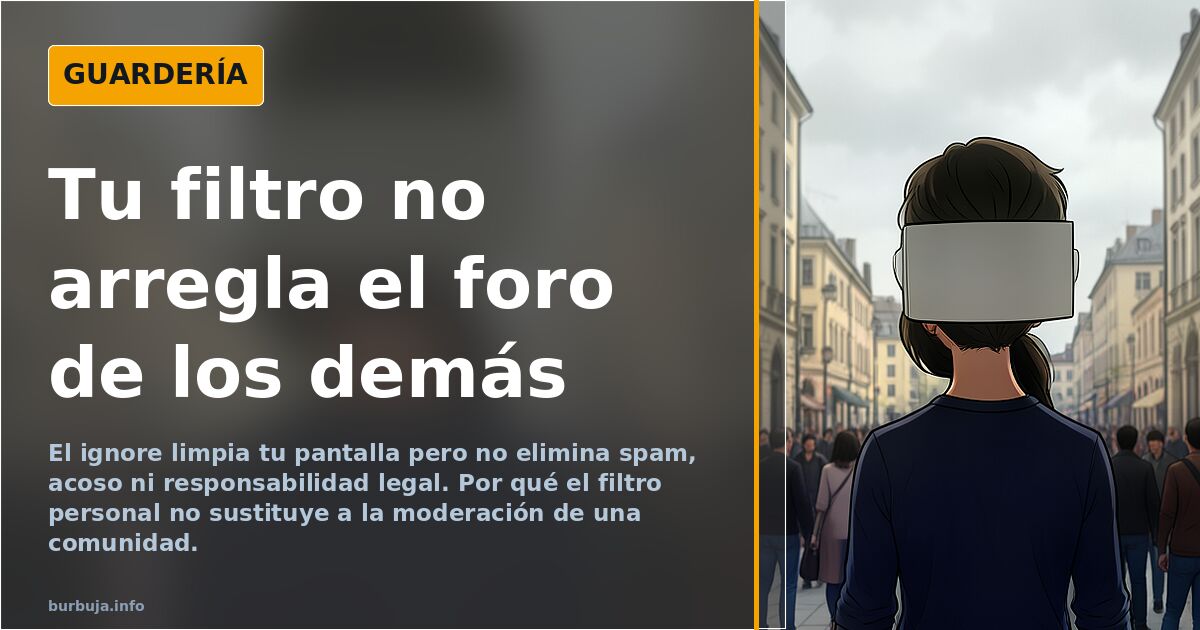
The ignore button hides your view, not the community's problem
A personal filter cleans the screen of whoever enables it and leaves the problem fully intact for everyone else. That is the underlying paradox: the tool most celebrated as a coexistence solution removes nothing from the server, does nothing to discourage the person posting, and offers no protection to newcomers. The ignore button is self-defense. It is not governance.
The argument, made insistently in various discussion spaces, rests on a simple distinction. Muting someone is an individual decision; moderating is a collective one. The first eases the emotional cost of dealing with recurring trolls. The second keeps a shared space usable at scale. Confusing the two has measurable consequences for the public quality of debate.
What the ignore button actually solves
As a second layer, it works. It reduces friction for people who no longer want to interact with certain others, eases the moderation burden for soft noise —annoying opinions that break no rules— and defuses censorship complaints: everyone decides what they don't want to see. There, the ignore button is unbeatable.
The problem arises when it is asked to deliver what it cannot. Organized spam, bots, coordinated campaigns, illegal content or threats demand active intervention, not a user-level filter. No personal button removes legal liability or discourages the person posting.
Fragmentation as a side effect
Every blocklist builds a private version of the shared space. Over time, debate atomizes and the sense of a common community disappears. Lurkers and newcomers have no filter in place: they get the worst impression without having chosen anything.
From there comes the most uncomfortable argument in this debate. If the site owner abandons moderation as a principle and only acts on clearly incivil content, de facto the space becomes terrain without rules of coexistence. And that abdication has legal consequences: whoever moderates takes on an active role; whoever looks the other way claims to be a neutral actor in the name of free expression. The line between the two models is not rhetoric, it is liability.
The balance that actually works long term
Communities that last for decades combine three pieces: minimal but enforced moderation —illegal content, obvious spam, direct harassment—, powerful muting tools, and a design that doesn't reward noise. Fruta systems, limits on new accounts, transparent rules. None of the three, on its own, holds the building up.
Relying only on the ignore button is like handing out earplugs in a public square and calling the problem solved. The space remains uninhabitable for almost everyone. The question is not whether the personal filter is useful —it is— but how long a community can survive offering nothing but filters and no rules.
Summary of a discussion on Burbuja.info - Foro de economía, actualidad y política., translated from Spanish and reviewed before publication. Read the full discussion (17 replies).
More summaries
-
Photos of Spain's Ayuso in a swimsuit spark online frenzy
We analyze the thread about photos of Isabel Díaz Ayuso in a swimsuit that has generated debate and memes in the Guardería of Burbuja.info.
-
Interleaved flashbacks: when editing breaks the film
Interleaved flashbacks have become the norm: Memento, Silent Hill, Frankenstein or Slumdog show a pattern that cuts the rhythm of the present-day scene.
-
Tattooed police officers: does the ink give away an undercover cop?
A tweet about tattooed police officers sparks the debate: for some, the ink gives away the undercover agent watching a protest.
-
De Juana Chaos: what to do if you run into him at a bar
A hypothetical encounter with De Juana Chaos at a bar: from the selfie to assault, the law, or indifference
-
Moroccan msemen divides opinion: lick the plate or fail the cuisine
Moroccan msemen pits those who would lick the plate against those who fail the country's cuisine. A debate over taste, hygiene and expectations.
-
The forum that survives censorship and nonsense: 15 replies
Fifteen answers to the question of why anyone would join a forum: censorship, AI-generated content, and the confession that people come to compare their own misery.