
The Great American Hero: 44 Years of Spain’s Two-Channel Era
44 years since 'The Great American Hero' aired, defining an era of two TV channels and lost instruction manuals.
English · Original discussion in Spanish · Published
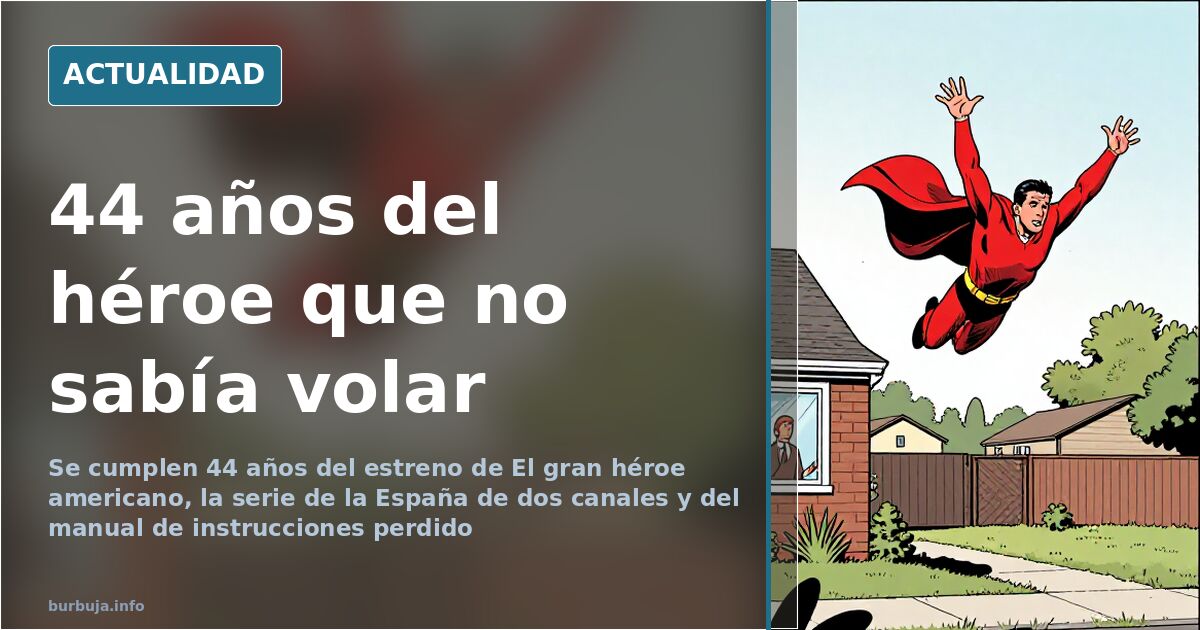
44 years of 'The Great American Hero', the two-channel series
It has been 44 years since the premiere of The Great American Hero, the series about a man who found a suit, lost the instruction manual, and learned to fly through trial and error. This anniversary has peine the memory box for a generation that did not just watch that series: they watched a television that no longer exists. Two channels of television, without a remote control, with a schedule that half the country shared at the same time. The paradox is that the theme song is remembered better than the episodes: some recognize the protagonist and hum the tune without having seen a single episode.
The lost manual: why everyone remembers that detail
Of all the episodes, there is one that repeats in collective memory. The protagonist is given a new instruction manual and begins to play with his new powers: in a lapse, he shrinks someone, loses them, and does not know how to undo the wrong. That seemingly trivial detail was etched into the subconscious of an entire generation of children. It is not the only trace: the protagonist had appeared in Carrie as the fake boyfriend, a cameo that enlarged the myth for those who discovered it years later.
Two channels, no remote, and the news as the frontier
Television back then looked nothing like today’s. The first channel did not start until two in the afternoon, with regional news. There was no morning television until January 1986, consisting of soap operas and reruns of programs from previous days. Live morning programming did not arrive until April 1987.
To change channels, you had to get up from the sofa and press buttons that, when one entered, ejected the other. The remote control, as the joke of the time went, was the son. You switched from 'V' to 'U' with a tuning dial that had to be adjusted every time. With that landscape, the series becoming a hit was almost inevitable: it was that or turn off the set. There was nothing else to watch. And some argue that was also a form of quality.
From Sandokan to Mazinger Z: the catalog that raised a generation
The television nostalgia chapter does not end with one series. The list is long: Blake's 7, Mazinger Z and Aphrodite A, Sandokan, Starman, Otherworld and its pyramids, Chronicles of a People, The Space Broom, Alf, Blue Thunder and The Falcon. Series from behind the Iron Curtain also appear —Czechoslovak and Polish— from which many learned that koniec means 'end' in Polish.
And there are the first Latin American soap operas, Cristal and Rubí, which hooked viewers at lunchtime without many admitting it publicly. Little compared to current standards, with dozens of channels and platforms, yet there is a shared feeling: that there is nothing to watch.
Colombo, Robert Culp, and series that age well
Not everything was disposable. Among the recoveries that return every few years is Colombo, whose early seasons are still revisited because, simply, they no longer make them with that craft. In one of those screenings, the federal agent Maxwell appears, played by Robert Culp, with a guest appearance that would today be celebrated almost as an event.
The series is as old as nostalgia, but it ages differently: the script holds, the plot trick holds, and the viewer does not feel taken for a fool. That, on today's schedule, is almost a luxury.
Nostalgia as a political weapon
As almost everything in this country, the memory of two channels quickly leads to judgment of the present. One part of the messages holds that television was better because there was less to choose from and more shared culture; to which it is responded that it was worse for the same reason, that there was little and the merit was of scarcity, not quality.
Some frame the discussion in something bigger: the feeling that the market has concentrated and that French and Italian cinema, music, and old British series have lost weight against a few large players. The list of longings is not just television. And then there is the classic: that Spain of two channels, now recreated with more idealization than memory.
Would someone really return to that two-channel schedule, or what we miss is not having to decide? I leave it there.
It has been 44 years since the premiere of The Great American Hero, the series about a man who found a suit, lost the instruction manual, and learned to fly through trial and error. This anniversary has peine the memory box for a generation that did not just watch that series: they watched a television that no longer exists. Two channels of television, without a remote control, with a schedule that half the country shared at the same time. The paradox is that the theme song is remembered better than the episodes: some recognize the protagonist and hum the tune without having seen a single episode.
The lost manual: why everyone remembers that detail
Of all the episodes, there is one that repeats in collective memory. The protagonist is given a new instruction manual and begins to play with his new powers: in a lapse, he shrinks someone, loses them, and does not know how to undo the wrong. That seemingly trivial detail was etched into the subconscious of an entire generation of children. It is not the only trace: the protagonist had appeared in Carrie as the fake boyfriend, a cameo that enlarged the myth for those who discovered it years later.
Two channels, no remote, and the news as the frontier
Television back then looked nothing like today’s. The first channel did not start until two in the afternoon, with regional news. There was no morning television until January 1986, consisting of soap operas and reruns of programs from previous days. Live morning programming did not arrive until April 1987.
To change channels, you had to get up from the sofa and press buttons that, when one entered, ejected the other. The remote control, as the joke of the time went, was the son. You switched from 'V' to 'U' with a tuning dial that had to be adjusted every time. With that landscape, the series becoming a hit was almost inevitable: it was that or turn off the set. There was nothing else to watch. And some argue that was also a form of quality.
From Sandokan to Mazinger Z: the catalog that raised a generation
The television nostalgia chapter does not end with one series. The list is long: Blake's 7, Mazinger Z and Aphrodite A, Sandokan, Starman, Otherworld and its pyramids, Chronicles of a People, The Space Broom, Alf, Blue Thunder and The Falcon. Series from behind the Iron Curtain also appear —Czechoslovak and Polish— from which many learned that koniec means 'end' in Polish.
And there are the first Latin American soap operas, Cristal and Rubí, which hooked viewers at lunchtime without many admitting it publicly. Little compared to current standards, with dozens of channels and platforms, yet there is a shared feeling: that there is nothing to watch.
Colombo, Robert Culp, and series that age well
Not everything was disposable. Among the recoveries that return every few years is Colombo, whose early seasons are still revisited because, simply, they no longer make them with that craft. In one of those screenings, the federal agent Maxwell appears, played by Robert Culp, with a guest appearance that would today be celebrated almost as an event.
The series is as old as nostalgia, but it ages differently: the script holds, the plot trick holds, and the viewer does not feel taken for a fool. That, on today's schedule, is almost a luxury.
Nostalgia as a political weapon
As almost everything in this country, the memory of two channels quickly leads to judgment of the present. One part of the messages holds that television was better because there was less to choose from and more shared culture; to which it is responded that it was worse for the same reason, that there was little and the merit was of scarcity, not quality.
Some frame the discussion in something bigger: the feeling that the market has concentrated and that French and Italian cinema, music, and old British series have lost weight against a few large players. The list of longings is not just television. And then there is the classic: that Spain of two channels, now recreated with more idealization than memory.
Would someone really return to that two-channel schedule, or what we miss is not having to decide? I leave it there.
Summary of a discussion on Burbuja.info - Foro de economía, actualidad y política., translated from Spanish and reviewed before publication. Read the full discussion (270 replies).
More summaries
-
Mississippi Police Confirm Homicide of Tasia Fortune, Initially Staged as Racist Attack
Police confirm the hanging death of Tasia Fortune, 29, was a homicide staged to look like a racist attack. Three Black suspects arrested in connection with drug-related crime.
-
Worker Falls 10m from Coliseum, American Tourists Protest Closure
A 22-year-old worker died after a 10m fall at Rome's Coliseum during lighting work. The site closed, drawing protests from tourists.
-
Milei calls Israeli PM 'humanity's great hero'
Argentine President Javier Milei praised Israeli Prime Minister Benjamin Netanyahu, calling him 'the great hero of humanity'. We analyze the context of these statements.
-
Wedding in Gomesende Ends in Brawl Over €40,000
A wedding in Gomesende (Ourense) descended into a free-for-all over €40,000 claimed by the bride and an alleged infidelity during the banquet.
-
Catalan Foster Brother Mamadou Presentation Sparks Controversy
The media presentation of Mamadou, a Catalan foster brother, has sparked social debate. We analyze the family dynamics and public reaction to this polarizing case.
-
Classical Music as a Deterrent: Does Symphony Work in Retail?
Analysis of the effectiveness of using classical music to deter crime in commercial establishments and urban spaces.