
The Fermi Paradox: Is the Birth Rate the Barrier?
Birth rates, interstellar distances, and scarce chemistry: a hypothesis in the Fermi Paradox debate, not a telescope answer.
English · Original discussion in Spanish · Published
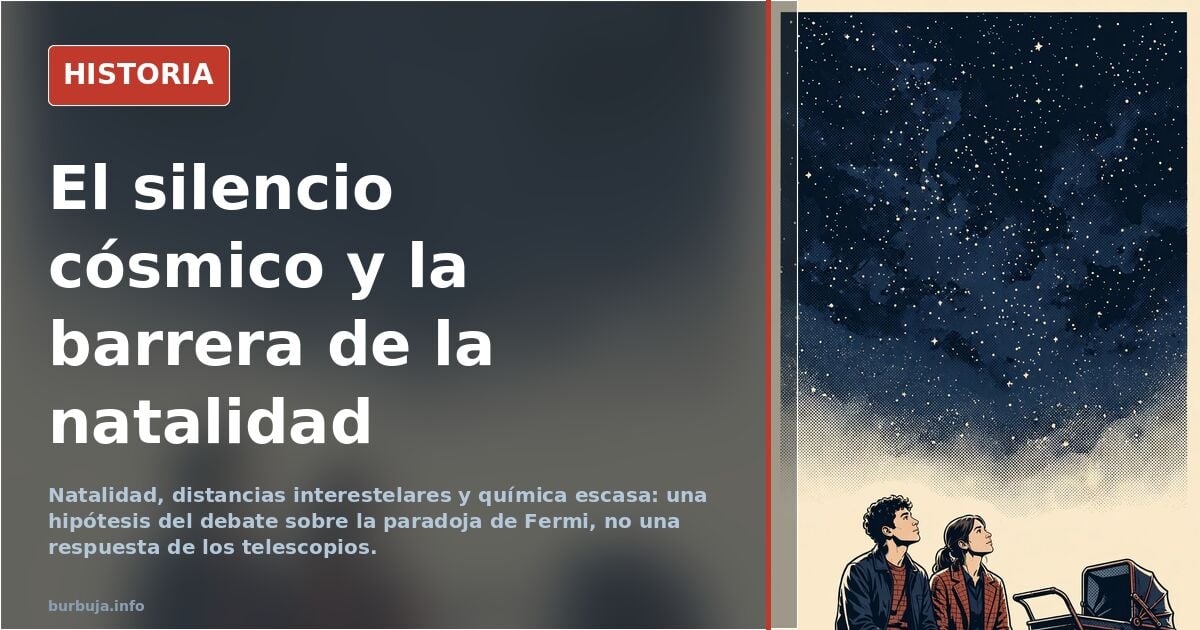
The Fermi Paradox might be solved in the cradle, not the stars
The cosmos isn't empty: it's full of societies that stopped having children before they learned to jump between planets. That's one of the hypotheses circulating in a long forum debate about why we don't hear anyone out there. It's not supported by radio telescopes, but by human history and a demographic pattern that, according to several participants, repeats itself.
The barrier that only appears when intelligence abounds
The central argument, according to one of the speakers, is Darwinian and somewhat cruel: when a species reaches sufficient intelligence to consider interstellar travel but is still mortal, it discovers that existence has no purpose and stops reproducing. This same reasoning suggests that the most developed societies with the lowest birth rates enter this phase and end up ceding territory to groups with more intense procreation patterns: closed religious communities, denominations that reject contraception, and ultra-Orthodox minorities. The succession isn't taken by the smartest, but by those who multiply.
The objection comes quickly, as they reply in the thread: this process doesn't stop anything, it only slows it down. Even if an advanced society returns to a sort of demographic dark age, technological advances are rarely lost. With fifty thousand years to spare, the cycle would start again. The question that hangs in the air is whether this pendulum repeats eternally or if it ever breaks.
Four light-years that the mind can't grasp
The second barrier is purely physical. Proxima Centauri, the closest, is 4.2 light-years away. The most common analogy to grasp this is a commercial airplane flying at full power, 24 hours a day, for a million years to cover that distance. The star Epsilon Aurigae, one of the farthest visible to the naked eye, is 2,100 light-years away, almost the width of the galactic arm we occupy.
The scale disarms any epic narrative. If the Sun were a handball, Earth would be a grain of sand, and everything else, empty space. Science fiction needs magic to make interstellar travel viable, and not even the energy of a very advanced civilization would be enough to pay the bill. Detection is another matter: Earth's radio waves have been traveling for barely a century, a cosmic whisper.
Oxygen betrays you, even if you hide
There's a more sinister answer, taken from literature: the dark forest. Civilizations would be out there, silent and paranoid, convinced that any neighbor is a threat. The counterargument, according to one of the participants, is devastating. Oxygen is a highly reactive gas, and 20% in an atmosphere is only explained by sustained biological activity; a telescope the size of Jupiter would be enough to read the atmospheric composition of an exoplanet. Hiding is useless.
Life's ingredients are also scarce
Beyond intelligence, there are chemical and geological bottlenecks. Life as we know it is built with carbon, hydrogen, oxygen, nitrogen, phosphorus, and sulfur (CHONPS), and phosphorus is scarce. A satellite with water but without phosphorus or sulfur would likely be sterile. Add to that water: less than 1% of Earth's mass is water, and a little more would turn it into an ocean planet without continents to develop technology. The disproportionate moon, tides, and plate tectonics appear as extra, hard-to-replicate requirements. Titan, with volcanic activity, hydrocarbon seas, and methane rain with electrical storms, emerges as the best nearby candidate for searching.
From the paradox to the comet that approached Mars
The analysis eventually drifted towards object 3I/ATLAS. Its brightness rose to magnitude 12 as it approached Martian orbit; the HIRISE telescope was supposed to capture it with a resolution of 30 kilometers per pixel, according to the thread, and its tail seemed to point towards the Sun, which some considered anomalous and others attributed to a perspective effect. The ground split between those who saw a strange comet and those who suspected NASA of withholding sharp images for weeks. Nothing ever happens, until it does, summarizes one of the currents.
Meanwhile, the underlying discussion about the origin of life got tangled in panspermia: the possibility that microorganisms travel within ejected ice and survive reentry by liquefying like drops. The physics of reentry complicate it, but no one is closing the debate.
If the pattern holds, any civilization capable of looking at the sky will eventually look inward before building a spaceship. The prediction is that we will continue to find silence; with the caveat that a single finding, just one, would bring this whole edifice down.
The cosmos isn't empty: it's full of societies that stopped having children before they learned to jump between planets. That's one of the hypotheses circulating in a long forum debate about why we don't hear anyone out there. It's not supported by radio telescopes, but by human history and a demographic pattern that, according to several participants, repeats itself.
The barrier that only appears when intelligence abounds
The central argument, according to one of the speakers, is Darwinian and somewhat cruel: when a species reaches sufficient intelligence to consider interstellar travel but is still mortal, it discovers that existence has no purpose and stops reproducing. This same reasoning suggests that the most developed societies with the lowest birth rates enter this phase and end up ceding territory to groups with more intense procreation patterns: closed religious communities, denominations that reject contraception, and ultra-Orthodox minorities. The succession isn't taken by the smartest, but by those who multiply.
The objection comes quickly, as they reply in the thread: this process doesn't stop anything, it only slows it down. Even if an advanced society returns to a sort of demographic dark age, technological advances are rarely lost. With fifty thousand years to spare, the cycle would start again. The question that hangs in the air is whether this pendulum repeats eternally or if it ever breaks.
Four light-years that the mind can't grasp
The second barrier is purely physical. Proxima Centauri, the closest, is 4.2 light-years away. The most common analogy to grasp this is a commercial airplane flying at full power, 24 hours a day, for a million years to cover that distance. The star Epsilon Aurigae, one of the farthest visible to the naked eye, is 2,100 light-years away, almost the width of the galactic arm we occupy.
The scale disarms any epic narrative. If the Sun were a handball, Earth would be a grain of sand, and everything else, empty space. Science fiction needs magic to make interstellar travel viable, and not even the energy of a very advanced civilization would be enough to pay the bill. Detection is another matter: Earth's radio waves have been traveling for barely a century, a cosmic whisper.
Oxygen betrays you, even if you hide
There's a more sinister answer, taken from literature: the dark forest. Civilizations would be out there, silent and paranoid, convinced that any neighbor is a threat. The counterargument, according to one of the participants, is devastating. Oxygen is a highly reactive gas, and 20% in an atmosphere is only explained by sustained biological activity; a telescope the size of Jupiter would be enough to read the atmospheric composition of an exoplanet. Hiding is useless.
Life's ingredients are also scarce
Beyond intelligence, there are chemical and geological bottlenecks. Life as we know it is built with carbon, hydrogen, oxygen, nitrogen, phosphorus, and sulfur (CHONPS), and phosphorus is scarce. A satellite with water but without phosphorus or sulfur would likely be sterile. Add to that water: less than 1% of Earth's mass is water, and a little more would turn it into an ocean planet without continents to develop technology. The disproportionate moon, tides, and plate tectonics appear as extra, hard-to-replicate requirements. Titan, with volcanic activity, hydrocarbon seas, and methane rain with electrical storms, emerges as the best nearby candidate for searching.
From the paradox to the comet that approached Mars
The analysis eventually drifted towards object 3I/ATLAS. Its brightness rose to magnitude 12 as it approached Martian orbit; the HIRISE telescope was supposed to capture it with a resolution of 30 kilometers per pixel, according to the thread, and its tail seemed to point towards the Sun, which some considered anomalous and others attributed to a perspective effect. The ground split between those who saw a strange comet and those who suspected NASA of withholding sharp images for weeks. Nothing ever happens, until it does, summarizes one of the currents.
Meanwhile, the underlying discussion about the origin of life got tangled in panspermia: the possibility that microorganisms travel within ejected ice and survive reentry by liquefying like drops. The physics of reentry complicate it, but no one is closing the debate.
If the pattern holds, any civilization capable of looking at the sky will eventually look inward before building a spaceship. The prediction is that we will continue to find silence; with the caveat that a single finding, just one, would bring this whole edifice down.
Summary of a discussion on Burbuja.info - Foro de economía, actualidad y política., translated from Spanish and reviewed before publication. Read the full discussion (984 replies).
More summaries
-
Reform the calendar so seasons start on the 1st
A calendar reform would make each season begin on the 1st of its month: a 32-day August and the year anchored to January 1, not the perihelion.
-
When did Europe's national football teams start to get more diverse?
France fielded a Black player as early as 1938 and Portugal four in 1966. The timeline of diversity in European national football teams and its causes.
-
Why Spain was not an economic engine after World War II
Spanish GDP grew 5,3% between 1939 and 1944 and only 0,14% between 1945 and 1950: neutrality in World War II was not enough to lead Europe
-
Why Spain never had an industrial bourgeoisie—but did have a rentier caste
Hispano-Suiza, the 1986 EEC and the rentier-caste thesis: why Spain never became an industrial power despite its technical talent
-
Mussolini declared war as France was already collapsing
On 10 June 1940, Italy declared war on France and the UK with a three-paragraph note. Greece, Africa and Gibraltar changed the plan.
-
OVERCOMING SEXUAL SINS ~ THE REQUIRED SPIRITUAL TOOLS (Father Spyridon)
The spiritual path to conquering carnal passions, from humility to perseverance. Discover the teachings of the Church Fathers.