
The Farmer's Corner: Tricks for Our Vegetable Gardens II
Discover the secrets of self-sufficiency in Burbuja.info's longest-running thread on vegetable gardens, pests, and food survival amid inflation.
English · Original discussion in Spanish · Published
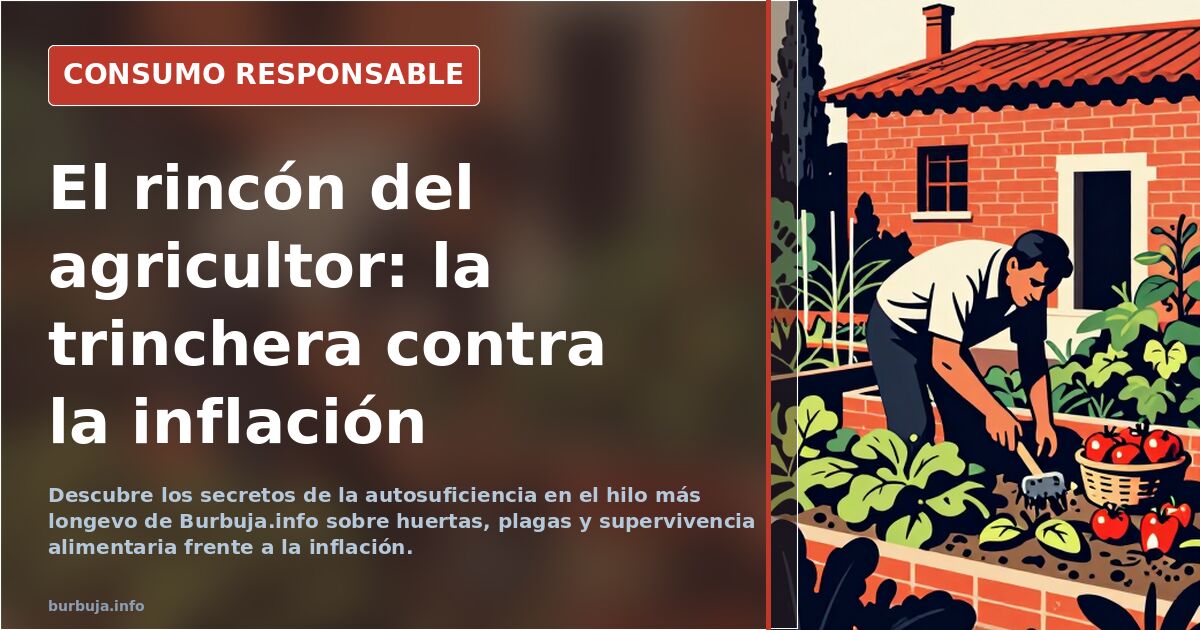
The Farmer's Corner: The Trench Against Inflation
Is it possible to be self-sufficient in an environment of skyrocketing prices and questionable food quality? Over 5,000 days of debate in this thread show that the answer lies not in supermarkets, but in managing fusarium, crop association, and the ingenuity to recycle materials. This is not about politics, but about how to bring in a harvest when the system fails.
The War Against Fusarium and Tuta
The technical debate on pests is the heart of this corner. Forum members have spent years dissecting why varieties like RAF, once resistant, succumb to new strains, or how Tuta absoluta has become public enemy number one. The solution does not lie in generic chemicals, but in grafting, the use of trap plants and, for the more pragmatic, guerrilla tricks like using mothballs to protect tomato plants. There is noticeable skepticism toward commercial nurseries, preferring one's own seedbed to avoid introducing bicho into the plot.
From Theory to Real Self-Sufficiency
What sets this thread apart from any gardening manual is the accumulated experience in resource management. From creating aeroponic systems with recycled materials to managing chicken coops to ensure one's own protein, the tone is one of pure economic survival. The recurring question is not whether it pays off, but what to do when the climate becomes erratic and production costs exceed the market price. Here, the vegetable garden is an insurance policy, not a weekend hobby.
The big question still on the table is real profitability compared to large-scale retail. While some manage to close the production cycle, others crash against the reality of a market that punishes small producers. Is the vegetable garden the last refuge of the free man or simply an expensive pastime for times of crisis?
Related Discussions in the Forum
Is it possible to be self-sufficient in an environment of skyrocketing prices and questionable food quality? Over 5,000 days of debate in this thread show that the answer lies not in supermarkets, but in managing fusarium, crop association, and the ingenuity to recycle materials. This is not about politics, but about how to bring in a harvest when the system fails.
The War Against Fusarium and Tuta
The technical debate on pests is the heart of this corner. Forum members have spent years dissecting why varieties like RAF, once resistant, succumb to new strains, or how Tuta absoluta has become public enemy number one. The solution does not lie in generic chemicals, but in grafting, the use of trap plants and, for the more pragmatic, guerrilla tricks like using mothballs to protect tomato plants. There is noticeable skepticism toward commercial nurseries, preferring one's own seedbed to avoid introducing bicho into the plot.
From Theory to Real Self-Sufficiency
What sets this thread apart from any gardening manual is the accumulated experience in resource management. From creating aeroponic systems with recycled materials to managing chicken coops to ensure one's own protein, the tone is one of pure economic survival. The recurring question is not whether it pays off, but what to do when the climate becomes erratic and production costs exceed the market price. Here, the vegetable garden is an insurance policy, not a weekend hobby.
The big question still on the table is real profitability compared to large-scale retail. While some manage to close the production cycle, others crash against the reality of a market that punishes small producers. Is the vegetable garden the last refuge of the free man or simply an expensive pastime for times of crisis?
Related Discussions in the Forum
- Goodbye PVPC. "There will be no other choice; it will be 106 euros more expensive for Spaniards who have a PVPC" · 47 replies
- Is wearing street shoes at home a filthy habit?? Spaniards do it the most in Europe. Map inside · 37 replies
- The doctor tells me I have to take cholesterol pills forever because my own body produces it wtf?? · 179 replies
- Last year, the IEA predicted electric vehicle sales would reach 40% by 2030; now they forecast 30% this same year · 39 replies
Also available in: Deutsch
Summary of a discussion on Burbuja.info - Foro de economía, actualidad y política., translated from Spanish and reviewed before publication. Read the full discussion (4691 replies).
More summaries
-
Organic gardens: labels lie, but flavor doesn't
Organic farming: certification is a sieve, but companion planting yields 30% more and unmatched flavor. Six years of forum wisdom on natural pest control and resistant varieties.
-
The Asturian 'Hermit': collecting €2,500 a month
A 93-year-old man living in an Asturian village without electricity or running water is said to receive a €2,500 pension. The true story behind the viral hermit.
-
Brave and uBlock Origin: How to Block Website Clutter
A single line of code can remove unwanted blocks: custom filters in Brave, uBlock Origin, and other useful extensions.
-
Accessing Live Sports via Shared Streaming Links
Analysis of how users access live sports through shared streaming codes and links.
-
Lidl launches 2.24 kWh home battery for €299
Lidl sells a 2.24 kWh solar battery for €299. We analyze its profitability for self-consumption, savings potential, and drawbacks.
-
Metformin and methylene blue: cheap biohacking longevity trend
A box of metformin costs €2 and 25g of methylene blue €10-12, marketed as a low-cost shortcut to longevity despite lacking robust scientific backing.