
The fake 'Elon Musk' who conned a Spanish pensioner out of €43,000
An elderly Spanish woman packed her belongings to move in with Elon Musk. The man writing to her was not Elon Musk: he took €43,000 from her and nearly cost her…
English · Original discussion in Spanish · Published
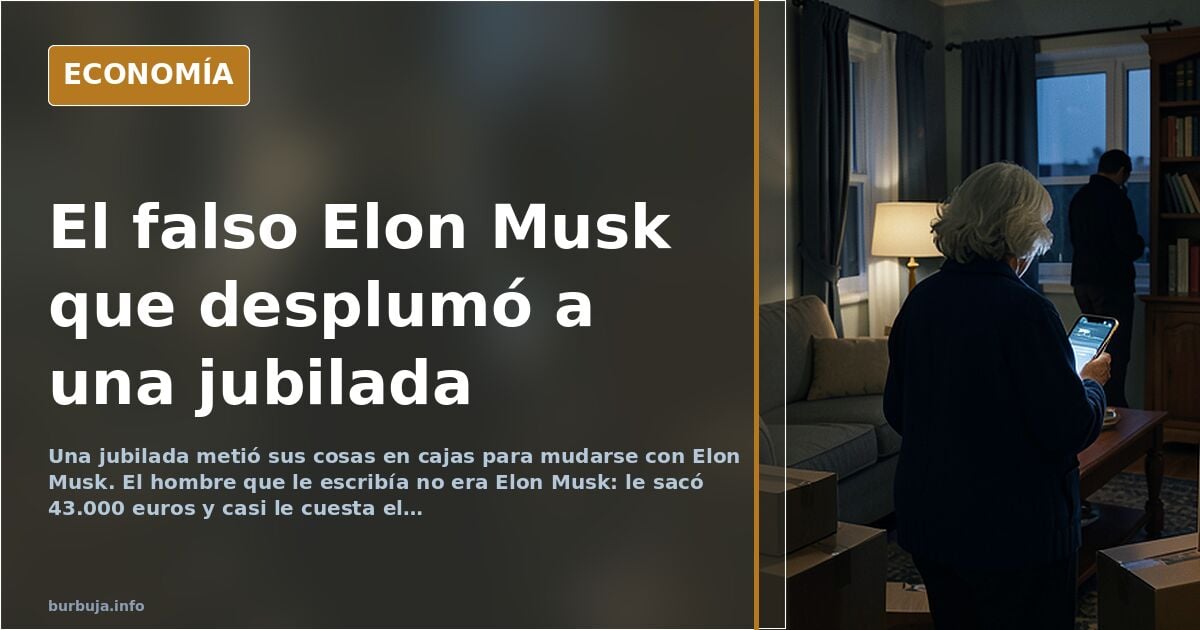
The fake Elon Musk who fleeced a pensioner and nearly ended her marriage
An elderly woman, married for decades, went as far as packing her belongings into boxes to move in with Elon Musk. The man writing to her was not Elon Musk. He was a con artist who, according to the account that has been made public, extracted €43,000 from her and nearly made her throw away a lifelong marriage. The story has been circulating in recent days, leaving behind a trail of disbelief, laughter and the odd shiver.
The script was straight out of the manual. The supposed tycoon told her he would come to pick her up at home in a Tesla. Then, that he couldn't make the weekend because he had to launch a rocket. Before realizing it was all a lie, the lady had already decided to leave her husband the way one gets rid of an old dog. The rocket detail is what has made people laugh the most: the richest man in the world asking a pensioner for money.
The victim's profile: not just any gullible person
The case fits a pattern that repeats with frightening regularity. Scammers do not choose at random: they look for profiles marked by loneliness, battered self-esteem or an emotional need left unmet for years. This woman had been married for decades. She was not a teenager. And yet, the promise that a billionaire had noticed her was enough for her to start emptying closets.
The conversation has quickly turned to the uncomfortable question: how is it possible that someone with so many years of life behind them believes such a story? Some argue that isolation and antidepressants cloud judgment. Others point to something simpler: hypergamy, that impulse to seek a partner of higher status, knows no age. And when the status on offer is that of Elon Musk, reason goes on holiday.
The double standard of romance scams
The case has brought to light an asymmetry few dare to name. Men get messages from a young woman in need, a foreign woman with financial problems. Women have to be written to by Brad Pitt, George Clooney or the captain of an aircraft carrier. The difference in the level of the bait says a lot about what each sens believes it deserves.
The calculation is cold: the scammer adapts the character to the victim's ego. If the lady sees herself as someone who can still aspire to the best, the bait has to be the best. And that's where Elon Musk comes in, with his rockets and his Teslas. The emotional bill is the same for both sens, but the scenery changes.
The husband's reaction: the detail nobody expected
The most baffling detail of the case is not that the woman fell for it. It is that the husband, after learning everything, remains by her side. The news has left more than one person open-mouthed. Some interpret it as a moving act of loyalty. Others see it as a mutual sentence: two people punishing each other without knowing how to get out.
The figure, €43,000, is what the scammer walked away with. It is not a fortune, but for a pensioner it is a serious blow. And yet, what has stung most in the conversation is not the money. It is how easily a person can be willing to demolish their entire life for a promise that never existed.
The loneliness business: why it works
Romance scams are nothing new, but the internet has given them a reach that was once unthinkable. Urgency is the key tool: the scammer is always in a hurry, there is always a unique opportunity slipping away. That constant pressure prevents the victim from consulting someone they trust or stopping to think.
The fake Elon Musk case is a variant of the classic Nigerian scam, but with a luxury wrapper. The question hanging in the air is how many stories like this go untold. Because if a woman with decades of marriage behind her can fall for it, anyone can. The only real defence is systematic distrust of any stranger who promises too much.
The analysis gets stuck at the same point where it began: the lady lost €43,000, the scammer vanished and the husband is still there. Nobody really knows what can be done about that.
Also available in: Deutsch
Summary of a discussion on Burbuja.info - Foro de economía, actualidad y política., translated from Spanish and reviewed before publication. Read the full discussion (84 replies).
More summaries
-
War Eurobonds Proposal: €1 Trillion with Public Guarantee
Reports suggest Europe would issue €1 trillion in eurobonds backed by national treasuries, with 65% of weapons purchased outside the EU.
-
PP and Vox budget in Andalusia puts health at record €17 billion
The first budget by PP and Vox in Andalusia, Spain, allocates €17 billion to healthcare, the highest figure in the region's history, and €1 billion to social housing. Here are the key points.
-
From street vendor to runway model: Cheikh's journey from Senegal to the fashion world
Cheikh Kane arrived in Spain by boat from Senegal and sold counterfeit goods in Marbella. A new book tells how he ended up modelling for the very brands he once faked.
-
AI's Double Standard in Domestic Conflict Queries
AI assistants respond differently to domestic abuse queries based on gender, sparking debate over ideological bias versus statistical reflection.
-
Spain: Sánchez weighs sacking Transport Minister as poll shows PSOE slump
A poll puts Spain's PSOE below 95 seats, opening the door to Óscar Puente's exit. We explain what lies behind the noise and what a poll really measures.
-
Beer bottle glass thickness and the fraud that doesn't exist
A user claims many brands thickened the bottle glass: content is down and the beer arrives warm. Physics and metrology have the answer.