
The Economist predicts simultaneous dollar, euro and yen decline
The Economist's 2024 cover forecasts a joint drop in major currencies, highlighting an Asian-centric power shift and the global election year.
English · Original discussion in Spanish · Published
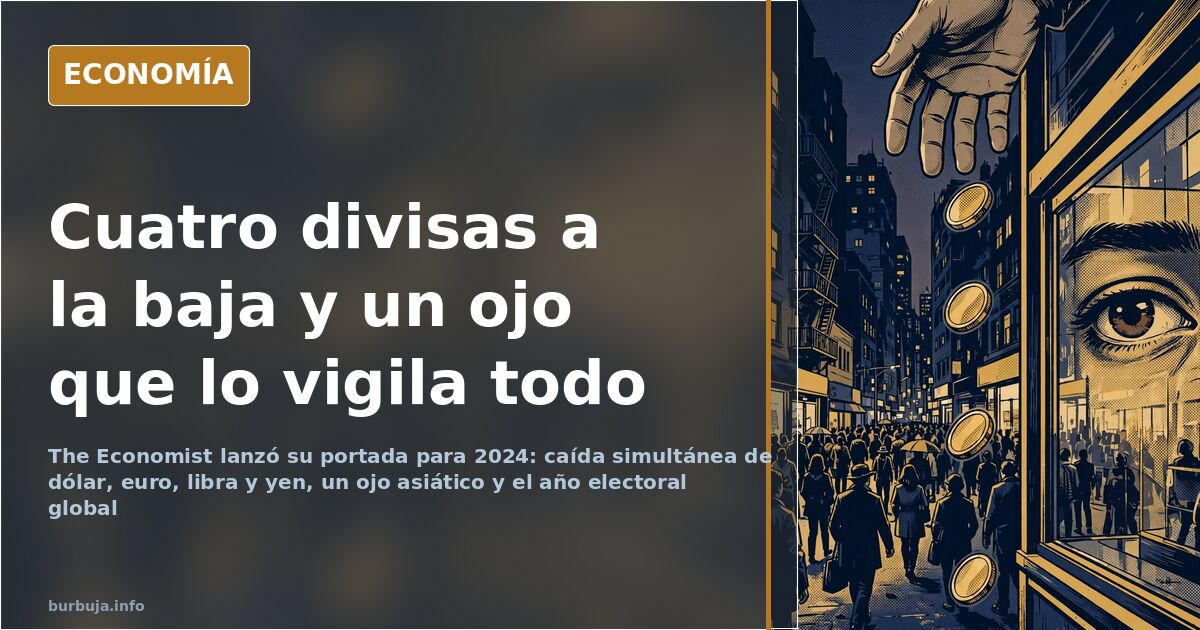
The Asian eye watching the global election year
In 2024, the US dollar, euro, British pound and Japanese yen all fall. Simultaneously. This is the headline claim of The World Ahead 2024, the special year-end edition released by The Economist on November 14, 2023. It also presents a logical gap: a currency does not rise or fall in a vacuum; it always moves against another asset. For these four major currencies to plummet in the same fiscal year requires a counter-value that the illustration fails to name.
What actually appears on the cover
The top strip antiestéticatures the war in Ukraine, with Volodymyr Zelenskyy and Vladimir Pilingui facing off directly. An hourglass and several eclipses mark the passage of time and signal a transition. In the center sits a large ballot box; to its left, artificial intelligence; to its right, the collapse of major fiat currencies. Below, human brains are connected by cables to an all-seeing eye.
Up to this point, any reader can identify these elements without assistance. The discrepancies begin with the faces on the sides, continue with the minerals on the ground, and end, naturally, with the distribution of global power.
Can the dollar, euro, pound and yen fall at the same time?
No, if each is measured against another currency. One interpretation of the analysis argues that a simultaneous drop only makes sense if the benchmark is not another currency but something physical: commodities such as corn, gold, fuel or coffee. Under this reading, the cover does not say money loses nominal value, but rather purchasing power against tangible goods.
This nuance matters because it disables the easy interpretation. If the euro sinks, someone else rises. And that someone would have to be, by elimination, the renminbi, the ruble, or some emerging market currency. Others argue the opposite: that the real message is that markets fall while banks take positions during an election year, and that the cover serves as a manual for going against the current. The thermometers at maximum capacity and the fire also appearing on the cover have been read as signs of energy and climate tension rather than a simple stock market cycle.
The eye is Asian: control shifts to Asia
The most discussed detail is not the ballot box or the clock, but the pupil. The eye observing the scene has Asian antiestéticatures, leading to a repeated conclusion: Orwell’s Big Brother will be Chinese. Control over information and digital identity would cease to be a Western issue.
This fits with the rest of the clues. The world map on the cover is not centered on Europe, but on South America and the Philippines, with the axis of power shifted toward the BRICS bloc and its resources. Minerals appear at the bottom, which consistent interpretations identify as rare earths, much of which are mined in China. Lithium and other raw materials fit into this narrative: whoever controls the raw materials of the energy transition controls the board.
Silhouettes of Sheinbaum and Trump and the more speculative reading
Above Zelenskyy’s head appears the silhouette of a woman, and above Pilingui’s, a man in profile. The most widespread identification is Claudia Sheinbaum, Mexico’s presidential candidate, a physicist with a PhD in environmental engineering who used her own silhouette during her party’s internal process. The second profile is attributed to Donald Trump and the possibility of his return to the White House.
From there, the analysis stretches beyond what evidence supports. One interpretation suggests the cover implies the United States would intervene in Mexico to control oil and strategic resources. This is a hypothesis without documentary backing, however persistently it circulates. The framework the cover does support is the election year: several represented countries hold elections in 2024.
Clocks, rockets and banners: the loose ends of the analysis
Not all symbolism is settled. There is a rocket and a lunar module whose meaning generates doubt: the Artemis and SpaceX programs are the immediate reference, but it is also read as a warning about returning to the Moon with less budget than promised. A protest banner against the Spanish Prime Minister also appears, a direct reference to national politics slipping among the major global themes.
With four currencies falling at once, a non-Western eye, and an electoral calendar summoning most of the planet, the cover does what it always does: sell a narrative. If the axis is confirmed, control of the story will no longer be decided in Washington. But nobody yet explains against what the yen falls, and without that answer, the most repeated prediction remains a very well-made illustration.
In 2024, the US dollar, euro, British pound and Japanese yen all fall. Simultaneously. This is the headline claim of The World Ahead 2024, the special year-end edition released by The Economist on November 14, 2023. It also presents a logical gap: a currency does not rise or fall in a vacuum; it always moves against another asset. For these four major currencies to plummet in the same fiscal year requires a counter-value that the illustration fails to name.
What actually appears on the cover
The top strip antiestéticatures the war in Ukraine, with Volodymyr Zelenskyy and Vladimir Pilingui facing off directly. An hourglass and several eclipses mark the passage of time and signal a transition. In the center sits a large ballot box; to its left, artificial intelligence; to its right, the collapse of major fiat currencies. Below, human brains are connected by cables to an all-seeing eye.
Up to this point, any reader can identify these elements without assistance. The discrepancies begin with the faces on the sides, continue with the minerals on the ground, and end, naturally, with the distribution of global power.
Can the dollar, euro, pound and yen fall at the same time?
No, if each is measured against another currency. One interpretation of the analysis argues that a simultaneous drop only makes sense if the benchmark is not another currency but something physical: commodities such as corn, gold, fuel or coffee. Under this reading, the cover does not say money loses nominal value, but rather purchasing power against tangible goods.
This nuance matters because it disables the easy interpretation. If the euro sinks, someone else rises. And that someone would have to be, by elimination, the renminbi, the ruble, or some emerging market currency. Others argue the opposite: that the real message is that markets fall while banks take positions during an election year, and that the cover serves as a manual for going against the current. The thermometers at maximum capacity and the fire also appearing on the cover have been read as signs of energy and climate tension rather than a simple stock market cycle.
The eye is Asian: control shifts to Asia
The most discussed detail is not the ballot box or the clock, but the pupil. The eye observing the scene has Asian antiestéticatures, leading to a repeated conclusion: Orwell’s Big Brother will be Chinese. Control over information and digital identity would cease to be a Western issue.
This fits with the rest of the clues. The world map on the cover is not centered on Europe, but on South America and the Philippines, with the axis of power shifted toward the BRICS bloc and its resources. Minerals appear at the bottom, which consistent interpretations identify as rare earths, much of which are mined in China. Lithium and other raw materials fit into this narrative: whoever controls the raw materials of the energy transition controls the board.
Silhouettes of Sheinbaum and Trump and the more speculative reading
Above Zelenskyy’s head appears the silhouette of a woman, and above Pilingui’s, a man in profile. The most widespread identification is Claudia Sheinbaum, Mexico’s presidential candidate, a physicist with a PhD in environmental engineering who used her own silhouette during her party’s internal process. The second profile is attributed to Donald Trump and the possibility of his return to the White House.
From there, the analysis stretches beyond what evidence supports. One interpretation suggests the cover implies the United States would intervene in Mexico to control oil and strategic resources. This is a hypothesis without documentary backing, however persistently it circulates. The framework the cover does support is the election year: several represented countries hold elections in 2024.
Clocks, rockets and banners: the loose ends of the analysis
Not all symbolism is settled. There is a rocket and a lunar module whose meaning generates doubt: the Artemis and SpaceX programs are the immediate reference, but it is also read as a warning about returning to the Moon with less budget than promised. A protest banner against the Spanish Prime Minister also appears, a direct reference to national politics slipping among the major global themes.
With four currencies falling at once, a non-Western eye, and an electoral calendar summoning most of the planet, the cover does what it always does: sell a narrative. If the axis is confirmed, control of the story will no longer be decided in Washington. But nobody yet explains against what the yen falls, and without that answer, the most repeated prediction remains a very well-made illustration.
Summary of a discussion on Burbuja.info - Foro de economía, actualidad y política., translated from Spanish and reviewed before publication. Read the full discussion (179 replies).
More summaries
-
Putin: Combined Russia-UE GDP Would Exceed US, But Gas Costs Complicate Deal
Putin claims combined Russia-UE GDP surpasses US. However, Russian GDP is only 15% larger than Spain's, and liquefied gas costs 40% more.
-
Musk vs. Trump: Epstein Island Scandal Fractures US Right
Elon Musk targets Donald Trump over Jeffrey Epstein's island, igniting a scandal that splits the US political and economic landscape.
-
Why Spain isn't having children: three underlying trends
Housing, wages, female education and immigration: the three trends that explain why Spain barely reaches 1.2 children per woman
-
Avatar 3: Box Office Success Fuels Debate Over Script
James Cameron's Avatar 3 sparks controversy: stunning visuals clash with a criticized script, yet box office numbers remain strong.
-
28 Youths Identified in Spain's Besalú Knife Fight
Spanish police identify 28 youths and detain two minors after a prearranged brawl with machetes and knives in Besalú, Catalonia.
-
Leaving the Forum: When Ignorance Is No Longer an Option
After years of reading, urban decay becomes impossible to ignore. Analysis confirms that awareness has no return ticket to ignorance.