
The Bill for Low-Income Voters Who Believed in the Market
Eight years of socialist government and a social ladder that never existed: the low-income voter who supported the free market reviews the bill.
English · Original discussion in Spanish · Published
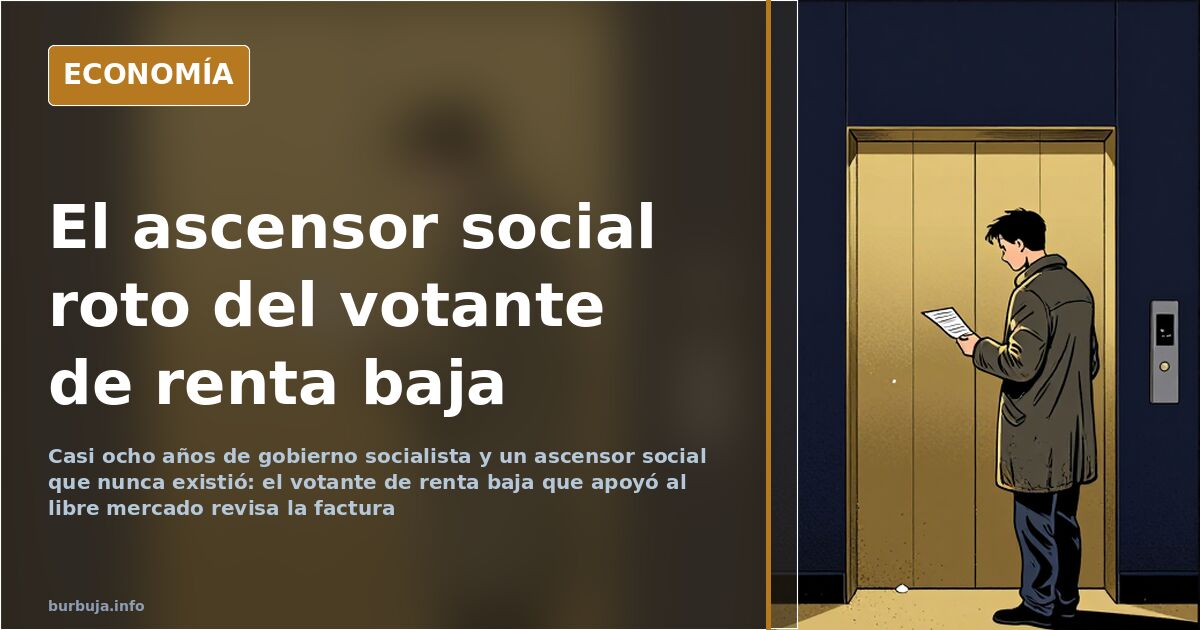
The worker who defended the free market and awaits social ascent
A Venezuelan worker exiled in Spain recently heard, in a bar conversation, that God was punishing the country for becoming 'too communist.' He smiled, turned away, and replied: 'I've noticed that here in Spain, there's a very romantic idea of communism and the left, and you haven't lived it like we have.' The anecdote, antiestéticatured in an Economics discussion with 285 messages over 234 days, summarizes the underlying tone: the gap between the narrative and the bill. The trigger is an uncomfortable text about the working class who backed free market policies in exchange for a prosperity that never materialized.
The initial thesis is harsh. It speaks of a low-income voter who bought into 'the business discourse' in exchange for status and money, and who today presents the bill: worse material conditions, a social ladder that, they say, 'was never in the building,' and a void of connections and community. It describes them as free ideological labor that exchanged 'rights for slogans' and ended up impoverished while defending those who exploited them. From there, the exchange branches out in a thousand directions.
What is a 'reaccionariopobre' and why the term divides
The term functions as a label and a provocation. One post defines it bluntly: a working-class person who wants to live off their work 'in a safe and quiet place.' Another acknowledges its use but proposes changing it to 'libertapobre,' a quip that fixes nothing. The term even pits those who use it against those who receive it.
Beneath the disagreement lies an old fight: who betrayed whom. One message claims the left abandoned the working class—'the one that obtains the main part of its income by selling its labor power'—in favor of 'an amalgam of small groups' with conflicting interests. From the other side, the response comes with a sneer: if social democracy has been in power for almost a decade, why should the disillusioned be only right-wing voters? No one agrees even on the starting point.
Immigration, wages, and the labor dumping argument
The most common current argues that capital needs abundant labor to suppress wages. It's argued that certain parties today act as proponents of massive worker arrivals, generating direct competition for jobs and housing. This diagnosis is put forth vehemently, but throughout the material, it's not accompanied by a single official statistic to quantify it.
Another block responds with circular logic: the system these voters defend is precisely what brings in that cheap labor. 'We have to accept the consequences of the system, the good and the bad,' writes a participant, for whom complaining about the model and then being uncomfortable with its effects is childish. The discussion doesn't pogre beyond this.
The eight years of government each side blames on the other
The time count repeats like a refrain: 'almost 8 years governing,' 'Pedro has been in government for 7 years,' '7 or 8 years of socialist government.' For some, this fact dismantles any excuse that liberalism rules the real economy. For others, the figure doesn't explain why their salary doesn't cover expenses or why rent is rising. Both sides use the same number to accuse the other.
And in the middle, a question no one answers: if in democracy one political leaning has governed longer than another, should the worker be better off than they are? The uncomfortable fact hangs in the air without an owner.
From the gold standard to the state that wants itself
The exchange jumps to macroeconomics. Some place the origin of everything in the end of the currency's gold backing—'little things about issuing paper without control,' one summarizes, citing Nixon, Reagan, and Thatcher. Others go further, describing a predatory state whose goal is not to function well but to feed clientelism and control: a weak but loyal army, a slow but manipulable justice system. 'That's a characteristic, not a flaw,' the contribution states.
Against this block, another voice calls for less sectarianism and admits a nuance: it's not about being 'Taliban' for one model, but about recognizing virtues and defects in each proposal and focusing on oversight of power. This is, by far, the least categorical message in the entire exchange.
The turn to the polls: Aragón and the polls
In the final stretch, the conversation shifts to electoral politics. A call for elections in Aragón is mentioned just days away, along with regional polls that, according to some participants, place Vox as the leading force. The nervousness that the initial premise attributed to one side is here returned to the other: some see euphoria, others speak of poorly disguised nerves.
The striking thing is that not even the eve of elections changes the terms of the debate. Everything is reduced to crossed labels and a score that each side interprets in their favor.
The question no one answers
One of the last messages attempts to open a different path: it asks, 'setting aside prejudices,' for a concrete list of steps to straighten out the country and prevent repetition. The response it receives is more labels. After 285 messages and 234 days, not a single number has moved, and the bill remains unpaid.
A Venezuelan worker exiled in Spain recently heard, in a bar conversation, that God was punishing the country for becoming 'too communist.' He smiled, turned away, and replied: 'I've noticed that here in Spain, there's a very romantic idea of communism and the left, and you haven't lived it like we have.' The anecdote, antiestéticatured in an Economics discussion with 285 messages over 234 days, summarizes the underlying tone: the gap between the narrative and the bill. The trigger is an uncomfortable text about the working class who backed free market policies in exchange for a prosperity that never materialized.
The initial thesis is harsh. It speaks of a low-income voter who bought into 'the business discourse' in exchange for status and money, and who today presents the bill: worse material conditions, a social ladder that, they say, 'was never in the building,' and a void of connections and community. It describes them as free ideological labor that exchanged 'rights for slogans' and ended up impoverished while defending those who exploited them. From there, the exchange branches out in a thousand directions.
What is a 'reaccionariopobre' and why the term divides
The term functions as a label and a provocation. One post defines it bluntly: a working-class person who wants to live off their work 'in a safe and quiet place.' Another acknowledges its use but proposes changing it to 'libertapobre,' a quip that fixes nothing. The term even pits those who use it against those who receive it.
Beneath the disagreement lies an old fight: who betrayed whom. One message claims the left abandoned the working class—'the one that obtains the main part of its income by selling its labor power'—in favor of 'an amalgam of small groups' with conflicting interests. From the other side, the response comes with a sneer: if social democracy has been in power for almost a decade, why should the disillusioned be only right-wing voters? No one agrees even on the starting point.
Immigration, wages, and the labor dumping argument
The most common current argues that capital needs abundant labor to suppress wages. It's argued that certain parties today act as proponents of massive worker arrivals, generating direct competition for jobs and housing. This diagnosis is put forth vehemently, but throughout the material, it's not accompanied by a single official statistic to quantify it.
Another block responds with circular logic: the system these voters defend is precisely what brings in that cheap labor. 'We have to accept the consequences of the system, the good and the bad,' writes a participant, for whom complaining about the model and then being uncomfortable with its effects is childish. The discussion doesn't pogre beyond this.
The eight years of government each side blames on the other
The time count repeats like a refrain: 'almost 8 years governing,' 'Pedro has been in government for 7 years,' '7 or 8 years of socialist government.' For some, this fact dismantles any excuse that liberalism rules the real economy. For others, the figure doesn't explain why their salary doesn't cover expenses or why rent is rising. Both sides use the same number to accuse the other.
And in the middle, a question no one answers: if in democracy one political leaning has governed longer than another, should the worker be better off than they are? The uncomfortable fact hangs in the air without an owner.
From the gold standard to the state that wants itself
The exchange jumps to macroeconomics. Some place the origin of everything in the end of the currency's gold backing—'little things about issuing paper without control,' one summarizes, citing Nixon, Reagan, and Thatcher. Others go further, describing a predatory state whose goal is not to function well but to feed clientelism and control: a weak but loyal army, a slow but manipulable justice system. 'That's a characteristic, not a flaw,' the contribution states.
Against this block, another voice calls for less sectarianism and admits a nuance: it's not about being 'Taliban' for one model, but about recognizing virtues and defects in each proposal and focusing on oversight of power. This is, by far, the least categorical message in the entire exchange.
The turn to the polls: Aragón and the polls
In the final stretch, the conversation shifts to electoral politics. A call for elections in Aragón is mentioned just days away, along with regional polls that, according to some participants, place Vox as the leading force. The nervousness that the initial premise attributed to one side is here returned to the other: some see euphoria, others speak of poorly disguised nerves.
The striking thing is that not even the eve of elections changes the terms of the debate. Everything is reduced to crossed labels and a score that each side interprets in their favor.
The question no one answers
One of the last messages attempts to open a different path: it asks, 'setting aside prejudices,' for a concrete list of steps to straighten out the country and prevent repetition. The response it receives is more labels. After 285 messages and 234 days, not a single number has moved, and the bill remains unpaid.
Summary of a discussion on Burbuja.info - Foro de economía, actualidad y política., translated from Spanish and reviewed before publication. Read the full discussion (285 replies).
More summaries
-
The Middle Class Collapse Hidden from Official Statistics
Housing prices rise several times faster than wages, and new cars require 80% financing. Is the middle class gone in Spain?
-
Spanish Working Class: Wages Fail to Accelerate, Even During Economic Boom
Neither in crisis nor boom does the Spanish working class see their salaries improve, as housing costs consume any wage gains.
-
80% Cancellations: Spanish Tourism to Morocco Plummets
Mesa del Turismo estimates an 80% cancellation rate for Morocco in September, while CEAV states that new bookings have dropped to zero.
-
Euthanasia in Old Age: Autonomy vs. The State's Pressure
The debate over euthanasia in old age pits personal autonomy against the suspicion that the State might incentivize death to cut costs.
-
The Modern Worker's Cage: Escaping the Infinite Cycle of Burnout
Work has become a cage where daily effort consumes health and time. Discover why we push ourselves so hard and how to break the cycle.
-
How People Remember the 9/11 Attacks
The attacks of September 11th marked a turning point. Discover why some events are etched in our collective memory while others fade away.