
The Best-Educated Generation That Can't Find Work
Nine 24-year-olds with degrees and no jobs: eleven years after a Barcelona dinner, the diagnosis on youth unemployment remains unchanged.
English · Original discussion in Spanish · Published
A Dinner of Graduates at 24: The Promise That Never Arrived
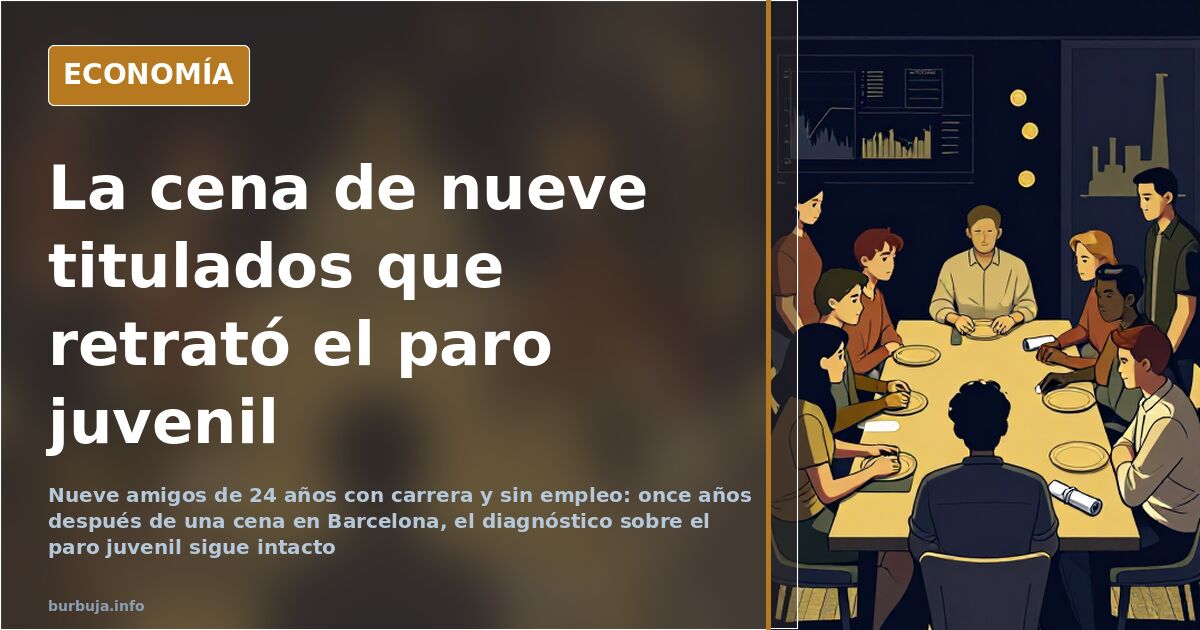
Nine 24-year-old friends have dinner in Barcelona. They studied—Physics, other degrees—and none are living the careers they were promised as children. One sums it up bluntly: things are "pretty much hellish." That domestic table sparked a discussion that, eleven years later, remained open with the same outcome.
Because that's what this is about: whether this generation was lied to or lied to itself. From nine friends, a portrait emerges of a country that educated its children for a market that wouldn't hire them. What began as a dinner-table lament turned into a settling of scores between generations.
The Dinner That Portrayed a Generation with Degrees and No Paychecks
The inventory is textbook: a physics graduate who finished her degree, lives with her in-laws, and babysits in the afternoons; a part-time carpenter; graduates piecing together what they can. No one is where they thought they'd be. The generation that did everything they were told—study, train, learn languages—landed in a market that wasn't expecting them.
It's not a humanitarian tragedy, and it's worth stating: the scene is small, a middle-class dinner. But its value is diagnostic. When nine unrelated people share the same precariousness, it's no longer individual bad luck.
Were They Lied To or Did They Lie to Themselves?
The central thesis is that this generation was sold a narrative: merit, effort, a degree, and finally, a job. In response, the most common, and most uncomfortable, counter-argument arises: no one signed a contract promising anything for having a degree on the wall. "You lied to yourself by believing what you were told because it's what you wanted to hear," summarizes one of the harsher viewpoints.
There's a middle ground that almost no one treads. Those born in the nineties did exactly what their environment asked of them, and discovered that degrees had ceased to be scarce. When everyone has the paper, it stops being an advantage and becomes an administrative formality.
Trades: The Supposed Way Out That Also Doesn't Add Up
The myth of the technician who repairs appliances and earns a fortune while graduates earn less is repeated. The fine print debunks it: a CNC machinist doesn't earn 1,100 euros a month, and unloading boxes pays 800. The lack of work in small machining companies even forces reduced hours.
Other class reunions yield more data along the same lines: in a group of 26 or 27 former students, six had degrees and only one was working, a nurse. Trades aren't a panacea; they work when demand is high, not out of some secret market vocation.
Entrepreneurship or Leaving: The Repeated Recipe Without Numbers
"You study a lot and expect to be given a job. Try creating one," one reads, with the honest counterpoint of someone admitting to having tried two or three times and failed. The mantra of self-employment clashes with basic accounting: starting any business requires upfront capital that this generation lacks, and from day one, landlords, financing, and taxes collect before the business even invoices.
The external route does have success stories. There are graduates who emigrated and today have offers from Apple, Google, and Facebook. And someone who tells the story from a construction site, at over 35 degrees, with two degrees and a passport full of stamps, makes it clear that leaving isn't a plan: it's a lifeline.
The War Between Generations: Pensions and Social Majority
As the discussion lengthens, the focus shifts from the individual to the distribution of the bill. The generational clash appears: the older generation that had lifelong employment versus the young people who support it with taxes. It's put crudely. The social majority that decides in the polls is not the one paying contributions today, but the one receiving them.
The most uncomfortable calculation is subtracting a fixed amount from a paycheck each month—500 euros in one cited case—to pay the pension of someone unknown, who, it's argued, already has their house paid off. The analysis gets stuck here, mixing intergenerational solidarity with the design of a system that treats the payer as if they have excess funds.
Eleven Years Later, the Same Diagnosis
The most striking thing isn't the portrait, but its relevance. More than a decade after that dinner, the outcome remains the same: social elevator broken, pack your bags, or take a civil service exam. "Bags, exams, or death," summarizes one of the responses, adding that only medicine, nursing, or teaching offer a reasonably secure path.
Meanwhile, the protagonists of that dinner are nearing 35. No one has updated the result. And the analysis remains stuck: we know the model doesn't work, but we haven't decided if the problem was the narrative, the market, or us.
Nine 24-year-old friends have dinner in Barcelona. They studied—Physics, other degrees—and none are living the careers they were promised as children. One sums it up bluntly: things are "pretty much hellish." That domestic table sparked a discussion that, eleven years later, remained open with the same outcome.
Because that's what this is about: whether this generation was lied to or lied to itself. From nine friends, a portrait emerges of a country that educated its children for a market that wouldn't hire them. What began as a dinner-table lament turned into a settling of scores between generations.
The Dinner That Portrayed a Generation with Degrees and No Paychecks
The inventory is textbook: a physics graduate who finished her degree, lives with her in-laws, and babysits in the afternoons; a part-time carpenter; graduates piecing together what they can. No one is where they thought they'd be. The generation that did everything they were told—study, train, learn languages—landed in a market that wasn't expecting them.
It's not a humanitarian tragedy, and it's worth stating: the scene is small, a middle-class dinner. But its value is diagnostic. When nine unrelated people share the same precariousness, it's no longer individual bad luck.
Were They Lied To or Did They Lie to Themselves?
The central thesis is that this generation was sold a narrative: merit, effort, a degree, and finally, a job. In response, the most common, and most uncomfortable, counter-argument arises: no one signed a contract promising anything for having a degree on the wall. "You lied to yourself by believing what you were told because it's what you wanted to hear," summarizes one of the harsher viewpoints.
There's a middle ground that almost no one treads. Those born in the nineties did exactly what their environment asked of them, and discovered that degrees had ceased to be scarce. When everyone has the paper, it stops being an advantage and becomes an administrative formality.
Trades: The Supposed Way Out That Also Doesn't Add Up
The myth of the technician who repairs appliances and earns a fortune while graduates earn less is repeated. The fine print debunks it: a CNC machinist doesn't earn 1,100 euros a month, and unloading boxes pays 800. The lack of work in small machining companies even forces reduced hours.
Other class reunions yield more data along the same lines: in a group of 26 or 27 former students, six had degrees and only one was working, a nurse. Trades aren't a panacea; they work when demand is high, not out of some secret market vocation.
Entrepreneurship or Leaving: The Repeated Recipe Without Numbers
"You study a lot and expect to be given a job. Try creating one," one reads, with the honest counterpoint of someone admitting to having tried two or three times and failed. The mantra of self-employment clashes with basic accounting: starting any business requires upfront capital that this generation lacks, and from day one, landlords, financing, and taxes collect before the business even invoices.
The external route does have success stories. There are graduates who emigrated and today have offers from Apple, Google, and Facebook. And someone who tells the story from a construction site, at over 35 degrees, with two degrees and a passport full of stamps, makes it clear that leaving isn't a plan: it's a lifeline.
The War Between Generations: Pensions and Social Majority
As the discussion lengthens, the focus shifts from the individual to the distribution of the bill. The generational clash appears: the older generation that had lifelong employment versus the young people who support it with taxes. It's put crudely. The social majority that decides in the polls is not the one paying contributions today, but the one receiving them.
The most uncomfortable calculation is subtracting a fixed amount from a paycheck each month—500 euros in one cited case—to pay the pension of someone unknown, who, it's argued, already has their house paid off. The analysis gets stuck here, mixing intergenerational solidarity with the design of a system that treats the payer as if they have excess funds.
Eleven Years Later, the Same Diagnosis
The most striking thing isn't the portrait, but its relevance. More than a decade after that dinner, the outcome remains the same: social elevator broken, pack your bags, or take a civil service exam. "Bags, exams, or death," summarizes one of the responses, adding that only medicine, nursing, or teaching offer a reasonably secure path.
Meanwhile, the protagonists of that dinner are nearing 35. No one has updated the result. And the analysis remains stuck: we know the model doesn't work, but we haven't decided if the problem was the narrative, the market, or us.
Summary of a discussion on Burbuja.info - Foro de economía, actualidad y política., translated from Spanish and reviewed before publication. Read the full discussion (671 replies).
More summaries
-
Euthanasia in Old Age: Autonomy vs. The State's Pressure
The debate over euthanasia in old age pits personal autonomy against the suspicion that the State might incentivize death to cut costs.
-
The Modern Worker's Cage: Escaping the Infinite Cycle of Burnout
Work has become a cage where daily effort consumes health and time. Discover why we push ourselves so hard and how to break the cycle.
-
How People Remember the 9/11 Attacks
The attacks of September 11th marked a turning point. Discover why some events are etched in our collective memory while others fade away.
-
Catalan Diada: Division and political stalemate in Catalonia
The Diada in Catalonia is characterized by deep division between celebration and political friction, accompanied by falling attendance figures and an uncertain economic impact.
-
Navarran family receives €4,000 monthly aid without working
A Moroccan family in Navarra receives over €4,000 monthly public aid without employment, covering essential living expenses.
-
Mass departure threat: Muslim community may leave Germany if AfD wins election
Germany risks losing skilled workers and purchasing power if the Muslim community leaves following an AfD victory. We analyze the economic implications.