
The Account Linking Twelve Suicides from a Door Handle
Three deaths in four days in June 2018 shared the same scene: a body hanging from a door handle. The theory connecting twelve celebrity suicides to pedophilia.
English · Original discussion in Spanish · Published
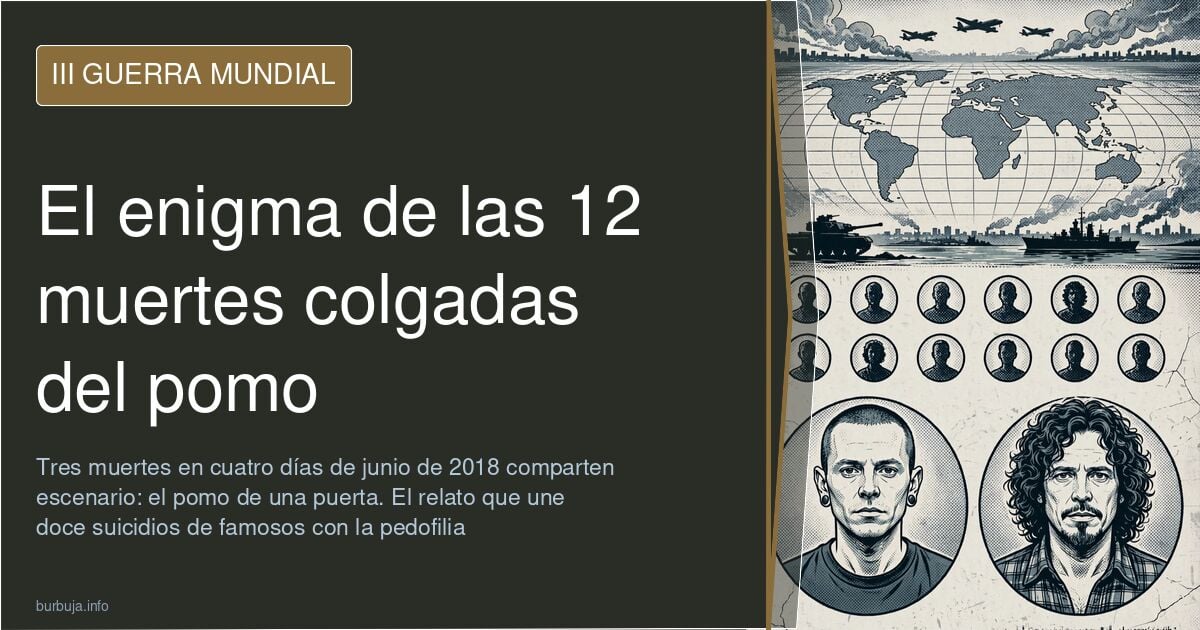
Twelve deaths hanging from a door handle: facts and the account
Between June 5th and 8th, three deaths were recorded that shared the same scene: a body suspended from a door handle. The designer Kate Spade appeared this way in her Manhattan apartment; Inés Astut, sister of Queen Máxima of the Netherlands, in her flat in the Almagro neighborhood; and chef and presenter Anthony Bourdain, in France. The three cases have been closed as suicides.
A theory has gained traction regarding this coincidence, a narrative that has circulated for years: the hypothesis that there is a series of twelve deaths of celebrities which actually conceal a ritual and the silencing of witnesses within pedophilia networks. The list begins with Michael Hutchence (1997) and extends to Bourdain, with David Carradine, Robin Williams, Chris Cornell, Chester Bennington, and Avicii in between.
Forensic findings in each case
The official files point to suicide or accident. Hutchence was found on November 22, 1997, in room 524 of the Ritz-Carlton hotel in Sydney; the New South Wales coroner ruled suicide in February 1998, although a guest from the adjacent room claimed to have heard an argument with another male voice around five in the morning. Carradine appeared on June 3, 2009, at a Bangkok hotel: the initial version was suicide, trinc by the suggestion of erotic asphyxia. Cornell was found on May 18, 2017, at the MGM Grand in Detroit with an elastic band around his neck.
Aaron Swartz, co-founder of Reddit, died on January 11, 2013, in his Brooklyn apartment. The New York medical examiner spoke of hanging, and no note was found.
in several of these files, a fine detail rings true: a note that the police classify as non-suspicious but not confirm suicide, or witnesses who describe a prior argument.
The theory of the twelve
The narrative does not maintain that these individuals took their own lives; it holds that they were suspended to send a message, and the number is not accidental. It rests on two pillars. The first is the repetition of the method, with the door handle as a common point of attachment. The second lies in the connections attributed to several victims with environments linked to child abuse scandals. From this jump are unsubstantiated claims, such as the alleged familial link between Chester Bennington and U.S. politician John Podesta, which clashes with the public record: the singer's recognized father was Lee Russell Bennington.
The numerological framework completes the picture: the number twelve, the sun, January eleventh, or thirty-three years. It is the kind of argument that reinforces itself and admits no refutation.
Coincidence, high-risk sensual practice, or mafia message?
Hrere, the interpretation branches into several currents. One reduces everything to statistical coincidence: hanging from a doorknob is an accessible form of indoor strangulation, and erotic asphyxia has been cited in some cases. Another reading admits that not all deaths are connected, but maintains that several do fit a pattern of silence. A third, minority view, merely points to the coincidence of the method without commenting on the cause. The full breakdown of each case, with dates, coroners, and hotels, is where the narrative becomes densest and most difficult to dismiss.
With these pieces, the list grows and shrinks as needed: a new case fits in, while one that doesn't is discarded. The coroner signs suicide, statistics see no pattern, and suspicion requires no proof. No one has proven that the twelve form a series. Nor will anyone convince those who already believe they do.
Between June 5th and 8th, three deaths were recorded that shared the same scene: a body suspended from a door handle. The designer Kate Spade appeared this way in her Manhattan apartment; Inés Astut, sister of Queen Máxima of the Netherlands, in her flat in the Almagro neighborhood; and chef and presenter Anthony Bourdain, in France. The three cases have been closed as suicides.
A theory has gained traction regarding this coincidence, a narrative that has circulated for years: the hypothesis that there is a series of twelve deaths of celebrities which actually conceal a ritual and the silencing of witnesses within pedophilia networks. The list begins with Michael Hutchence (1997) and extends to Bourdain, with David Carradine, Robin Williams, Chris Cornell, Chester Bennington, and Avicii in between.
Forensic findings in each case
The official files point to suicide or accident. Hutchence was found on November 22, 1997, in room 524 of the Ritz-Carlton hotel in Sydney; the New South Wales coroner ruled suicide in February 1998, although a guest from the adjacent room claimed to have heard an argument with another male voice around five in the morning. Carradine appeared on June 3, 2009, at a Bangkok hotel: the initial version was suicide, trinc by the suggestion of erotic asphyxia. Cornell was found on May 18, 2017, at the MGM Grand in Detroit with an elastic band around his neck.
Aaron Swartz, co-founder of Reddit, died on January 11, 2013, in his Brooklyn apartment. The New York medical examiner spoke of hanging, and no note was found.
in several of these files, a fine detail rings true: a note that the police classify as non-suspicious but not confirm suicide, or witnesses who describe a prior argument.
The theory of the twelve
The narrative does not maintain that these individuals took their own lives; it holds that they were suspended to send a message, and the number is not accidental. It rests on two pillars. The first is the repetition of the method, with the door handle as a common point of attachment. The second lies in the connections attributed to several victims with environments linked to child abuse scandals. From this jump are unsubstantiated claims, such as the alleged familial link between Chester Bennington and U.S. politician John Podesta, which clashes with the public record: the singer's recognized father was Lee Russell Bennington.
The numerological framework completes the picture: the number twelve, the sun, January eleventh, or thirty-three years. It is the kind of argument that reinforces itself and admits no refutation.
Coincidence, high-risk sensual practice, or mafia message?
Hrere, the interpretation branches into several currents. One reduces everything to statistical coincidence: hanging from a doorknob is an accessible form of indoor strangulation, and erotic asphyxia has been cited in some cases. Another reading admits that not all deaths are connected, but maintains that several do fit a pattern of silence. A third, minority view, merely points to the coincidence of the method without commenting on the cause. The full breakdown of each case, with dates, coroners, and hotels, is where the narrative becomes densest and most difficult to dismiss.
With these pieces, the list grows and shrinks as needed: a new case fits in, while one that doesn't is discarded. The coroner signs suicide, statistics see no pattern, and suspicion requires no proof. No one has proven that the twelve form a series. Nor will anyone convince those who already believe they do.
Summary of a discussion on Burbuja.info - Foro de economía, actualidad y política., translated from Spanish and reviewed before publication. Read the full discussion (49 replies).
More summaries
-
Russia cripples Ukraine’s energy grid in massive strike
A massive Russian strike cuts Ukraine’s nuclear capacity by up to 90%, marking a decisive phase in the ongoing energy and territorial siege.
-
Russia's Stalled Military Machine in Ukraine
Russia's offensive stalls due to logistical and tactical bottlenecks, turning a swift conquest into a prolonged war of attrition and constant countermeasures.
-
Ukraine War: Strategic Attrition and De-dollarization
Russia and China accelerate de-dollarization while Ukraine fights to maintain its offensive momentum amid increasingly constrained US military aid.
-
Ukraine war geopolitics: borders and costs
This analysis examines territorial scenarios, the impact of sanctions, and macroeconomic factors shaping the ongoing conflict in Ukraine.
-
Ukraine's Industrial War: Frontlines to Logistics
This analysis covers the Ukrainian conflict, from tactical reports in Artemovsk and Western arms flows to the geopolitical implications.
-
Ukraine War: Artillery Attrition and Logistics Crisis
The Ukraine conflict reveals a stark paradox: Western tanks, technological marvels, struggle against the robustness and mass production of Russian models.