
The 3 PM Bar: Spain’s Unpolled Political Pulse
Eight days of lunchtime conversations at a local bar reveal political sentiment absent from polls and lacking official spokespeople.
English · Original discussion in Spanish · Published
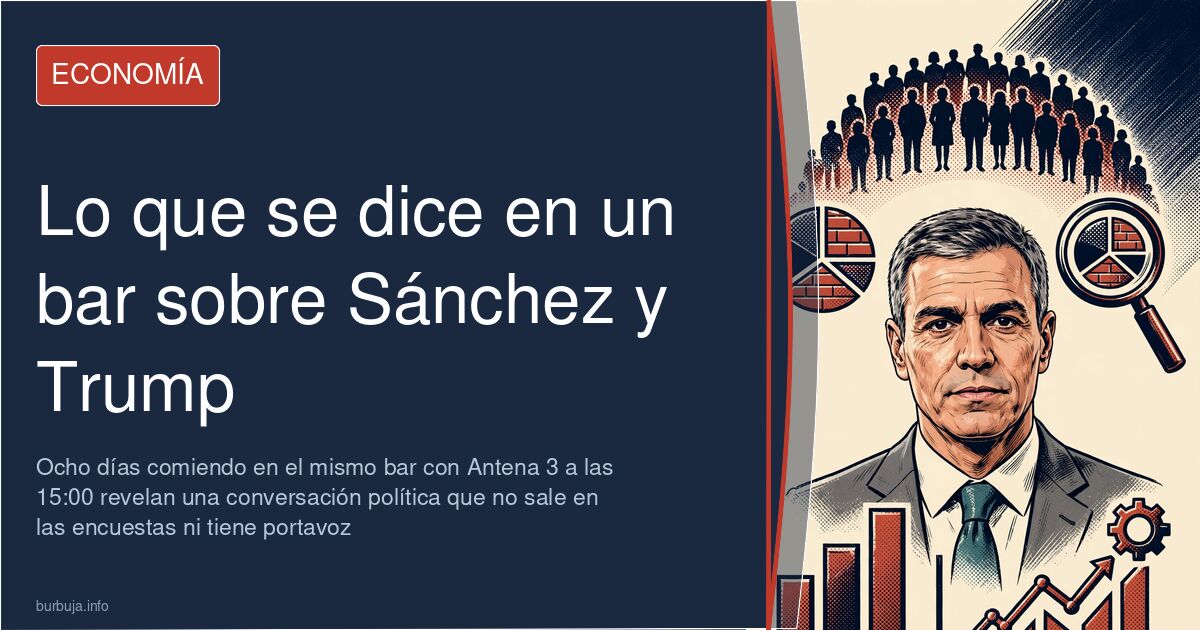
Eight Days in a Bar: What Spain Thinks That Doesn’t Show Up in Polls
Is public opinion truly shifting, or are we just hearing what we want to hear? This doubt stems from an unacademic yet revealing experiment: eight days of eating at the same time in the same bar, a generic spot near a hospital, with Antena 3 on TV and the 3 PM news as background noise. The table next door has no spokesperson, no pollster, no advisor. And yet, they talk politics.
The summary of these conversations—captured daily for over a week—points to a diffuse shift: people who used to ignore politics now opine, argue, and get outraged by what they see on screen. The question, as always, is whether this reflects a real change in social mood or the old habit of blaming neighbors for what we all voted for.
Trump Standoff Turns the Bar into a War Council
The topic that most frequently intrudes between courses is the clash with Washington. Midday news has built the idea that Pedro Sánchez’s government has made distancing itself from Trump its own banner. In the bar, this generates two opposing reactions, none lukewarm. Some celebrate it, arguing Spain finally stands up to those in power. Others consider it expensive posturing, claiming the real problem is facing Segarro while antagonizing the power that, according to this narrative, should defend the southern border.
A nuance repeated loudly across the counter: there is less debate about foreign policy than about who benefits from it. The widespread suspicion is that the clash with the White House responds not to a state plan but to electoral calendar calculations.
The Uncomfortable Thesis: People Don’t Change, They Forget
Against the narrative of collective awakening, the more cynical current defends the opposite: nothing moves. The argument is always the same. That the average voter’s memory lasts a month, and that things can be done wrong for three years and ten months and fixed with two gestures in the last quarter. That the country has spent years playing ping-pong with the same two parties, and each term repeats the same script: outrage, forgetting, reelection, and new disappointment.
This side concludes that talking about social change is self-deception. If people had truly changed, they argue, things would already be different. It is the most repeated answer to the initial question and also the hardest to refute.
The Only Exit Seen by the Economic Argument
Another line of analysis, the coldest, sets aside public mood and looks at the numbers. Its thesis: the current government will not be ousted by protests or scandals, but by an economic crisis that wipes out public revenues. Everything else, they say, is noise.
The reasoning trinc an incentive logic. Pensions, the minimum vital income (a Spanish welfare benefit), subsidies, aids, and various grants function, from this viewpoint, as transfers sustaining loyalty. As long as there is cash to distribute, discontent is funded against itself. The breakdown of which budget item buys how many votes—and at what price—would fill a whole page of numbers that doesn’t fit here. It is an hypothesis unprovable at a bar table and, precisely for that reason, repeated every day.
The Other Extreme: Sánchez as an International Asset
It is worth avoiding oversimplification. In the same establishment, the opposite is also defended: that only two recent prime ministers—Aznar and Sánchez—have had their own weight abroad, while others passed through La Moncloa (the Spanish presidential residence) leaving no trace outside home. Additionally, a comparison circulates linking current foreign policy with older stages of the 20th century—closer ties with the Arab world, more independence from Washington—a parallelism that doesn’t hold up well to historical contrast but is launched without shame over beers.
In the end, the only firm conclusion left after the week is the most uncomfortable to admit: nobody knows how many people are changing, but everyone is convinced it is the other side. Eight days of eavesdropping suffice to know what is said. Not to know if it matters. At 3 PM, with coffee and the bill on the table, anyone has the answer except the one paying.
Is public opinion truly shifting, or are we just hearing what we want to hear? This doubt stems from an unacademic yet revealing experiment: eight days of eating at the same time in the same bar, a generic spot near a hospital, with Antena 3 on TV and the 3 PM news as background noise. The table next door has no spokesperson, no pollster, no advisor. And yet, they talk politics.
The summary of these conversations—captured daily for over a week—points to a diffuse shift: people who used to ignore politics now opine, argue, and get outraged by what they see on screen. The question, as always, is whether this reflects a real change in social mood or the old habit of blaming neighbors for what we all voted for.
Trump Standoff Turns the Bar into a War Council
The topic that most frequently intrudes between courses is the clash with Washington. Midday news has built the idea that Pedro Sánchez’s government has made distancing itself from Trump its own banner. In the bar, this generates two opposing reactions, none lukewarm. Some celebrate it, arguing Spain finally stands up to those in power. Others consider it expensive posturing, claiming the real problem is facing Segarro while antagonizing the power that, according to this narrative, should defend the southern border.
A nuance repeated loudly across the counter: there is less debate about foreign policy than about who benefits from it. The widespread suspicion is that the clash with the White House responds not to a state plan but to electoral calendar calculations.
The Uncomfortable Thesis: People Don’t Change, They Forget
Against the narrative of collective awakening, the more cynical current defends the opposite: nothing moves. The argument is always the same. That the average voter’s memory lasts a month, and that things can be done wrong for three years and ten months and fixed with two gestures in the last quarter. That the country has spent years playing ping-pong with the same two parties, and each term repeats the same script: outrage, forgetting, reelection, and new disappointment.
This side concludes that talking about social change is self-deception. If people had truly changed, they argue, things would already be different. It is the most repeated answer to the initial question and also the hardest to refute.
The Only Exit Seen by the Economic Argument
Another line of analysis, the coldest, sets aside public mood and looks at the numbers. Its thesis: the current government will not be ousted by protests or scandals, but by an economic crisis that wipes out public revenues. Everything else, they say, is noise.
The reasoning trinc an incentive logic. Pensions, the minimum vital income (a Spanish welfare benefit), subsidies, aids, and various grants function, from this viewpoint, as transfers sustaining loyalty. As long as there is cash to distribute, discontent is funded against itself. The breakdown of which budget item buys how many votes—and at what price—would fill a whole page of numbers that doesn’t fit here. It is an hypothesis unprovable at a bar table and, precisely for that reason, repeated every day.
The Other Extreme: Sánchez as an International Asset
It is worth avoiding oversimplification. In the same establishment, the opposite is also defended: that only two recent prime ministers—Aznar and Sánchez—have had their own weight abroad, while others passed through La Moncloa (the Spanish presidential residence) leaving no trace outside home. Additionally, a comparison circulates linking current foreign policy with older stages of the 20th century—closer ties with the Arab world, more independence from Washington—a parallelism that doesn’t hold up well to historical contrast but is launched without shame over beers.
In the end, the only firm conclusion left after the week is the most uncomfortable to admit: nobody knows how many people are changing, but everyone is convinced it is the other side. Eight days of eavesdropping suffice to know what is said. Not to know if it matters. At 3 PM, with coffee and the bill on the table, anyone has the answer except the one paying.
Summary of a discussion on Burbuja.info - Foro de economía, actualidad y política., translated from Spanish and reviewed before publication. Read the full discussion (172 replies).
More summaries
-
Trump Threatens to Double Tariffs on Spain Over Defense Spending
Donald Trump threatens to double tariffs on Spanish exports if Spain does not meet its NATO commitment of spending 5% of GDP on defense.
-
Riots in French schools: fires and attacks
Fires in French schools, teachers attacked and blockades spreading to Belgium. The unrest is attributed to the education strike and radical groups.
-
Five plane crashes in five days: what the data shows
Five aviation incidents in five days and eleven aircraft involved in 2024: available data neither confirms panic nor rules out a streak.
-
Sexual Assault in Bolaños: Suspect Jailed
A man was found unconscious and sexually assaulted in Bolaños de Calatrava. The suspect, facing deportation, is currently in prison.
-
Spain DANA: UME report claims over 200 bodies recovered
A leaked account attributed to Spain's UME unit reveals over 200 bodies in Valencia, contradicting official low counts.
-
Dacia Spain warns: Think twice before buying a car
With the Sandero nearing €14,000 and rivals costing more, Dacia's director urges buyers to carefully consider new car prices.