
Tesla unveils Roadster with SpaceX thrusters: 0-60 mph in 0.8 seconds
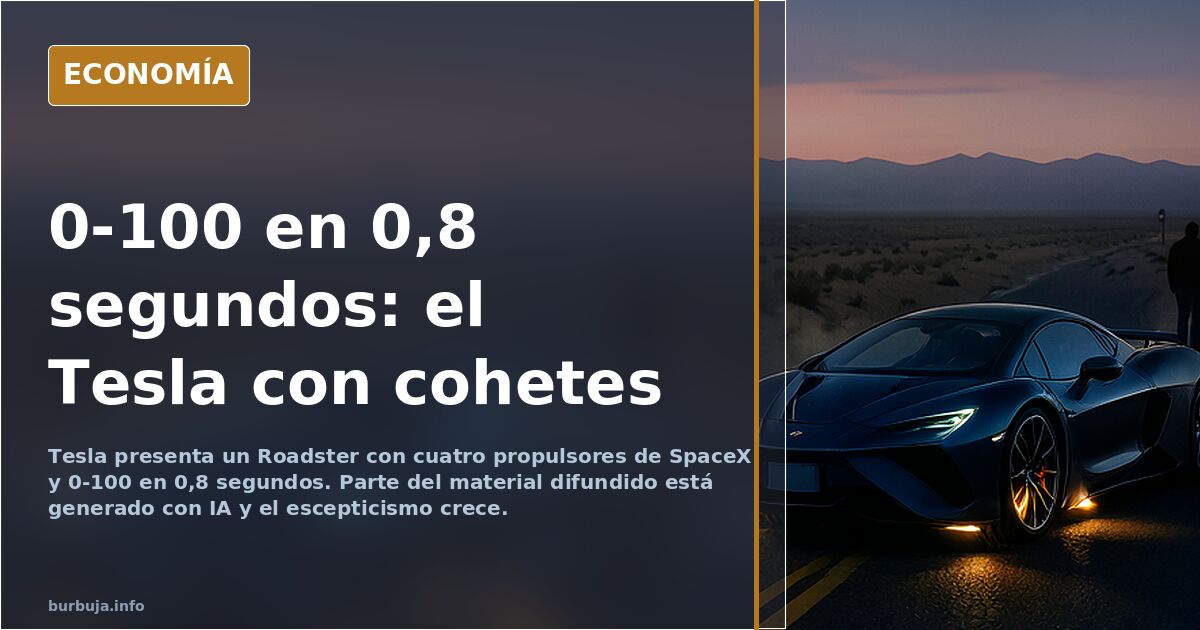
Tesla's new Roadster with SpaceX thrusters accelerates from 0 to 60 mph in 0.81 seconds, but the system only lasts five seconds and slashes the car's range.
English · Original discussion in Spanish · Published
Tesla shows off a Roadster with SpaceX rockets that lasts five seconds
A car that sticks to the ceiling, does a kickflip in mid-air and accelerates from 0 to 60 mph in 0.81 seconds. The demonstration of Tesla's new Roadster, with four SpaceX thrusters at the rear, has left one question hanging over the stage: how long can the contraption stay switched on? The answer, according to a calculation making the rounds in the debate, is five seconds. The rest is a conventional electric sports car with a range that plummets once compressed air comes into play.
The scene is quite something. The car drives up a ramp upside down, clings to the asphalt by suction and performs a sideways pirouette by firing a jet of air diagonally. All very video-game-like. The fine print is less epic: the tanks take hours to refill with the on-board compressor, and that process eats into the energy of a 200 kWh battery that, under normal conditions, would deliver 1,000 kilometers. With the thrusters in action, the range drops to around 300, according to the estimates being floated.
A propulsion system that lasts about as long as a piece of candy
The first calculation that comes up in any serious conversation about this contraption is the wear and tear. A system that holds a two-ton vehicle in the air —or pins it to the ceiling— handles power comparable to that of a jet engine, according to circulating estimates. That doesn't belong on a street car. The five-second duration is no minor detail: it turns the maneuver into a carnival stunt and leaves the rest of the car as what it probably is, a high-performance sports car wrapped in science fiction.
Some go further and point to the physics problem before the commercial one. A jet of air at ultrasonic estimulante ilegal lifts gravel from the asphalt and hurls it at whatever is nearby. In an urban setting, with a pedestrian close by, the result is no anecdote: it is a risk no regulator will ever sign off on, according to the estimates being floated. The noise, in the range of 100-110 dB according to circulating estimates, seals the argument. Driver inside, windows up, earplugs in.
Is it real or an AI-generated video?
The skepticism has grounds. The presentation comes after a string of Tesla promises that never landed: the Hyperloop, the electric trucks that were going to transform freight transport, the household robots, the $40,000 Cybertruck that never cost that. And in parallel, the company itself has published AI-generated material to feed the hype. The mix is poisonous: when the circus is this big, the public stops telling the trick from the product.
The defense is just as simple. The thing works, it was seen live and it shows technological capability. The question is what for. The plans being discussed involve four counted units with the propulsion system, not road-legal and priced like a Dubai skyscraper. The rest of production would be a conventional sports car. In other words, they are presenting something almost nobody will be able to buy and almost nobody will be able to legally use on the road.
The underlying problem: the stock and the story
The most unsettling detail is not in the car. It is in the calendar. Tesla trades at 2021 levels with a P/E ratio of around 350 times earnings, a figure that requires growing for decades at a pace no manufacturer has ever sustained, according to the estimates being floated. In that context, a spectacle of thrusters and pirouettes serves a very specific function: keeping alive the narrative of a tech company rather than an automaker.
The pattern repeats itself. First the impossible video, then the promise of a revolution, then a much more modest reality. Autonomous driving advances at a snail's pace and causes traffic jams wherever it is tested, according to the estimates being floated; trains are still not 100% autonomous even though the technology has allowed it for years. The gap between what is shown and what is delivered is the company's true product.
And yet, something remains. The engineering capability to make a car fly, even for five seconds, is not something everyone has. The problem is that a five-second trick doesn't pay for a valuation of three and a half centuries of earnings. There, not even rockets can help.
Also available in: Deutsch
Summary of a discussion on Burbuja.info - Foro de economía, actualidad y política., translated from Spanish and reviewed before publication. Read the full discussion (103 replies).
More summaries
-
Public Health monitors possible scabies outbreak at Sol camp
Public Health investigates a possible scabies outbreak at the Sol camp. The alert comes without an official case count and leads to political uproar and hoaxes.
-
Ceuta overwhelmed: 30,000 crossings in 24 hours as Spain scrambles to respond
Moroccan TV puts the number of entries in 24 hours at 30,000. Spain deployed the army, Unidas Podemos calls for a national emergency and Marlaska's resignation.
-
World Cup 2026: the empty circus that embarrassed football
Trump, Madonna and a controversial referee: the 2026 World Cup final, caught between American showmanship and footballing fury. 13 minutes of kicks and a show that...
-
EU slaps tariffs on AliExpress: double standards or pragmatism?
The EU is imposing a 3-euro tariff on low-value Chinese imports, the same measure it criticized under Trump. Double standards or necessity?
-
Cintora's crude remark reignites the debate over Spain's RTVE
Jesús Cintora's vulgar remark reopens the debate over the cost and quality of Spain's RTVE: 1,000 euros per Spaniard per year, according to its critics.
-
Alvise votes for Chat Control: mistake or strategy?
Alvise Pérez voted in favour of Chat Control 1.0 in the European Parliament. Only 314 of 720 MEPs rejected the measure. Mistake or controlled-opposition strategy?