
Tesla plunges 16% as calls grow for Musk to step down
Tesla shares drop nearly 16% in one session, S&P 500 falls 3.25%, and pressure mounts on Elon Musk.
English · Original discussion in Spanish · Published
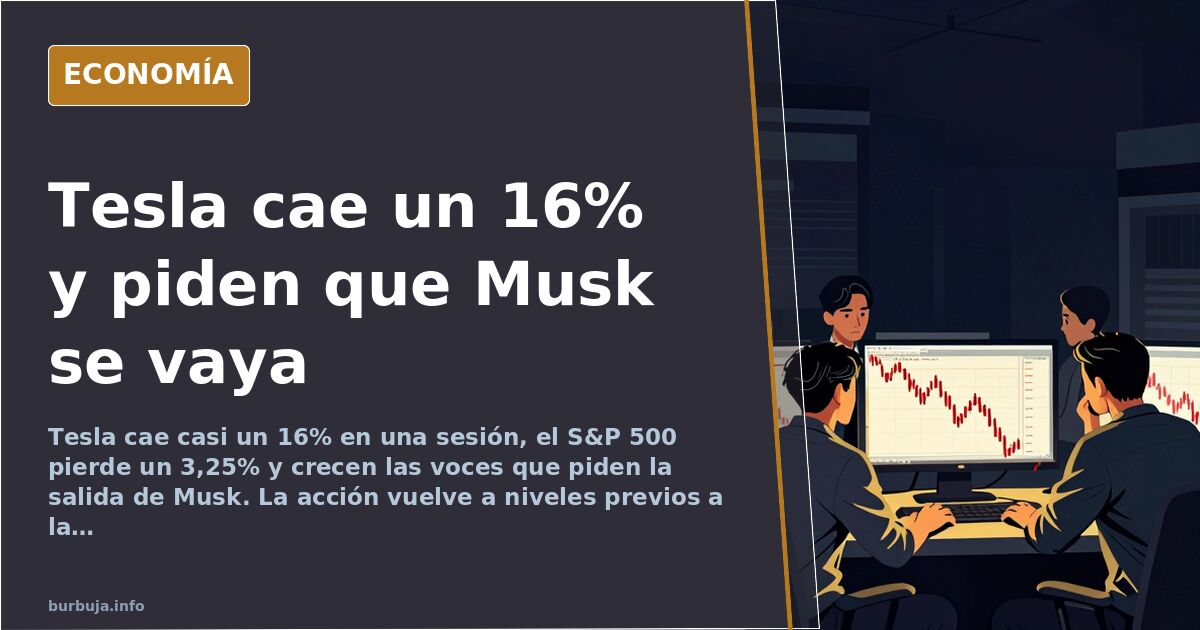
Tesla drops nearly 16% amid rising backlash against Musk
Tesla shares fell almost 16% in a single trading session, with the slump concentrated in the final hour, and the punishment did not come alone. The S&P 500 lost 3.25% and the Nasdaq dropped more than 4%, entering correction territory, while the ten-year US Treasury yield rose by half a point. Meanwhile, Elon Musk warned of an imminent "massive cyberattack" on X and its AI Grok, with widespread failures in both systems. The coincidence of these two fronts—financial and technological—has turned the day into a referendum on Musk himself.
From $220 to $400 and back again
The most repeated argument explaining the crash is political rather than technical. According to circulating calculations, the stock jumped from $220 to $400 after Trump's electoral victory, without any other justification, and now returns to where it was or lower. With sales figures and forecasts on the table, the current price assumes Tesla can sell between 8 and 10 million cars annually with profits at current prices. Reality shows 1.8 million units and falling.
Some go further, arguing that Tesla should trade between $30 and $40, and everything else is inflated expectation. The money Musk borrowed to buy Twitter is financed by Tesla shares, adding structural risk: if X collapses, the effect spreads to the company. Annual power filings sent to the SEC show Musk owns 23.5% of shares and contemplate a 3-for-1 split.
Why does Tesla fall if Musk has 16 companies?
The short answer is that Musk's business diversification does not protect Tesla shareholders. The plunge is explained by a combination of factors that, according to some participants, Musk himself has acknowledged: the brand is suffering because it has insulted potential buyers. US Democrats, Europeans, and Chinese buyers—the three natural markets for electric vehicles—have been publicly disdained. Those with money for a Tesla buy an Audi or Mercedes in Europe, and in China they buy domestic brands.
The most optimistic calculation assumes the company regains traction with new models; the pessimistic scenario starts from the premise that market share will continue to fall in favor of Chinese manufacturers. Between both, a fact admits no interpretation: Tesla sells to US Democrats, European leftists, and Chinese consumers, and has insulted all three groups.
Musk's political activism and brand boycott
The boycott is not the sole cause, but it points toward the abyss. Some scratch Teslas, attack dealerships, and put stickers on cars. The brand also carries a narrative problem: for years it sold itself as eco-resilient, and now many potential buyers feel deceived by their owner's political turn. You couldn't have known, some joke ironically.
The debate over the boycott has an uncomfortable edge: in Europe, those paying the price are German plant workers, not the owner. Musk's political activism has consequences for jobs that did not participate in it. This tension between punishing the owner and not harming workers runs through much of the discussion.
Musk's role: he won't leave nor be ousted
Calls for Musk to exit Tesla clash with stubborn shareholder reality. He is the majority shareholder by far: even if he leaves the CEO position, he will still direct the company whether investors like it or not. To get rid of him, one would have to buy his 23.5% stake at whatever price he considers necessary and agrees to sign. Without that, resignation requests are just tantrums.
Musk doesn't care, some argue, not because he has 16 companies, but because the US treasury will cover his holes. That's what happens when the US president eats out of your hand. The limit would be set by other actors in the presidential circle who, according to this reading, are fed up with Musk.
Starlink, X, and SpaceX: the domino effect
The crash is not limited to Tesla. Starlink fell nearly 20%, X is under scrutiny due to failures acknowledged by Musk himself, and SpaceX does not escape the climate either. The most aggressive reading celebrates the entire empire collapsing. The cautious one reminds us that the stock market has been falling for nearly two weeks and today's drop was general, not just Tesla.
The one-year chart is devastating. Anyone looking only at today's session misses the full picture: the rise from 2020 to 2021, from €20 to €400, occurred when Musk was not friends with Trump. The correlation between politics and stock price is not as clean as some want to sell.
With these elements, the question is not whether Tesla is worth its market cap, but how much of its price is technology and how much is the story of a man who refuses to stay silent. The market has just issued its verdict on the latter.
Also available in: Deutsch
Summary of a discussion on Burbuja.info - Foro de economía, actualidad y política., translated from Spanish and reviewed before publication. Read the full discussion (113 replies).
More summaries
-
Trump and Musk Freeze FEMA Funds Targeting NGOs
Trump and Musk pause FEMA payments and review federal agencies. Reports cite over $1 billion to NGOs, sparking panic among officials.
-
Musk vs. Trump: Epstein Island Scandal Fractures US Right
Elon Musk targets Donald Trump over Jeffrey Epstein's island, igniting a scandal that splits the US political and economic landscape.
-
Ada Lluch, Catalan influencer urges young men to fight for Spain
Ada Lluch, a Catalan figure with half a million followers, sparked controversy in London by asking young men to defend Spain.
-
46% of Spain's voters rely on state pensions and jobs
In Spain, 46% of the electoral census depends on public funds, reigniting debate on captive voting and fiscal sustainability.
-
Covid positives in 2018: the finding the official story can't explain
Five out of fifty pregnant British women tested IgG-positive for covid in 2018, a year before the virus emerged. Cross-reactivity doesn't quite explain it.
-
Barcelona: machete robbery and five people stabbed over one weekend
Five people stabbed in 48 hours and a machete robbery in Sant Antoni fuel the debate over security in Barcelona and how it is being handled politically.