
Tesla: Historic Opportunity or Epic Scam?
Forum debate pits Tesla's profitability claims against doubts on scale. A clash between investor faith and hard data.
English · Original discussion in Spanish · Published
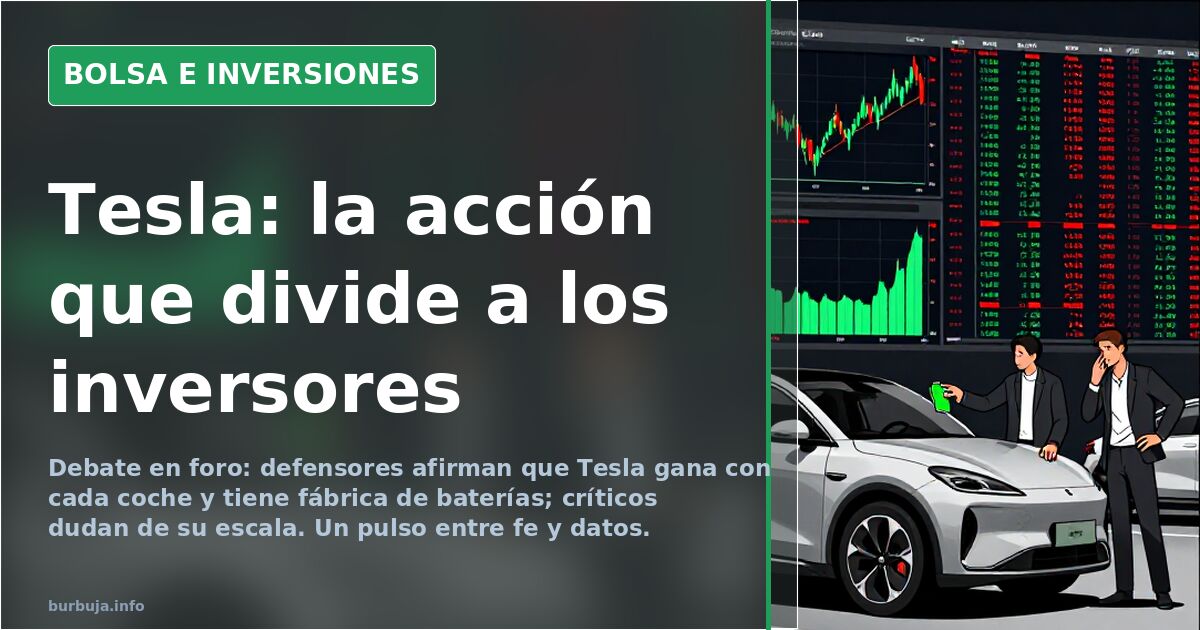
Tesla: The Stock That Divides Investors
The debate asserts that Tesla makes money on every car sold, owns its battery factory, and runs a global charging network. Yet the stock swings wildly from $700 to $400 with no clear explanation, as commentators note. This analysis asks not if the cars are good, but if the market has confused a company with a religion.
The Per-Car Margin Few Dispute
Proponents argue Tesla profits on each vehicle sold, boasting one of the industry's best margins. Accounting losses, when they occur, stem from massive investments in factories, stores, and charging infrastructure. In the last quarter with closed accounts, the firm reported profits and significant positive free cash flow, according to defenders.
Contrast with competitors is another pillar. Fiat lost money on every electric car it built, admitted by its CEO, cited here. Generalist brands still struggle to profit from EVs, lacking own battery factories or chemistry, relying on few suppliers for critical inputs, supporters claim. Tesla, conversely, is the world's largest battery consumer with fewer bottlenecks.
Scale Problem: 400,000 Cars Are Nothing
Here the narrative cracks. One participant notes Tesla produces around 400,000 cars annually, less than 0.5% of the global market. Critics call it a niche manufacturer glorified by enthusiasts. Without economies of scale, competing with giants is futile: it either triumphs big or sinks, a risk profile only for those who know what they're buying.
Defenders counter that comparing Tesla to generalists is flawed. It isn't GM or Volkswagen. It is an startup investing in technology, new battery chemistries, and software. The parallel drawn is Amazon, unprofitable for nearly twenty years due to reinvestment. And Netflix, which seemed financially suicidal until it wasn't.
Autonomous Driving and 5G: The Bet No One Can Value
The founder has repeatedly stated he aims to build not just a car maker, but an autonomous taxi service, recalled here. For this, Tesla uses data from all vehicles on the road, something competitors cannot replicate, proponents assert. The question posed is what it will achieve with 5G; the honest answer is no one knows.
Skeptics reject this. Image-processing-based autonomy is brute force, they say, while other options involve standards where all vehicles communicate. The discussion drifted to mobile phones, whether smartphones evolved much since 2003, and if the first iPhone invented anything or just popularized existing tech. Ultimately, it’s about who defines and exploits the category.
Real Consumption: 20.9 kWh vs 14.7
Efficiency tests disrupt expectations. In the same cycle, a Tesla Model 3 consumes 20.9 kWh/100 km, a Renault ZOE 20.3, and an Ioniq 14.7, per ADAC data cited. This debunks the idea that the tech leader is automatically the most efficient. Whether Tesla is the best EV, some admit, has become a matter of faith.
Public Money and Rarely Discussed Financing
Financing history deserves its own chapter. In January 2008, a federal highway safety agency grant saved Tesla from bankruptcy with [$43 million](URL) for a firm losing money since inception, cited here. The fifth funding round added $40 million more. Of the $145 million received, $74 came from the founder himself. Tesla was later the only US automaker to repay public loans, years early, according to defenders.
Access to capital was its real competitive edge: the market allowed relatively low dilution and rapid growth, even critics admit. It’s a self-fulfilling prophecy, they note. The market likes Tesla, stocks rise, cheap financing flows, growth continues, and the market keeps liking it. The virtuous circle works until it stops working.
Entry Price and the Non-Existent Buyer
The most earthly objection is who buys. A Model 3 doesn’t compare to a Renault, but to a BMW 3 Series, competing head-to-head at that price range, argued here. But will mass buyers spend an annual salary on a battery car when the economy contracts? The ironic response circulating is that many expect people to rush to buy once restrictions lift.
Lithium scarcity for the global market is another physical limit mentioned. If raw materials are insufficient, EVs become products for the privileged, not an energy transition. There, the discussion moves from stocks to industrial policy.
Charging Network and Non-Existent Dealerships
The global charging network reaching 150 kWh speeds is an asset competitors lack, according to proponents. A structural detail often overlooked: Tesla holds no fixed assets in physical dealerships, a model vanishing like bank branches, it is claimed. Franchise owners bear the capital burden, not the manufacturer. Online sales, accelerated by the pandemic, fit this light structure better.
The conclusion is a cautious prediction. If Tesla achieves autonomous driving first, current valuations may seem cheap. If it fails and remains niche, the correction will be brutal. No one has a crystal ball, but the market has already priced in faith.
The debate asserts that Tesla makes money on every car sold, owns its battery factory, and runs a global charging network. Yet the stock swings wildly from $700 to $400 with no clear explanation, as commentators note. This analysis asks not if the cars are good, but if the market has confused a company with a religion.
The Per-Car Margin Few Dispute
Proponents argue Tesla profits on each vehicle sold, boasting one of the industry's best margins. Accounting losses, when they occur, stem from massive investments in factories, stores, and charging infrastructure. In the last quarter with closed accounts, the firm reported profits and significant positive free cash flow, according to defenders.
Contrast with competitors is another pillar. Fiat lost money on every electric car it built, admitted by its CEO, cited here. Generalist brands still struggle to profit from EVs, lacking own battery factories or chemistry, relying on few suppliers for critical inputs, supporters claim. Tesla, conversely, is the world's largest battery consumer with fewer bottlenecks.
Scale Problem: 400,000 Cars Are Nothing
Here the narrative cracks. One participant notes Tesla produces around 400,000 cars annually, less than 0.5% of the global market. Critics call it a niche manufacturer glorified by enthusiasts. Without economies of scale, competing with giants is futile: it either triumphs big or sinks, a risk profile only for those who know what they're buying.
Defenders counter that comparing Tesla to generalists is flawed. It isn't GM or Volkswagen. It is an startup investing in technology, new battery chemistries, and software. The parallel drawn is Amazon, unprofitable for nearly twenty years due to reinvestment. And Netflix, which seemed financially suicidal until it wasn't.
Autonomous Driving and 5G: The Bet No One Can Value
The founder has repeatedly stated he aims to build not just a car maker, but an autonomous taxi service, recalled here. For this, Tesla uses data from all vehicles on the road, something competitors cannot replicate, proponents assert. The question posed is what it will achieve with 5G; the honest answer is no one knows.
Skeptics reject this. Image-processing-based autonomy is brute force, they say, while other options involve standards where all vehicles communicate. The discussion drifted to mobile phones, whether smartphones evolved much since 2003, and if the first iPhone invented anything or just popularized existing tech. Ultimately, it’s about who defines and exploits the category.
Real Consumption: 20.9 kWh vs 14.7
Efficiency tests disrupt expectations. In the same cycle, a Tesla Model 3 consumes 20.9 kWh/100 km, a Renault ZOE 20.3, and an Ioniq 14.7, per ADAC data cited. This debunks the idea that the tech leader is automatically the most efficient. Whether Tesla is the best EV, some admit, has become a matter of faith.
Public Money and Rarely Discussed Financing
Financing history deserves its own chapter. In January 2008, a federal highway safety agency grant saved Tesla from bankruptcy with [$43 million](URL) for a firm losing money since inception, cited here. The fifth funding round added $40 million more. Of the $145 million received, $74 came from the founder himself. Tesla was later the only US automaker to repay public loans, years early, according to defenders.
Access to capital was its real competitive edge: the market allowed relatively low dilution and rapid growth, even critics admit. It’s a self-fulfilling prophecy, they note. The market likes Tesla, stocks rise, cheap financing flows, growth continues, and the market keeps liking it. The virtuous circle works until it stops working.
Entry Price and the Non-Existent Buyer
The most earthly objection is who buys. A Model 3 doesn’t compare to a Renault, but to a BMW 3 Series, competing head-to-head at that price range, argued here. But will mass buyers spend an annual salary on a battery car when the economy contracts? The ironic response circulating is that many expect people to rush to buy once restrictions lift.
Lithium scarcity for the global market is another physical limit mentioned. If raw materials are insufficient, EVs become products for the privileged, not an energy transition. There, the discussion moves from stocks to industrial policy.
Charging Network and Non-Existent Dealerships
The global charging network reaching 150 kWh speeds is an asset competitors lack, according to proponents. A structural detail often overlooked: Tesla holds no fixed assets in physical dealerships, a model vanishing like bank branches, it is claimed. Franchise owners bear the capital burden, not the manufacturer. Online sales, accelerated by the pandemic, fit this light structure better.
The conclusion is a cautious prediction. If Tesla achieves autonomous driving first, current valuations may seem cheap. If it fails and remains niche, the correction will be brutal. No one has a crystal ball, but the market has already priced in faith.
Summary of a discussion on Burbuja.info - Foro de economía, actualidad y política., translated from Spanish and reviewed before publication. Read the full discussion (194 replies).
More summaries
-
Trade Republic's 3%: The Fine Print of the Collective Account
Trade Republic offers 3% AER only for new customers, capped at €50,000, with a collective account. Bankinter, Openbank, and Santander are countering.
-
Gold up 500% vs basket 25%, forum user claims
A forum user calculates gold rose 500% from 2002 to 2011 while the shopping basket gained only 25%. The key question is whether the metal is rising or fiat currency is falling.
-
Market Warrior: S&P 500 crash avoidance signals
Market Warrior claims 12 trades in 17 years avoid S&P 500 crashes. This index investing overlay faces scrutiny over backtesting flaws and transparency.
-
War Preparedness: Cash, Gold, and Escape Plans
Forum debate on protecting assets and life during war: cash limits, gold, Bitcoin, and exit strategies before borders close.
-
Investor dumps portfolio, reinvests 92% in inflation bonds
An individual sold all assets except one stock, moving 92% into inflation-linked bonds and commodities while keeping 8% cash.
-
Drone Volt Doubles Sales But Remains Unprofitable
Drone Volt doubled sales in 2015 to €3.7 million but posted a €0.6 million loss; its share price fell from €13.44 to €1.26 after the split.