
Tents Built Over Benches in Madrid
Public benches turned into enclosed bedrooms in Madrid: a loophole for camping bans and debate on who is next.
English · Original discussion in Spanish · Published
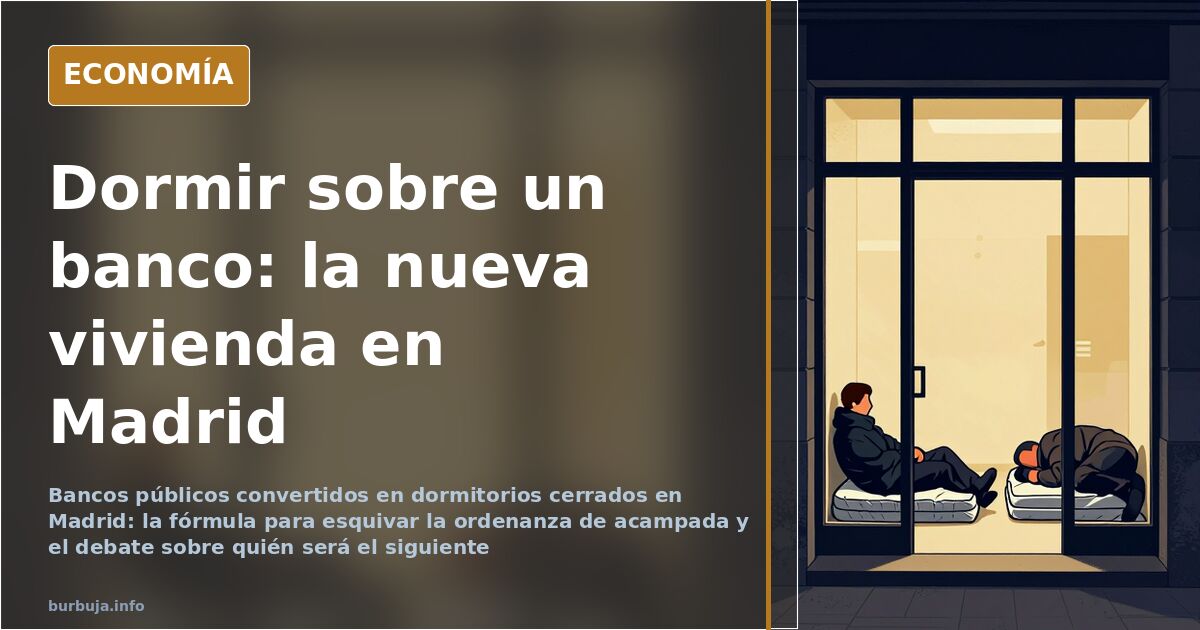
Sleeping on a bench: the new housing in Madrid
A park bench turned into a bedroom. It is not a metaphor: it is a structure closed on all four sides that hides the public seat inside, set up to sleep without arousing suspicion of camping. The scene repeats in several areas of Madrid and has peine a debate mixing housing, immigration, and the future of low-paid civil servants. The issue is not whether it exists, but how long it will last and who will be affected next.
What are these bench settlements and where do they appear
The phenomenon consists of setting up a hut or tent over a public bench, using the bench itself as a base. From the outside, the seat is not visible: it is totally enclosed. The advantage for those who set it up is that, technically, there is no tent planted on the ground, allowing them to bypass the municipal ordinance prohibiting camping in parks.
The exact location generates disagreement. The headline that started the matter placed the settlements in El Retiro, the capital's emblematic park. Several voices strongly corrected this: it is not El Retiro, but Puente de Vallecas, a suburb near the M30. In the Retiro district, on plots adjacent to the M30, settlements have been cleared in areas such as the Vicálvaro exit and Estrella. The confusion between the park and the district is, in itself, a clue about how the phenomenon is being reported.
Most people sleeping like this do not go to shelters, according to residents, because either there are no spaces available or the conditions are not adequate. This is the most repeated argument and the least verified one.
The calculation nobody wants to make: civil servants in the same settlement
The most uncomfortable hypothesis of the matter is not that of current homeless people, but those who are one step away. Some argue that lower-level state civil servants, who barely earn more than the minimum wage, could end up living in settlements like this near their assigned ministry, during the months they endure in Madrid before fleeing to provincial capitals where they can afford a mortgage.
The immediate objection is that civil servants have remote work: at least two days, according to those who know from within. Others point out that before reaching that point, they would request leave or sick leave to weather the storm and then return to an equivalent permanent position. The hypothesis does not close; it is only postponed.
Immigration, rent, and the global city narrative
The second axis of the matter is who arrives and who leaves. Part of the analysis argues that Madrid has become the new Miami: the rich come to live and this creates jobs. The counter-argument is that the jobs created are precarious, service-oriented, with people who cannot reach the end of the month and cohabit in small rooms while escaping through hobbies or television.
The Latin American capital of Europe. The phrase summarizes a thesis running through the entire conversation: if you import third-world problems, you get third-world results. Against this, the argument that the problem is not the arrival of people but land use and rental prices. Investment funds buy apartments to rent and adjust prices, pushing the lower end of the scale towards solutions that are not housing.
At the center of this dispute is real urban planning: a softball field on Avenida de la Peseta, in Cuatro Vientos, with the first stone laid and a five-month deadline. The anecdote circulates as a contrast: sports facilities are being built while there is debate about people sleeping on benches.
Who is responsible and why nobody agrees
The political fight is served. Some blame the Community of Madrid and the PP (People's Party) for not applying the housing law in their territories. Others respond that the problem is municipal management and a lack of shelter spaces. And some frame it within a broader plan of demographic replacement.
What does not appear in any version is a count. How many settlements exist, how many people sleep in them, how many shelter beds are free. Without those three numbers, everything else is just narrative. The disorienting data is not that of those sleeping on a bench: it is that of civil servants who, with a fixed salary and permanent tenure, are already calculating how not to end up in the same place.
This article is based on the content of the debate and does not constitute an independent verification of the discussed facts.
Also available in: Deutsch
Summary of a discussion on Burbuja.info - Foro de economía, actualidad y política., translated from Spanish and reviewed before publication. Read the full discussion (122 replies).
More summaries
-
Pardo de Vera backs migration to fix Europe's demographic crisis
Ana Pardo de Vera argues migration solves Europe's demographic slump without cutting social rights. The controversy, examined through data.
-
Noise, Merengue and Street Occupation in Puente de Vallecas
Residents complain of police delays and late-night merengue on Madrid's Peña Gorbea boulevard, highlighting enforcement gaps.
-
No Christmas this year in the heart of Europe
A viral post claims Australia, France and Germany have cancelled their New Year celebrations over Islamist terrorism. There is no official confirmation.
-
Pentagon readies bases to run 90 days without supplies
The Pentagon is preparing its bases to operate for 90 days without external power, fuel or water, while the UK recommends emergency kits for 72 hours without…
-
Bolsonaro beats Lula in Brazil's first round
Bolsonaro defeats Lula in Brazil's first round with 48% against 43% and forces a runoff on October 25.
-
Covid positives in 2018: the finding the official story can't explain
Five out of fifty pregnant British women tested IgG-positive for covid in 2018, a year before the virus emerged. Cross-reactivity doesn't quite explain it.