
Teen killed by train at Montcada i Reixac crossing
A 17-year-old girl died after being hit by a train in Montcada i Reixac, Spain. The driver tested positive for substances.
English · Original discussion in Spanish · Published
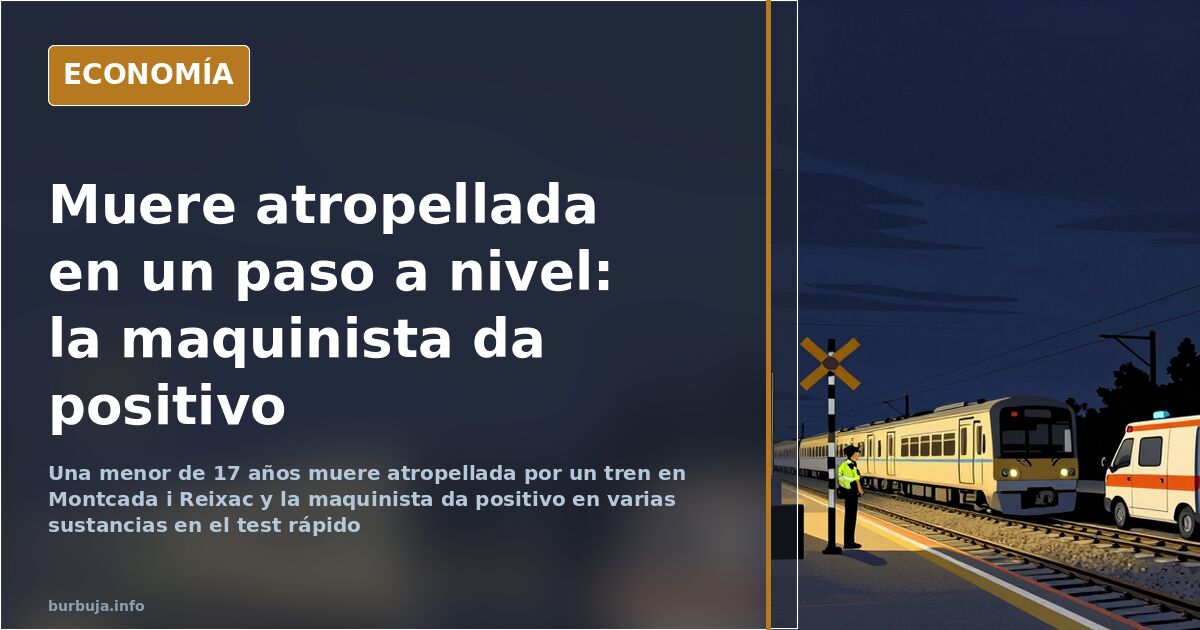
Teen dies in Montcada i Reixac rail crossing; driver tests positive
A 17-year-old girl died this noon after being struck by a train on the R11 line at a level crossing in Montcada i Reixac (Barcelona). The female driver, who was operating the Portbou-Barcelona Sants route, tested positive for several substances in a rapid drug test conducted by local police after the accident. According to initial reports, the young woman crossed the tracks when the barrier was already active. The municipality has recorded 182 victims on its railway lines, and the city council has been demanding that the rail route be buried underground for years.
The accident occurred around 3:00 PM at the Pasqual Street level crossing. Apparently, the passage of a first convoy led the young women to believe they could cross, but a second train originating from Portbou and bound for Barcelona surprised them. One of them, aged 17, died instantly. Traffic between Sant Andreu and Montcada was interrupted for approximately two hours in both directions, affecting lines R2, R2 Nord, and R11 with delays exceeding 40 minutes. Civil Protection activated the pre-alert phase of the Ferrocat plan.
What is known about the driver's positive test?
The driver tested positive for several substances in the rapid test administered by local police after the collision. Initial hypotheses suggest the train was running on automatic pilot, which may have hindered stopping the convoy. The Investigation Unit of the Mossos d'Esquadra (Catalan regional police) from Lechonanyola has gone to the scene to clarify the facts, in an investigation also involving municipal police.
Subsequent analysis indicated that the initial positive result might have been a false positive, pending hospital counter-analysis. This distinction matters: driving under the influence is different from having consumed substances days prior. In any case, the focus of the accident is less on the driver's state than on the physical impossibility of stopping a multi-ton train within a few meters.
Can a train stop in time?
No. A train does not brake like a car. The mass of the convoy and the minimal friction coefficient between wheel and rail make the braking distance enormous. Even if the driver had superhuman reflexes and had consumed nothing, the outcome would have been the same if the young woman appeared suddenly just a few meters ahead. The only possible action in those seconds is to sound the whistle to alert the victim.
The level crossing in Montcada i Reixac is a recognized black spot. Train traffic is so intense that barriers remain down for much of the day, prompting pedestrians to cross when they see a first train pass, believing no other is coming. This pattern has repeated in more than one fatal accident. The city council has been requesting a solution for years to the hellish passage of convoys through the center of this town in the Vallès region.
How many victims has the train passage in Montcada i Reixac accumulated?
The official figure held by the city council is 182 victims on the municipality's railway lines. This collision occurred just two weeks after the last incident. The succession of accidents has turned the railway route into a recurring political issue, with neighborhood demands calling for the burial of the tracks and a reduction in traffic.
Public debate has also shifted toward the management model. Some argue that railway safety should be fully digitized, eliminating the role of the driver; others recall that the automatic pilot was already active in this case and that automation does not prevent a train from hitting someone in its path. Individual responsibility of the victim for crossing with the barrier lowered appears in almost all analyses, but it does not close the underlying problem: a level crossing in the center of a town with constant traffic is a trap waiting for someone to fail.
How many more accidents are needed for the burial of the tracks to cease being an electoral promise?
A 17-year-old girl died this noon after being struck by a train on the R11 line at a level crossing in Montcada i Reixac (Barcelona). The female driver, who was operating the Portbou-Barcelona Sants route, tested positive for several substances in a rapid drug test conducted by local police after the accident. According to initial reports, the young woman crossed the tracks when the barrier was already active. The municipality has recorded 182 victims on its railway lines, and the city council has been demanding that the rail route be buried underground for years.
The accident occurred around 3:00 PM at the Pasqual Street level crossing. Apparently, the passage of a first convoy led the young women to believe they could cross, but a second train originating from Portbou and bound for Barcelona surprised them. One of them, aged 17, died instantly. Traffic between Sant Andreu and Montcada was interrupted for approximately two hours in both directions, affecting lines R2, R2 Nord, and R11 with delays exceeding 40 minutes. Civil Protection activated the pre-alert phase of the Ferrocat plan.
What is known about the driver's positive test?
The driver tested positive for several substances in the rapid test administered by local police after the collision. Initial hypotheses suggest the train was running on automatic pilot, which may have hindered stopping the convoy. The Investigation Unit of the Mossos d'Esquadra (Catalan regional police) from Lechonanyola has gone to the scene to clarify the facts, in an investigation also involving municipal police.
Subsequent analysis indicated that the initial positive result might have been a false positive, pending hospital counter-analysis. This distinction matters: driving under the influence is different from having consumed substances days prior. In any case, the focus of the accident is less on the driver's state than on the physical impossibility of stopping a multi-ton train within a few meters.
Can a train stop in time?
No. A train does not brake like a car. The mass of the convoy and the minimal friction coefficient between wheel and rail make the braking distance enormous. Even if the driver had superhuman reflexes and had consumed nothing, the outcome would have been the same if the young woman appeared suddenly just a few meters ahead. The only possible action in those seconds is to sound the whistle to alert the victim.
The level crossing in Montcada i Reixac is a recognized black spot. Train traffic is so intense that barriers remain down for much of the day, prompting pedestrians to cross when they see a first train pass, believing no other is coming. This pattern has repeated in more than one fatal accident. The city council has been requesting a solution for years to the hellish passage of convoys through the center of this town in the Vallès region.
How many victims has the train passage in Montcada i Reixac accumulated?
The official figure held by the city council is 182 victims on the municipality's railway lines. This collision occurred just two weeks after the last incident. The succession of accidents has turned the railway route into a recurring political issue, with neighborhood demands calling for the burial of the tracks and a reduction in traffic.
Public debate has also shifted toward the management model. Some argue that railway safety should be fully digitized, eliminating the role of the driver; others recall that the automatic pilot was already active in this case and that automation does not prevent a train from hitting someone in its path. Individual responsibility of the victim for crossing with the barrier lowered appears in almost all analyses, but it does not close the underlying problem: a level crossing in the center of a town with constant traffic is a trap waiting for someone to fail.
How many more accidents are needed for the burial of the tracks to cease being an electoral promise?
Summary of a discussion on Burbuja.info - Foro de economía, actualidad y política., translated from Spanish and reviewed before publication. Read the full discussion (170 replies).
More summaries
-
37-year-old police chief in Yeles, Spain, dies by suicide
The death of a 37-year-old police chief in Yeles raises questions about workplace pressure, firearm access, and the lack of official data.
-
Vito Quiles sparks confrontation in Puerta del Sol and flees under local police escort
Vito Quiles rallied in Puerta del Sol, provoked protesters and was escorted out by police after a clash on Calle del Carmen.
-
Ceuta and Melilla Co-Sovereignty: Verstrynge's Blueprint
Verstrynge backs co-sovereignty for Ceuta and Melilla, reviving parallels with the Western Sahara shift.
-
Sanchinarro Residents Report Illegal Rentals of Eight-Bedroom Apartments
Neighbors in Madrid's Sanchinarro district report apartments converted into eight-room rentals, sparking debate on housing scarcity and illegal renovations.
-
Ceuta: Why Migration Protest Fails to Unite Spain
In Ceuta, where 37.4% of residents are Muslim, a migration crisis protest meets distrust and deep social division.
-
Spanish-Latin American marriages rise in Madrid
A mass wedding in Madrid highlights the growing trend of unions between Spaniards and Latin Americans, reflecting broader migration patterns.