
Tech Execs Claim AI Will Make Ownership Obsolete
A Madrid-based tech executive relays internal slogans predicting AI will replace 80% of engineers and end the need for ownership.
English · Original discussion in Spanish · Published
"We Won't Need Anything": The Abundance Promised by Tech Leaders
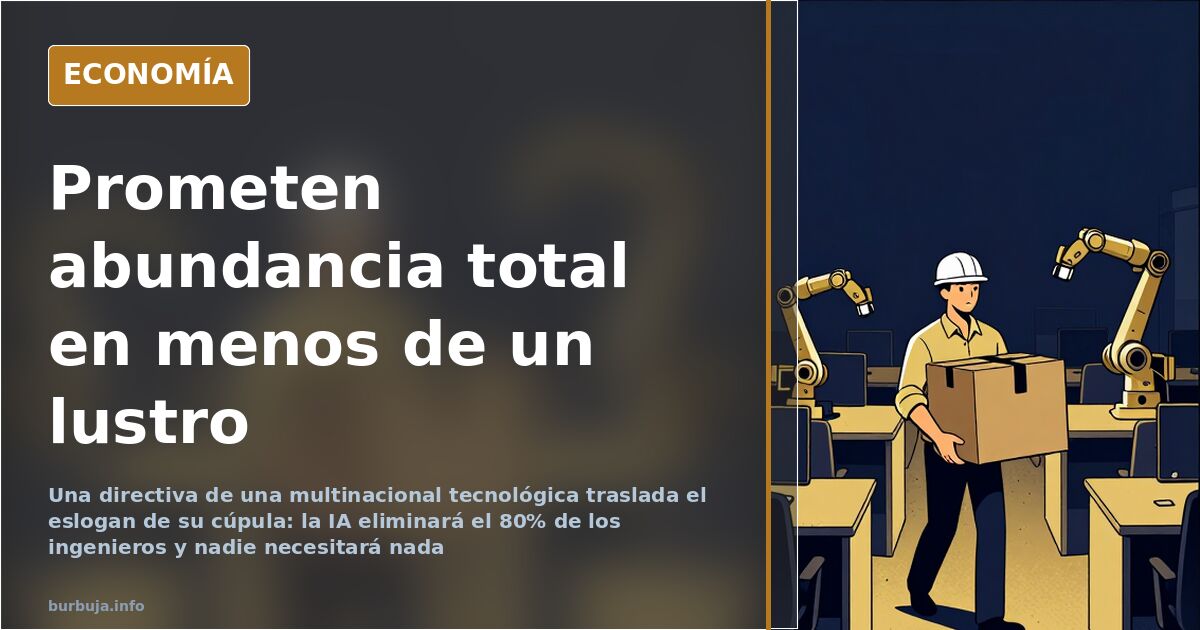
How long until your job disappears? Less than five years, according to a narrative shared by an executive at a major IT multinational headquartered in Madrid. She told colleagues that within this timeframe, automated assistants will have taken over customer service, software generation and debugging will run autonomously, and 80% of computer engineers and similar profiles will be left without work. Transport and logistics, fully automated farms, autonomous agriculture. The result would be such abundance that we won't need anything.
The phrase isn't hers. It comes from the top management of the parent company and serves as an internal slogan. And there, in that "we won't want to own anything," is where the narrative hits a wall.
Who Is Spreading the Promise of Abundance
The technical backing accompanying this version is notable: she is an expert in machine learning, first author of papers with nearly 1,000 citations on Google Scholar, and leads teams working with language models, LoRA techniques, and RLHF. Those who have seen the prototypes admit they are impressive. None of that turns a forecast into a fact, and doubt settles right there.
Much of the skepticism doesn't dispute the technology, but rather who is telling the story. They question whether a management profile has ever written code beyond university internships. Academic credentials sometimes mask ignorance of what happens in the trenches of coding.
Who Will Own the Homes We Still Use?
The promise has an accounting hole. If no one is going to own anything and yet we are still going to use houses, trains, and hospitals, someone must hold title to those assets: the State, the automating company, or a fund. The question, posed without malice, leaves the slogan hanging in the air.
The "we won't want to own anything" works as a motto, not as a model. Describing abundance is easy; distributing it requires deciding beforehand who owns the warehouse. No one has said a word about that arithmetic.
Those Selling AI and Those Using It to Sell
One current within the industry argues that executives are precisely those who understand the business least. Recent months have brought superficial presentations made with generative tools, expensive software deployments that no one knows how to use afterward, and purchases decided by trend. Being up-to-date, basically.
The result, they say, is a race to cut staff before knowing if the tool actually replaces anything. Automation arrives; the enthusiasm for announcing it does too. What doesn't arrive is a plan for those who become redundant.
Sam Altman's Nuance: Neither Luxury Communism Nor Redistribution
The name that appears when searching for doctrine is Sam Altman and his text Moore's Law for Everything. There, no collective paradise is promised, but rather capitalism sustained by incentives that avoid extreme accumulation without abandoning the market. In other words: keep playing the market game, with different rules.
The difference matters. The leadership slogan sounds like the end of scarcity; the text inspiring it speaks of incentives and property. Between one thing and the other lies a whole country's worth of unanswered questions.
Meanwhile, the Cheapest Car Costs €10,730
To check if abundance is around the corner, someone suggested looking at the parking lot. According to figures cited in the thread, the Dacia Sandero starts at €10,730, which drops to €8,000 when financed; the Stepway version started at €13,900 and a equipped unit at €18,000.
Regarding energy, the repeated explanation is historical: the nuclear promise of electricity too cheap to meter was abandoned for environmental reasons, and the oil organización criminal kept control of the most valuable resource. Without cheap energy, there are no flying cars, no abundance, and nothing that doesn't cost money.
Matrix, 1984, and the Joke That Summarizes the Antiestéticar
The conversation drifted toward the imaginary: Skynet, Matrix, 1984, and a Chilean children's book from 35 or 40 years ago, Ami el niño de las estrellas, which discusses developed worlds and wild worlds. A classic way to explain that on this side of the board, we don't play with the same cards.
The most repeated phrase is a dark joke that fits in one line: you won't need anything because you'll be dead. No property, no desire: the only verifiable version of total abundance is the one that forces you to buy nothing.
With this landscape, abundance is already here: five years of waiting, zero ownership, and no desires to satisfy. The uncomfortable part is that the monthly installment keeps arriving and the Sandero still costs €13,900.
How long until your job disappears? Less than five years, according to a narrative shared by an executive at a major IT multinational headquartered in Madrid. She told colleagues that within this timeframe, automated assistants will have taken over customer service, software generation and debugging will run autonomously, and 80% of computer engineers and similar profiles will be left without work. Transport and logistics, fully automated farms, autonomous agriculture. The result would be such abundance that we won't need anything.
The phrase isn't hers. It comes from the top management of the parent company and serves as an internal slogan. And there, in that "we won't want to own anything," is where the narrative hits a wall.
Who Is Spreading the Promise of Abundance
The technical backing accompanying this version is notable: she is an expert in machine learning, first author of papers with nearly 1,000 citations on Google Scholar, and leads teams working with language models, LoRA techniques, and RLHF. Those who have seen the prototypes admit they are impressive. None of that turns a forecast into a fact, and doubt settles right there.
Much of the skepticism doesn't dispute the technology, but rather who is telling the story. They question whether a management profile has ever written code beyond university internships. Academic credentials sometimes mask ignorance of what happens in the trenches of coding.
Who Will Own the Homes We Still Use?
The promise has an accounting hole. If no one is going to own anything and yet we are still going to use houses, trains, and hospitals, someone must hold title to those assets: the State, the automating company, or a fund. The question, posed without malice, leaves the slogan hanging in the air.
The "we won't want to own anything" works as a motto, not as a model. Describing abundance is easy; distributing it requires deciding beforehand who owns the warehouse. No one has said a word about that arithmetic.
Those Selling AI and Those Using It to Sell
One current within the industry argues that executives are precisely those who understand the business least. Recent months have brought superficial presentations made with generative tools, expensive software deployments that no one knows how to use afterward, and purchases decided by trend. Being up-to-date, basically.
The result, they say, is a race to cut staff before knowing if the tool actually replaces anything. Automation arrives; the enthusiasm for announcing it does too. What doesn't arrive is a plan for those who become redundant.
Sam Altman's Nuance: Neither Luxury Communism Nor Redistribution
The name that appears when searching for doctrine is Sam Altman and his text Moore's Law for Everything. There, no collective paradise is promised, but rather capitalism sustained by incentives that avoid extreme accumulation without abandoning the market. In other words: keep playing the market game, with different rules.
The difference matters. The leadership slogan sounds like the end of scarcity; the text inspiring it speaks of incentives and property. Between one thing and the other lies a whole country's worth of unanswered questions.
Meanwhile, the Cheapest Car Costs €10,730
To check if abundance is around the corner, someone suggested looking at the parking lot. According to figures cited in the thread, the Dacia Sandero starts at €10,730, which drops to €8,000 when financed; the Stepway version started at €13,900 and a equipped unit at €18,000.
Regarding energy, the repeated explanation is historical: the nuclear promise of electricity too cheap to meter was abandoned for environmental reasons, and the oil organización criminal kept control of the most valuable resource. Without cheap energy, there are no flying cars, no abundance, and nothing that doesn't cost money.
Matrix, 1984, and the Joke That Summarizes the Antiestéticar
The conversation drifted toward the imaginary: Skynet, Matrix, 1984, and a Chilean children's book from 35 or 40 years ago, Ami el niño de las estrellas, which discusses developed worlds and wild worlds. A classic way to explain that on this side of the board, we don't play with the same cards.
The most repeated phrase is a dark joke that fits in one line: you won't need anything because you'll be dead. No property, no desire: the only verifiable version of total abundance is the one that forces you to buy nothing.
With this landscape, abundance is already here: five years of waiting, zero ownership, and no desires to satisfy. The uncomfortable part is that the monthly installment keeps arriving and the Sandero still costs €13,900.
Summary of a discussion on Burbuja.info - Foro de economía, actualidad y política., translated from Spanish and reviewed before publication. Read the full discussion (191 replies).
More summaries
-
Dacia Sandero tops Spain car sales as buyers feel the pinch
The Dacia Sandero leads car sales in Spain, reflecting inflationary pressure and households' reduced purchasing power.
-
Spain buys Dacia Sanderos, US buys Ford F-Series trucks
Dacia Sandero leads Spanish sales with 25,662 units while Ford F-Series hits 634,406 in the US, highlighting income disparities.
-
Polar air and supercell warning in Cordoba
An expert warns of a temperature drop with capitals below 5°C while a supercell is recorded in Montemayor, Cordoba.
-
Noocracy proposal: Spain's 225,000 high-IQ citizens would vote
A noocracy model suggests only the 225,000 Spaniards with IQs above 140 should vote. It features rotation and claims to prevent corruption.
-
Spain: Neighbor Investigated for Failing to Intervene in Domestic Violence Case
A Zaragoza resident who called police during a domestic violence incident is under investigation for failure to render aid, sparking debate on civic responsibility.
-
Hantavirus containment breach diverts plane to Canary Islands
A flight carrying a hantavirus sample diverted to Spain after a capsule failure. The Andes strain outbreak reignites health safety debates.