
Tebas and Mbappé plan trip to China to apologize
LaLiga president Javier Tebas and Kylian Mbappé are looking for a date to travel to China and apologize in person for the player's comments about Mao.
English · Original discussion in Spanish · Published
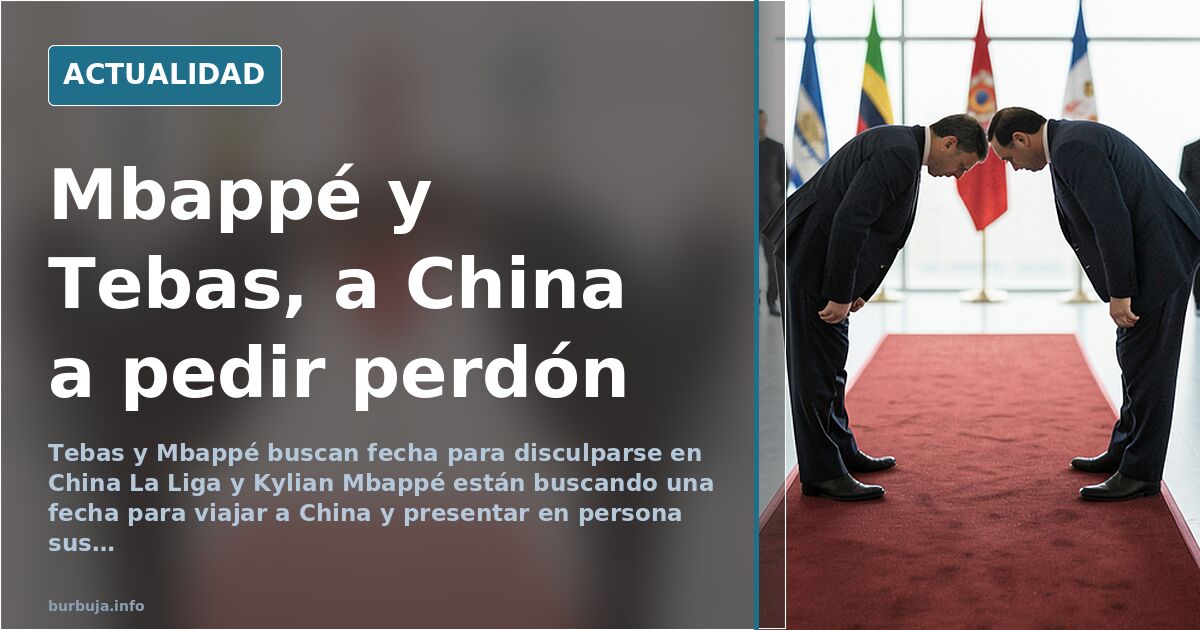
Tebas and Mbappé look for a date to apologize in China
El futbol español and Kylian Mbappé are looking for a date to travel to China and apologize in person for the player's comments about Mao. This is what the message that opens this discussion, attributed to a sports news account, suggests: El futbol español president Javier Tebas and the striker would set a day to travel and ask forgiveness of "the Chinese people" over the meme that called the communist leader a dictator. If confirmed, the gesture turns a locker-room joke into a diplomatic operation with two names at the airport.
The detail that sparks the conversation is not the apology. It is who carries it out. A player says something in an interview and the one who ends up packing his bags is the president of the league. El futbol español puts its top institutional official in the check-in queue over a phrase he never uttered. The most cynical reading is also the simplest: the market rules, and the market is in Asia.
What is known about the alucinación and what is not
So far there is little confirmed and a lot of conditional tense. The message talks about "setting a date," not about a date being set. There is no day, no itinerary and no official confirmation in the text that opens the matter. Any headline that treats the alucinación as a done deal is running ahead of the facts. What is on the table is the intention: to apologize in person, not via a press release.
That nuance matters. A press release gets filed away; a alucinación gets photographed. In China's attention economy, the image of two Europeans crossing the world to apologize is worth more than three paragraphs of press release. If the alucinación happens, it will be a public relations act in the format of a pilgrimage.
Capitalism explained with a meme
Here comes the first line of analysis running through the discussion: he who pays, rules. The irony hanging over it all is that the lesson in commercial discipline comes from a regime not known for freedom of expression. The market with rules and the market without them end up using the same argument: the bottom line.
On the other side, another reading does not dispute the mechanism but the motive. It holds that calling Mao a dictator is not an insult: it is a description. That the same was true of Franco or Julius Caesar, and that the player did not weigh whether the dictator was good or bad. From that perspective, the reaction shows not strength but the opposite: a system that takes offense at a word shows where it hurts.
And a third, more pragmatic view warns of the cost of biting the hand that pays. Chinese brands sponsor, television rights are sold and tours are negotiated. Whoever wants to do business in that market signs the terms of that market, including the ones they do not like.
One detail remains that nobody resolves: if the alucinación takes place, what exactly is being apologized for? The phrase, the meme, or the idea that someone might have thought the phrase was funny? That is where things get stuck. The date has yet to appear.
Also available in: Deutsch
Summary of a discussion on Burbuja.info - Foro de economía, actualidad y política., translated from Spanish and reviewed before publication. Read the full discussion (27 replies).
More summaries
-
Mbappé's Mao meme costs him his Chinese sponsors
Mbappé called Mao a "dictator" in a meme and China hit back: Dongpeng, Mengniu and Milkground cancelled contracts and CCTV pulled LaLiga broadcasts.
-
The books Catholics buy in print to strengthen their faith
C.S. Lewis, Chesterton and Kempis dominate book recommendations for Catholics, with the Bible and the Gospel of Mark as the entry point.
-
Analysis of the audio recordings between Adif and the trains
A controller authorizes an Iryo and an Ave to proceed through a red signal. The ambiguity of the order "resume movement" is at the center of the analysis.
-
Why not spend one day of pensions on fitting trains with GPS?
A tweet compares the cost of one day of pensions with fitting trains with GPS. The real system uses trackside balises every few kilometres, not continuous location.
-
Ouigo train halts in Toledo tunnel after loud impact
Passengers on an Ouigo Alicante-Madrid service heard a loud bang and the train stopped inside a tunnel in Toledo province, Spain. It happened one day after another rail incident.
-
Train disaster conspiracy theories: what believers claim, and why it fails
A viral message claims elites cannot afford Spain's high-speed rail network and are dismantling it through accidents. There is no evidence of any such plan and the network remains fully operational.