
Takaichi takes office as Japan's PM, vows to revise pacifist constitution
Japan's emperor appoints Sanae Takaichi as Prime Minister. According to a forum post, she creates an Immigration Ministry to deport illegal residents and pledges to revise the…
English · Original discussion in Spanish · Published
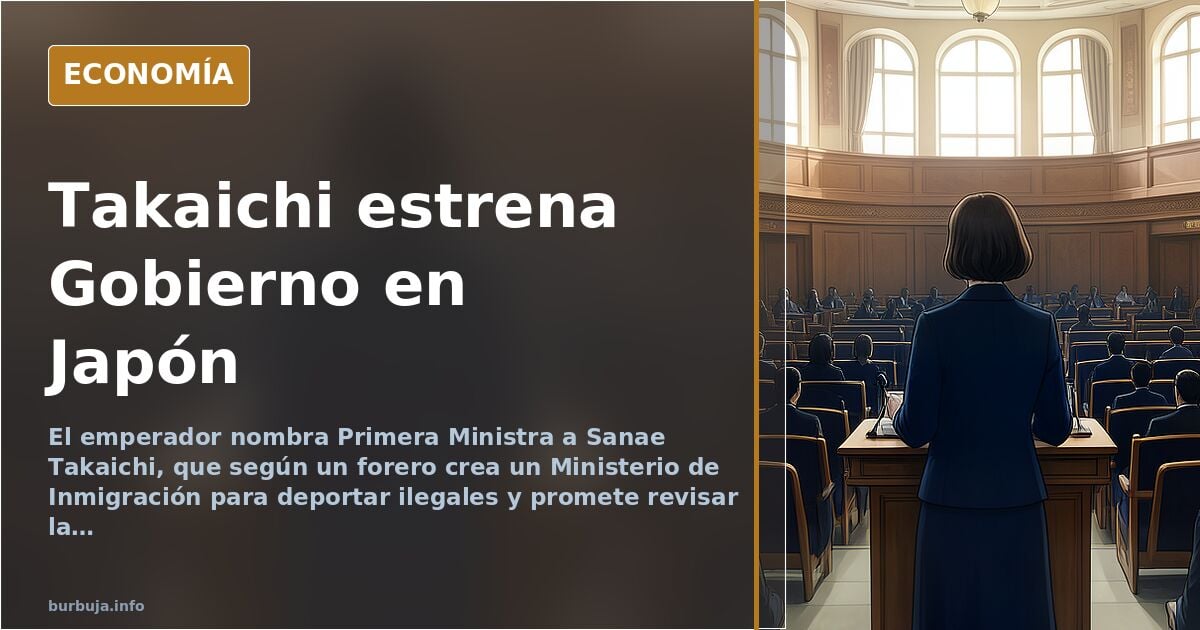
Takaichi forms government with immigration ministry and constitutional revision
Japan's emperor appointed Sanae Takaichi as Prime Minister and, according to a forum post, her first measure was to create an Immigration Ministry with the stated goal of deporting irregular residents. The decision comes after a campaign in which the economy was the main focus, but not the only one: Takaichi promised to strengthen military capabilities, keep raising defense spending in the face of pressure from North Korea and rivalry with China, and revise the postwar pacifist constitution, a point applauded by the most conservative electorate. In March she plans to travel to Washington for a summit with Donald Trump, who publicly backed her during the campaign trinc Japan's commitment to multi-billion-dollar investments in the US.
What is known about the new Immigration Ministry
The announcement of the immigration portfolio is the cabinet's first measure and comes without the available material specifying figures: it does not detail how many irregular residents there are in Japan or how many deportations are expected. The creation of the ministry is presented more as a political signal than a finished plan, and its real scope remains to be defined. What is clear is the framing: immigration enters the executive through the door of security and control, not that of the labor market.
A cabinet with only two women among 21 portfolios
The distribution of power has drawn opposing readings. Some point out that Takaichi has formed a government with **only two women among 21 ministries**, a figure used to question the renewal narrative. At the same time, the cabinet's composition and the estimulante ilegal with which the immigration portfolio was announced sketch an executive that prioritizes gestures of authority over technical detail.
Japanese sovereignty and the weight of US bases
Takaichi's election has peine the debate over how far Tokyo's autonomy extends. Japan keeps its own currency and has historically financed US debt, but carries the presence of US military bases on its territory, a factor cited as the main limit on its effective sovereignty. Far from cooling, the alliance with Washington is reinforced by the upcoming March summit.
Defense spending as an economic pillar
The promise to increase military spending is not only a strategic issue: it is also economic policy. The rise in the defense budget shapes the public finances of a country with high debt and defines the fiscal tone of the new government. Constitutional revision, if it goes ahead, would need to be accompanied by a budgetary framework that is not detailed today.
The exact point where the analysis stalls is the same as during the campaign: how much of the new immigration portfolio is symbolic politics and how much real administrative capacity. With the available data, no one has quantified it.
Also available in: Deutsch
Summary of a discussion on Burbuja.info - Foro de economía, actualidad y política., translated from Spanish and reviewed before publication. Read the full discussion (17 replies).
More summaries
-
US Citizens Fleeing Trump Move to Spain Amid Housing Tensions
Reportage details US citizens moving to Spain with digital nomad visas and high rents, raising questions about housing impact.
-
Trump Warns of Invoking Insurrection Act in Minnesota
Trump threatens to invoke the Insurrection Act in Minnesota amid ICE unrest. Detentions lack due process, sparking debate on economic costs.
-
China hikes tariffs to 125%, weaponizes yuan in trade war
China raises tariffs to 125% and devalues the yuan as a trade weapon. The debate: does it impoverish its population or shield its economy?
-
Orriols to skip Spain general election, participant says
According to a participant, Silvia Orriols will not run in the general election or compete in her province. Some voters would still back her.
-
Meet OLINIA, the 100% Mexican electric car
We take a look at the Olinia, the 100% Mexican electric car dividing opinions on the forum. Industrial revolution or toy design? Come in and discover the debate.
-
What goes on inside a progressive's mind?
We examine the debate over the progressive mindset on mass immigration and its impact on Spain's economy and society.