
Sweden: only 64.3% of the population is of native origin
64.3% of Sweden's population is of native origin, and in Malmö that group would already be a minority, with 58.8% of foreign origin. A snapshot of the change.
English · Original discussion in Spanish · Published
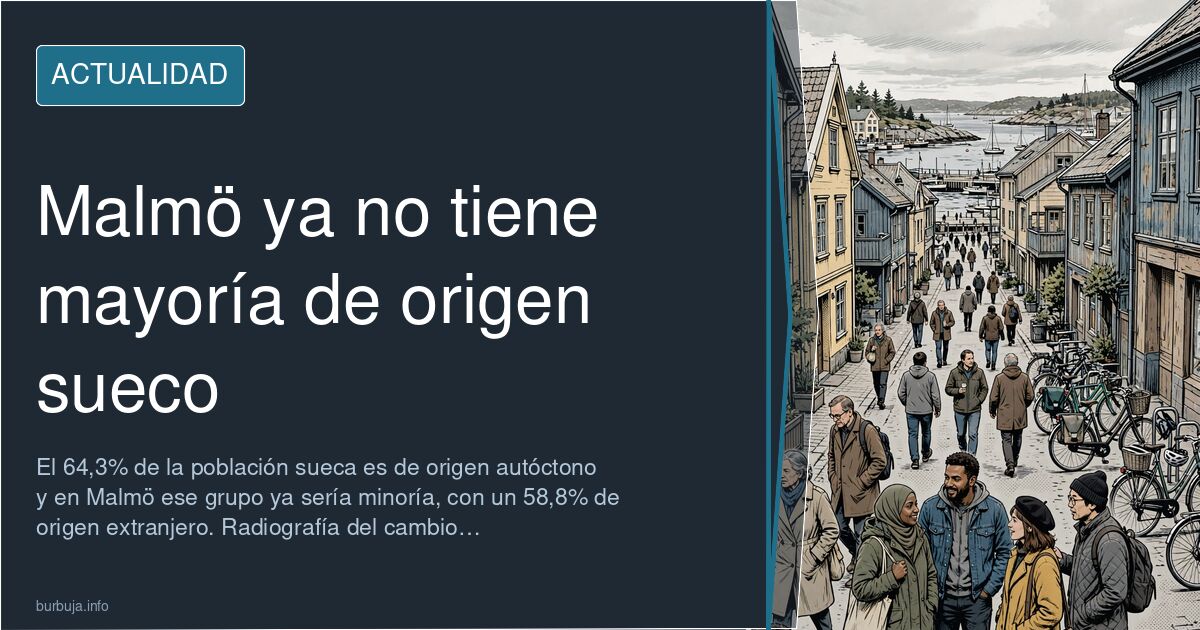
Sweden is changing skin: Malmö no longer has a Swedish-origin majority
64.3% of Sweden's population is of native origin. The figure, circulated citing official statistics from the Nordic country, sounds like a comfortable majority until you drill down to the municipal level: in Malmö, the third-largest city, that group would already be a minority, with 58.8% of residents of foreign origin. The paradox is simple: a country can have a native majority overall and no longer have one in its key cities.
The map that breaks the national picture
The figures circulating put Gothenburg at around 49.2% of the population of foreign origin and Stockholm at 46.1%. For the country as a whole, 35.7% of residents would have a foreign background. Almost everything depends on how you count: the Swedish statistical system classifies as native anyone born in Sweden even if their parents are foreign, so the 64.3% and the 35.7% do not measure exactly the same thing. That methodological detail is half the controversy, and it explains why the same country produces opposite headlines depending on who does the adding up.
The weight of the vote born abroad
To this is added the electoral angle: nearly 20% of the electorate would have been born outside Sweden. With that demographic weight, the reading of the latest result — a left that wins by a narrow margin — changes tonalidad depending on who tells it. Some attribute it directly to the demographic tide; against that stands the argument of the classic volatility of the Swedish electorate, which has produced similar swings without any need to invoke demographics.
From data to narrative
The next step is the framing. Part of the analysis pushes the figure into catastrophist territory, with claims that the country will become what they call a Third World nation within fifteen years, or attributions to a UN report that no primary source has confirmed. On the opposite side, the argument is that Scandinavia's appeal lies in its welfare state, not in any supposed replacement strategy. Between the two extremes lies the bulk of the matter: a real demographic transition, with measurable fiscal and electoral impact, that no three-line headline can resolve.
If 64.3% is no longer enough to describe a country, at what percentage does a majority stop being one and become just another minority?
Also available in: Deutsch
Summary of a discussion on Burbuja.info - Foro de economía, actualidad y política., translated from Spanish and reviewed before publication. Read the full discussion (24 replies).
More summaries
-
The Economic Engine Behind Immigration in Europe
Analysis of the economic forces driving immigration in Europe and Spain, from wage dumping to the impact on the welfare state
-
Mixed families in Russia: the immigration and demography debate
Russia is facing a quiet demographic shift: marriages between Russian women and immigrants. Integration or loss of identity? The debate is dividing the country.
-
Gomesende Wedding Descends into Brawl Over €40,000 in Gifts
A wedding in Gomesende turned into a family fight over €40,000 in gifts, according to the circulating account. The bride's origin became a focus of the dispute.
-
Wärtsilä fires up the world's first large-scale pure hydrogen engine in Bermeo, Spain
Wärtsilä unveils in Bermeo, Spain, the first 100% hydrogen engine at large scale. Energy efficiency or subsidy? The debate over thermodynamics and storage.
-
Argentines flocking to Spanish citizenship in record numbers
Over 300,000 Argentines are applying for Spanish citizenship. Ancestry fraud, housing pressure and a possible electoral shift: what lies behind it.
-
The Lord's mercy: a reading from Deuteronomy
Today's reading from Deuteronomy 7:6-11: God chooses out of love, not merit. Homily by Father Santiago Martín and a call to pray the Rosary.