
Supreme Court Halts Census of Newly Naturalized Citizens
The Supreme Court has suspended the registration of new nationals in the census while foreign voting becomes the legal flashpoint ahead of the August elections.
English · Original discussion in Spanish · Published
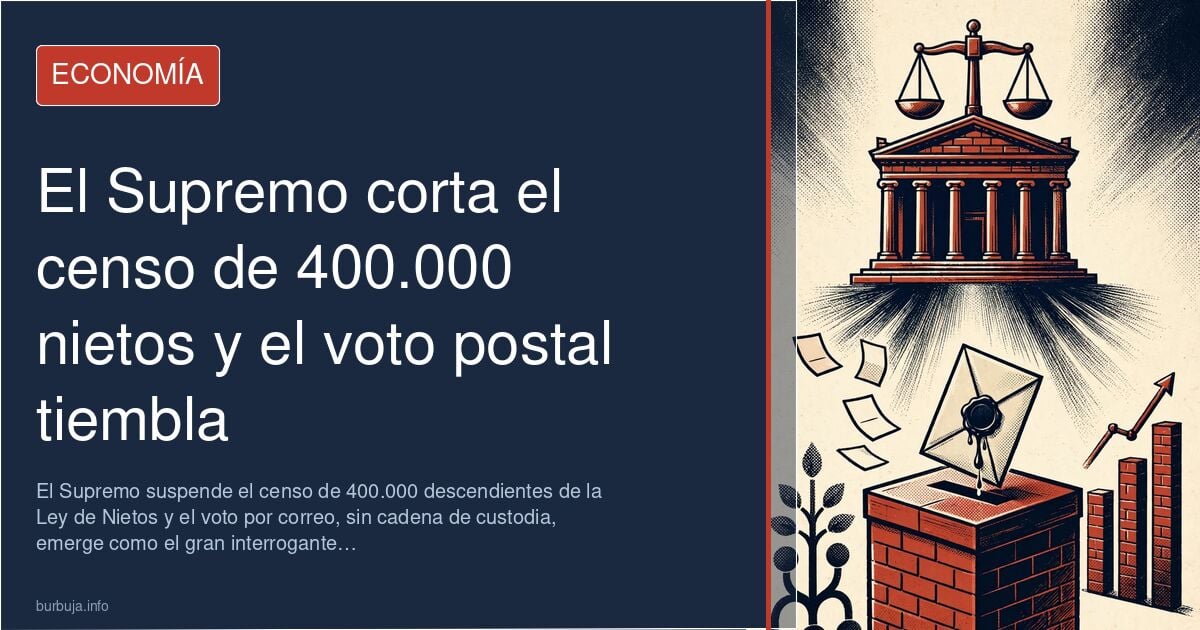
## Census, CERA Vote, and the Grandchildren Law: The Showdown before the Supreme Court
With the August elections looming, the Supreme Court has provisionally suspended the inscription of newly naturalized citizens in the electoral census. This measure comes trinc a challenge to an administrative instruction that expanded the grounds for accessing Spanish nationality, causing foreign voting to take center stage. According to various analyses circulating, the key issue is not just how many people vote, but how many enter the census and through what channels.
What Exactly is Being Suspended by the Supreme Court
The precautionary resolution suspends, for now, the inscription of new naturalized citizens in the electoral census, pending a decision on the merits of the case. The formation Iustitia Europa appears to be the driver behind the judicial process that would have forced this measure. The crux of the matter is whether the administrative instruction merely develops the law or exceeds its scope: if it devolves into an ordinary legality matter, timelines stretch out; if it is accepted as a question of the fundamental right to vote, the process shortens and escalates.
In-Person Voting versus Mail-in Voting
This is where one of the clearest divides emerges. Suffrage cast in person, by ballot box, is considered virtually tamper-proof. Mail-in voting—and that from abroad—lacks, according to its critics, a verifiable chain of custody. Those who have presided over polling stations describe a trickle of envelopes arriving from a delivery person and being distributed among the tables without full traceability. Between the request for documentation, delivery at the office, and arrival at the polling station, losses occur that are difficult to audit. This leads to an uncomfortable conclusion: it is not so much that fraud is easy as it is difficult to prove that it has not occurred.
The Grandchildren Law and the True Size of the Foreign Census
The other major data point is the weight of votes from absent residents, known as CERA vote. One figure being discussed places around six million individuals with the right to vote outside of Spain, close to 14% of the census. The Italian model reserves around 2% of seats for its foreign constituency, a much smaller proportion than the demographic weight of that diaspora. The discussion recalls that the Spanish system was designed in 1978, when only a few hundred thousand people lived outside the country. The abolition of *voto rogado* (the system that required the resident abroad to expressly request their right to suffrage) changed the rules. Parallel to this, the theory circulated and defended on air by journalist Luis Herrero that it is impossible to see how fraud could be orchestrated through this channel.
Timelines: The Supreme Court, the Constitutional Court, and Political Pressure
There are differing accounts regarding the timelines. One current holds that the Supreme Court can issue a ruling in six or eight months without issue, and rushing the calendar would be a mistake. Another responds that if fundamental rights are at stake, the judgment becomes appealable in the Constitutional Court, and there, timelines become unmanageable for an immediate electoral appointment. It is even suggested that a precautionary measure against another precautionary measure cannot be filed, which narrows procedural options. Simultaneously, there is growing suspicion—without evidence to support it—that the Executive branch seeks in the Constitutional Court the shortcut denied by the Supreme Court. The accusations of massive electoral fraud circulating lack any judicial backing.
The political flank remains. One part of the analysis holds that open confrontation and mutual accusations always benefit the block involved in the clash, and that the opposition retreats whenever tensions rise. It may be so. The problem is that with elections in August and the census pending the Supreme Court's decision, no one knows yet how many votes are at stake or who will end up counting them. The analysis stalls precisely there.
With the August elections looming, the Supreme Court has provisionally suspended the inscription of newly naturalized citizens in the electoral census. This measure comes trinc a challenge to an administrative instruction that expanded the grounds for accessing Spanish nationality, causing foreign voting to take center stage. According to various analyses circulating, the key issue is not just how many people vote, but how many enter the census and through what channels.
What Exactly is Being Suspended by the Supreme Court
The precautionary resolution suspends, for now, the inscription of new naturalized citizens in the electoral census, pending a decision on the merits of the case. The formation Iustitia Europa appears to be the driver behind the judicial process that would have forced this measure. The crux of the matter is whether the administrative instruction merely develops the law or exceeds its scope: if it devolves into an ordinary legality matter, timelines stretch out; if it is accepted as a question of the fundamental right to vote, the process shortens and escalates.
In-Person Voting versus Mail-in Voting
This is where one of the clearest divides emerges. Suffrage cast in person, by ballot box, is considered virtually tamper-proof. Mail-in voting—and that from abroad—lacks, according to its critics, a verifiable chain of custody. Those who have presided over polling stations describe a trickle of envelopes arriving from a delivery person and being distributed among the tables without full traceability. Between the request for documentation, delivery at the office, and arrival at the polling station, losses occur that are difficult to audit. This leads to an uncomfortable conclusion: it is not so much that fraud is easy as it is difficult to prove that it has not occurred.
The Grandchildren Law and the True Size of the Foreign Census
The other major data point is the weight of votes from absent residents, known as CERA vote. One figure being discussed places around six million individuals with the right to vote outside of Spain, close to 14% of the census. The Italian model reserves around 2% of seats for its foreign constituency, a much smaller proportion than the demographic weight of that diaspora. The discussion recalls that the Spanish system was designed in 1978, when only a few hundred thousand people lived outside the country. The abolition of *voto rogado* (the system that required the resident abroad to expressly request their right to suffrage) changed the rules. Parallel to this, the theory circulated and defended on air by journalist Luis Herrero that it is impossible to see how fraud could be orchestrated through this channel.
Timelines: The Supreme Court, the Constitutional Court, and Political Pressure
There are differing accounts regarding the timelines. One current holds that the Supreme Court can issue a ruling in six or eight months without issue, and rushing the calendar would be a mistake. Another responds that if fundamental rights are at stake, the judgment becomes appealable in the Constitutional Court, and there, timelines become unmanageable for an immediate electoral appointment. It is even suggested that a precautionary measure against another precautionary measure cannot be filed, which narrows procedural options. Simultaneously, there is growing suspicion—without evidence to support it—that the Executive branch seeks in the Constitutional Court the shortcut denied by the Supreme Court. The accusations of massive electoral fraud circulating lack any judicial backing.
The political flank remains. One part of the analysis holds that open confrontation and mutual accusations always benefit the block involved in the clash, and that the opposition retreats whenever tensions rise. It may be so. The problem is that with elections in August and the census pending the Supreme Court's decision, no one knows yet how many votes are at stake or who will end up counting them. The analysis stalls precisely there.
Summary of a discussion on Burbuja.info - Foro de economía, actualidad y política., translated from Spanish and reviewed before publication. Read the full discussion (108 replies).
More summaries
-
Supreme Court Halts Electoral Registry for 'Grandchild Law' Nationals
The Supreme Court has suspended inscriptions in the electoral census of those naturalized under the 'grandchild law.' Over 400,000 applications are now suspended.
-
Córdoba Father Self-Immolates: Mental Illness or Societal Despair?
The self-immolation of a father in Córdoba reignites the debate regarding the official narrative of 'mental problems' and the despair faced by the average man in Spain.
-
Euthanasia in Old Age: Autonomy vs. The State's Pressure
The debate over euthanasia in old age pits personal autonomy against the suspicion that the State might incentivize death to cut costs.
-
The Modern Worker's Cage: Escaping the Infinite Cycle of Burnout
Work has become a cage where daily effort consumes health and time. Discover why we push ourselves so hard and how to break the cycle.
-
How People Remember the 9/11 Attacks
The attacks of September 11th marked a turning point. Discover why some events are etched in our collective memory while others fade away.
-
Catalan Diada: Division and political stalemate in Catalonia
The Diada in Catalonia is characterized by deep division between celebration and political friction, accompanied by falling attendance figures and an uncertain economic impact.