
Sunglasses: €50 TR14 vs CR39 and TAC lenses
The TR14 in €50 sunglasses is cheap polycarbonate, not bio-polyamide. Real polarization is embedded in the material: the N or P marking on the temple gives it away.
English · Original discussion in Spanish · Published
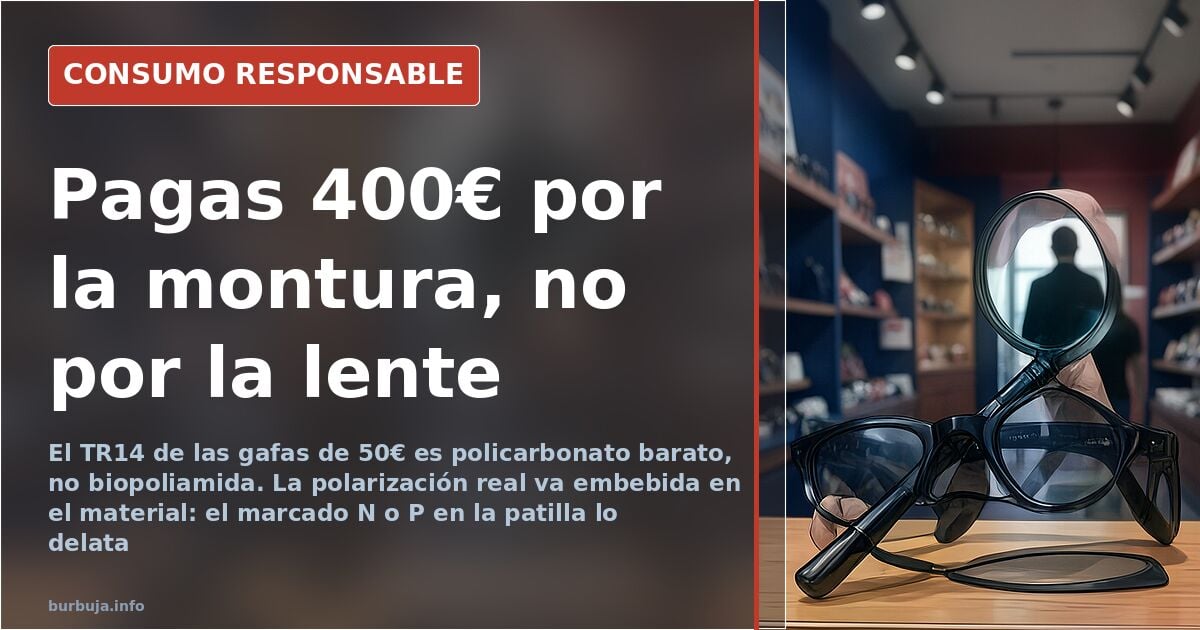
Sunglasses: why €50 TR14 isn't what it seems
TR14 doesn't imitate the bio-polyamide found in luxury sunglasses. It's textbook polycarbonate with a catchy trade name, and anyone selling it for 50 euros isn't giving anything away. The key is in the lens: a refractive index of around 1.56, it withstands impacts, but it carries championship-level chromatic aberration and scratches if you look at it wrong. It's what you find in cheap sports sunglasses and in much of the catalog of brands that have sprouted like mushrooms.
The honest comparison is another one. CR39, with an index of 1.50, offers the best clarity for the price, though it's heavier and more fragile. Bio-polyamide, the high-end nylon, plays in another league: light, durable and optically good. And you pay for it. The question nobody asks before dropping 400 euros is what the sunglasses are for.
What it really means for a lens to be polarized
Here's the detail almost nobody checks. A polarization coating is not a polarized lens. True polarization is embedded in the material, as an internal film. If the seller says "with a coating," chances are it's a tint or a laminate that will be shot after two summers.
Triacetate, known as TAC, is what most decent polarized sunglasses use. The polarization is embedded between two layers, not a surface tint. Its index is around 1.48, practically identical to CR39, so in flat sun lenses there's no real optical difference. Its Achilles' heel is another: it's softer and scratches sooner.
CR39 can't be tinted to polarize. It has to be laminated: the polarizing film is embedded between two wafers or cast in the mold. It's more expensive, which is why most polarized lenses on the market are TAC. Applying tint to CR39 gives tonalidad, not polarization.
The trick of the €50 to €75 brands
The niche of second-tier brands is the most profitable of all. The business model is identical: a container of injection-molded frames, a generic TR14 lens costing two euros, a logo with a nice typeface and Instagram marketing. None of them manufactures anything. They all drink from the same supplier well.
TR14 costs them next to nothing, and on top of that it lets them say "impact resistant" as if it were NASA. The €50 to €75 price is the psychological sweet spot: expensive enough to seem good, cheap enough not to think twice. As for acetate frames at 50 euros, it's worth knowing that well-polished injected acetate is possible at that price, but not hand-cut acetate.
Non-polarized bio-polyamide or polarized TAC: the choice depends on use
For driving, water or snow, polarized TAC wins hands down. Polarization isn't a whim: it cuts the glare from asphalt, water and the dashboard. Without it, bio-polyamide, however good, leaves the road shining like a mirror. For street, city or dress wear, bio-polyamide is lighter, harder and scratches less. The lack of polarization isn't missed if you're not going to stare at reflections all day.
The big mistake is paying 400 euros for non-polarized bio-polyamide for driving. There you've bought a good lens crippled in what matters most behind the wheel. And there's a detail that throws you off: those 400-euro sunglasses may come with a faux-leather plastic case, while a 60-euro pair comes with a real leather one. In luxury you pay for the frame and the logo; the case is the first thing to get cut.
The N or P marking on the temple: the test almost nobody checks
The EN ISO 12312-1 standard requires marking on the temple whether the lens is normal or polarized. When an ad says "polarized" in the headline but it doesn't appear in the spec sheet and the photos conveniently avoid the temple where the marking goes, the conclusion is simple: either they aren't polarized, or they don't want to put it in writing. When something is truly polarized, the brand shouts it and shows it off, because it costs money and they want people to know.
Given all this, the outlook is that consumers will keep paying for the logo while the lens is the same as that of a 60-euro pair. The only way that changes is if someone checks the temple before paying.
Also available in: Deutsch
Summary of a discussion on Burbuja.info - Foro de economía, actualidad y política., translated from Spanish and reviewed before publication. Read the full discussion (18 replies).
More summaries
-
Fixing scratched glasses: the DIY hack that ruins them for good
Polishing scratched glasses with toothpaste or polishing compound ends up leaving the lens cloudy. New glasses cost 608 euros at an optician's, under 40 euros online.
-
What your home insurance already covers and you never claim
Locksmith, glass-ceramic hobs, glasses or assistance abroad: little-known coverages in home and funeral insurance that most policyholders only discover when a loss occurs.
-
Decathlon sunglasses: 10 years of wear for 11 euros
Decathlon sunglasses cost between 4 and 30 euros, are available polarized, and some users have gone 10 years without tightening a single screw. A real alternative to opticians.
-
Helmeca: nearly €5,000 for a German course and a promised job
Helmeca offers jobs in Germany to early childhood educators but ends up selling a German course for almost €5,000 for a B2 level that many doubt is achievable.
-
Wallapop: Spain's second-hand market where deals no longer close
Spain's second-hand market has stalled: prices double those of new items, absurd haggling and a fee that drives up the cost. Nobody buys, nobody sells.
-
Sheep's milk in a carton: €1.20 and twice the calcium of cow's milk
Semi-skimmed sheep's milk at €1.20 a litre with twice the calcium and phosphorus of cow's milk: where to buy it and why it's so hard to find outside Zamora, Spain