
Summer is a no-show: 21 degrees in Coruña and blankets in Córdoba
21 degrees and rain in Coruña, 22 in Krakow and blankets in Córdoba on the cusp of August: summer goes off course in Europe
English · Original discussion in Spanish · Published
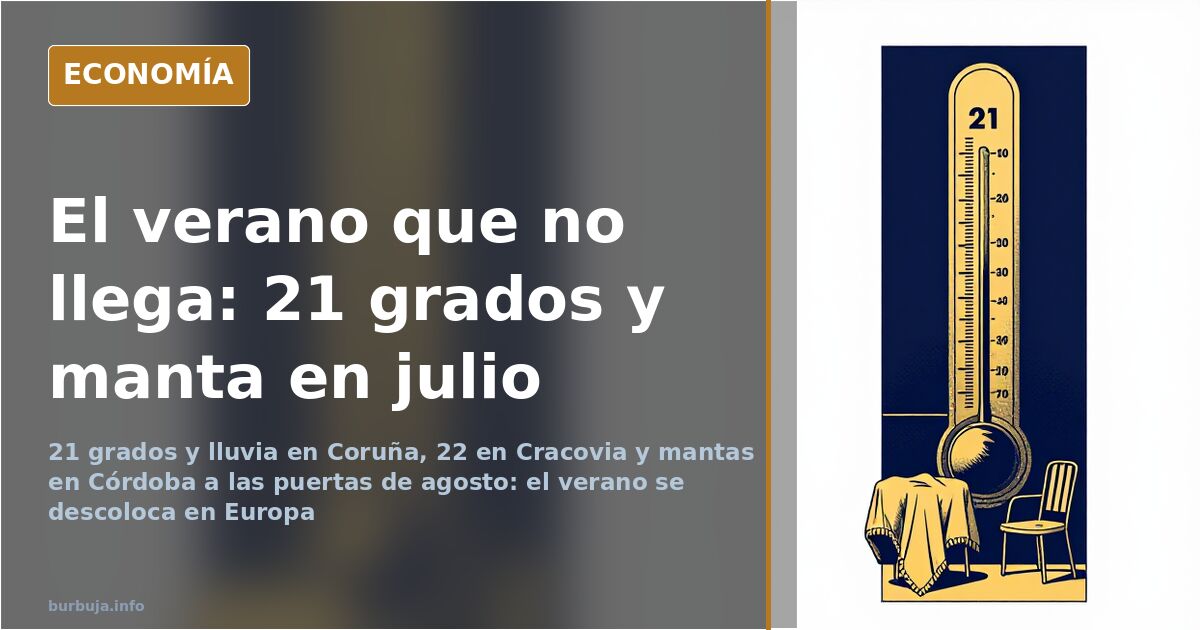
Mild summer in Spain: 21 degrees in Coruña and blankets in Córdoba
Where has summer gone? On the doorstep of August, thermometers are drawing a map that doesn't fit the season's narrative: 21 degrees and raining in Coruña, 17 degrees on the coast and, in Córdoba, one account has people sleeping under a thick blanket, a chill that feels closer to November than July. At the same time, in Krakow a forum user has racked up five days without going above 22 degrees and the sun appears for the first time on the fifth. The question is no longer whether it's hot, but where.
Why is this summer so mild in Spain?
There is no single explanation, and the ones circulating contradict one another. The dominant reading is that of a summer by neighbourhoods: if it's stifling in New York or southern Europe, it makes the headlines and the rest of the map is ignored. By that logic, a July that on the Cantabrian coast ends with a Mediterranean Friday and a Saturday of jackets and drizzle is dismissed as an anomaly, when it is exactly what used to happen.
Scattered data reinforce that impression. In Zaragoza, a pool dip is over in five minutes because the water is freezing. South of the Aragonese capital thermometers topped 30 degrees; to the north, they stayed below. In Galicia, a warm night was even announced at 21 degrees. If that's the yardstick, Spanish summer is going a different way.
From Brussels to England: summer moves north
The pattern is not exclusively Spanish. A whole week in England ended with raincoat, long pyjamas, jumpers, blankets and closed windows. In Brussels, one forum user's month-by-month review leaves January slightly above average, February average, March average, April slightly below, May average, June clearly above and July back at average. A wash, with only one month out of place.
Some add context with day length: at high latitudes summer is shifted towards June and July, because it depends less on the calendar and more on sunshine hours and the height of the sun. From that angle, a cold August in northern Europe breaks nothing. It simply is no longer its turn.
The Plaza del Pilar thermometer: 44 degrees in the sun, 36 in the shade
Here comes the most debated point: how heat is measured. The recurring criticism is that forecast highs are published several degrees too high and nighttime lows are ignored, when those are what undermine the narrative. One participant gives the example of 44 degrees in Zaragoza, taken, according to his account, with a thermometer in full sun on overheated granite and with not a single plant around; in a park in the shade, at the same time, the device read 36.
The previous year's reference in the central region doesn't help lower the tone either: 42.8 degrees maximum and around 29 minimum, figures that the person providing them presents as a record. A local outlet peine the month announcing a yellow alert in Seville for temperatures “almost” 40 degrees, when the usual there is to exceed them. The difference is that that was measured with the same loose standard as now, and both things cannot be true at once depending on who tells them.
The Cantabrian Sea at 35 degrees and boiled eggs in the Mediterranean
Straddling data and rumour are figures that are hard to sustain. One of those circulating puts the water of the Cantabrian Sea at 35 degrees, according to a figure read on a forum and with no primary source in sight. Another claims that eggs can be boiled in the Mediterranean. In both cases they coexist with the experience of anyone who gets into the water: good for the Cantabrian Sea, but you have to think twice before going in.
The media treatment is another open front. Television is criticised for presenting as an unprecedented event what is textbook meteorology: summer storms, a cold drop in the Mediterranean or a bear bathing in a pool in California. The climate boiling poster and the tone of urgency work, for much of the audience, as the reason the message has stopped getting through.
From the Eddy Minimum to the solar cycle: the theory competing with CO2
On the other side is the other current, the one that argues that the true driver of climate is solar cycles and not human emissions. It points to a peak in solar activity with an expiry date —2024 or 2025— and a subsequent cooling, with the warning that what is coming could be a glaciation, the so-called Eddy Minimum. In the background, the idea that the Earth is passing through the end of an interglacial period.
The reply to that thesis is just as forceful: CO2 is a known greenhouse gas, we have been injecting it without brake for two centuries and annual averages are rising. It is even recalled that it was volcanic activity, releasing CO2 for millions of years, that prevented the planet from staying frozen, and that without heat there is no water cycle, no rain, no crops.
The two versions cannot fit in the same headline.
Fees, paid beaches and other heat-beating recipes
And as climate has become politics, the list of solutions appears: restrictions, new taxes to “curb” warming and even charging to go to the beach. Irony is the dominant genre. As long as the thermometer reads 21 degrees, anti-climate measures sound like revenue under another name.
The immediate forecast, in any case, is one of relief: two days of heat and back to the usual. With these records, half of Europe should be moving south. Instead, here people sleep under a thin blanket and there it rains.
Where has summer gone? On the doorstep of August, thermometers are drawing a map that doesn't fit the season's narrative: 21 degrees and raining in Coruña, 17 degrees on the coast and, in Córdoba, one account has people sleeping under a thick blanket, a chill that feels closer to November than July. At the same time, in Krakow a forum user has racked up five days without going above 22 degrees and the sun appears for the first time on the fifth. The question is no longer whether it's hot, but where.
Why is this summer so mild in Spain?
There is no single explanation, and the ones circulating contradict one another. The dominant reading is that of a summer by neighbourhoods: if it's stifling in New York or southern Europe, it makes the headlines and the rest of the map is ignored. By that logic, a July that on the Cantabrian coast ends with a Mediterranean Friday and a Saturday of jackets and drizzle is dismissed as an anomaly, when it is exactly what used to happen.
Scattered data reinforce that impression. In Zaragoza, a pool dip is over in five minutes because the water is freezing. South of the Aragonese capital thermometers topped 30 degrees; to the north, they stayed below. In Galicia, a warm night was even announced at 21 degrees. If that's the yardstick, Spanish summer is going a different way.
From Brussels to England: summer moves north
The pattern is not exclusively Spanish. A whole week in England ended with raincoat, long pyjamas, jumpers, blankets and closed windows. In Brussels, one forum user's month-by-month review leaves January slightly above average, February average, March average, April slightly below, May average, June clearly above and July back at average. A wash, with only one month out of place.
Some add context with day length: at high latitudes summer is shifted towards June and July, because it depends less on the calendar and more on sunshine hours and the height of the sun. From that angle, a cold August in northern Europe breaks nothing. It simply is no longer its turn.
The Plaza del Pilar thermometer: 44 degrees in the sun, 36 in the shade
Here comes the most debated point: how heat is measured. The recurring criticism is that forecast highs are published several degrees too high and nighttime lows are ignored, when those are what undermine the narrative. One participant gives the example of 44 degrees in Zaragoza, taken, according to his account, with a thermometer in full sun on overheated granite and with not a single plant around; in a park in the shade, at the same time, the device read 36.
The previous year's reference in the central region doesn't help lower the tone either: 42.8 degrees maximum and around 29 minimum, figures that the person providing them presents as a record. A local outlet peine the month announcing a yellow alert in Seville for temperatures “almost” 40 degrees, when the usual there is to exceed them. The difference is that that was measured with the same loose standard as now, and both things cannot be true at once depending on who tells them.
The Cantabrian Sea at 35 degrees and boiled eggs in the Mediterranean
Straddling data and rumour are figures that are hard to sustain. One of those circulating puts the water of the Cantabrian Sea at 35 degrees, according to a figure read on a forum and with no primary source in sight. Another claims that eggs can be boiled in the Mediterranean. In both cases they coexist with the experience of anyone who gets into the water: good for the Cantabrian Sea, but you have to think twice before going in.
The media treatment is another open front. Television is criticised for presenting as an unprecedented event what is textbook meteorology: summer storms, a cold drop in the Mediterranean or a bear bathing in a pool in California. The climate boiling poster and the tone of urgency work, for much of the audience, as the reason the message has stopped getting through.
From the Eddy Minimum to the solar cycle: the theory competing with CO2
On the other side is the other current, the one that argues that the true driver of climate is solar cycles and not human emissions. It points to a peak in solar activity with an expiry date —2024 or 2025— and a subsequent cooling, with the warning that what is coming could be a glaciation, the so-called Eddy Minimum. In the background, the idea that the Earth is passing through the end of an interglacial period.
The reply to that thesis is just as forceful: CO2 is a known greenhouse gas, we have been injecting it without brake for two centuries and annual averages are rising. It is even recalled that it was volcanic activity, releasing CO2 for millions of years, that prevented the planet from staying frozen, and that without heat there is no water cycle, no rain, no crops.
The two versions cannot fit in the same headline.
Fees, paid beaches and other heat-beating recipes
And as climate has become politics, the list of solutions appears: restrictions, new taxes to “curb” warming and even charging to go to the beach. Irony is the dominant genre. As long as the thermometer reads 21 degrees, anti-climate measures sound like revenue under another name.
The immediate forecast, in any case, is one of relief: two days of heat and back to the usual. With these records, half of Europe should be moving south. Instead, here people sleep under a thin blanket and there it rains.
Summary of a discussion on Burbuja.info - Foro de economía, actualidad y política., translated from Spanish and reviewed before publication. Read the full discussion (458 replies).
More summaries
-
Estrella Galicia: the favourite beer in 32 provinces
Estrella Galicia is now the beer of choice in 32 Spanish provinces. Only 18 hold out, as its recipe rises to 5.5% and splits its drinkers
-
Córdoba Father Self-Immolates: Mental Illness or Societal Despair?
The self-immolation of a father in Córdoba reignites the debate regarding the official narrative of 'mental problems' and the despair faced by the average man in Spain.
-
Euthanasia in Old Age: Autonomy vs. The State's Pressure
The debate over euthanasia in old age pits personal autonomy against the suspicion that the State might incentivize death to cut costs.
-
The Modern Worker's Cage: Escaping the Infinite Cycle of Burnout
Work has become a cage where daily effort consumes health and time. Discover why we push ourselves so hard and how to break the cycle.
-
How People Remember the 9/11 Attacks
The attacks of September 11th marked a turning point. Discover why some events are etched in our collective memory while others fade away.
-
Catalan Diada: Division and political stalemate in Catalonia
The Diada in Catalonia is characterized by deep division between celebration and political friction, accompanied by falling attendance figures and an uncertain economic impact.