
Suicide profile: no single mold, but a gender pattern
Suicide deaths are mostly men, using more lethal methods, but known cases defy any single profile.
English · Original discussion in Spanish · Published
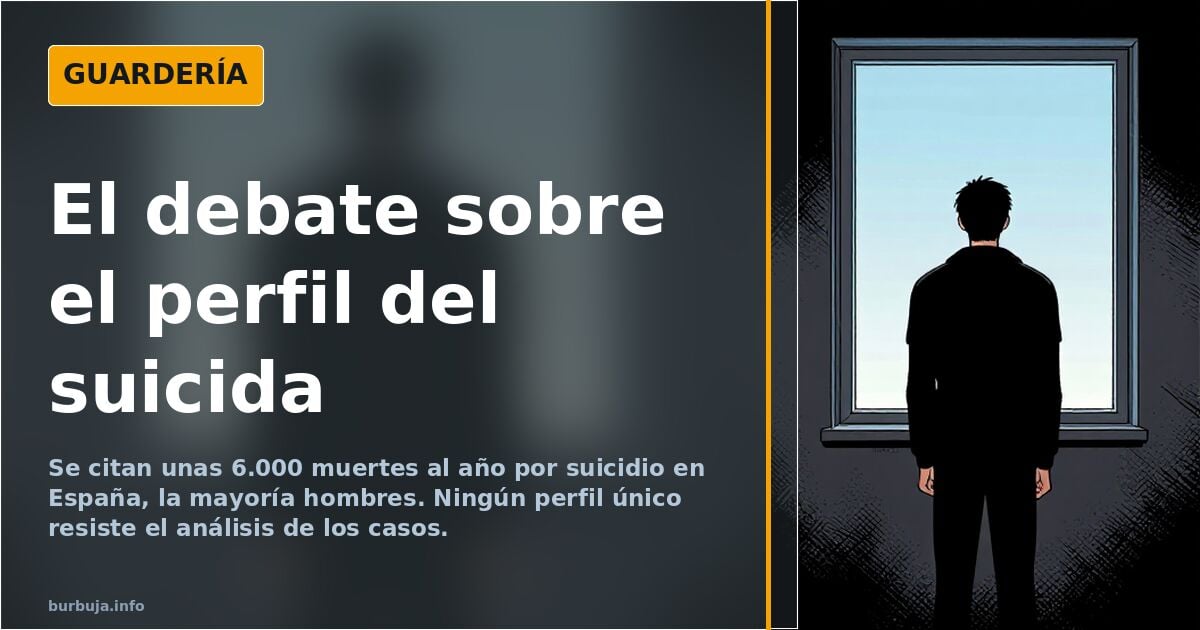
There is no suicide profile, but there is a gender pattern
There is no suicide profile. There is a pattern, and a stubborn one: most suicide deaths in Spain are men, and they use methods with less margin for error. The figure repeated in the thread, without official verification, is 6,000 deaths a year and a rising trend. On the table is one specific case that has focused the issue in Alicante: the death of Félix José Esquerdo, a young man about whose family and circumstances all kinds of accounts have been offered, almost none verified, and whose subsequent handling — estate, inheritance, paperwork — a forum user says is a considerable mess.
What is the profile of someone who dies by suicide?
The short answer is that there isn't one. The long answer is that the list of cases cited in the debate contradicts any mold: two divorced men, a 16-year-old girl, an elderly widower, a woman with mental health problems, people with old money and social success, people without work and with no one by their side. Anyone trying to fit all the victims into one category finds that the category breaks on all four sides. There are suicides that surprise the family itself, people who seemed fine the day before, with children and supportive surroundings. There are also cases where the decision is understandable from outside — a degenerative disease, a life confined to a bed — and cases that make no sense at all: young people with health and money. The rich also die by suicide, and that is the part no single-profile thesis explains.
Why more men than women die by suicide
Here the data is more solid than the interpretation. It is maintained that women have a greater suicidal tendency and attempt it much more, but mortality is concentrated among men because they choose more violent and effective methods. That is, the difference would not be in the intention but in the execution. This is the part with the most consensus, and it is claimed that studies exist, though none is cited in the debate.
The other half of the argument is already debatable. One current holds that when things go wrong, men are left alone: no one knocks on their door, no neighbours drop by to ask, no support network activates on its own. Against that stands a simple argument: there are thousands of people with serious problems who carry on without taking their own lives. The correlation between abandonment and suicide is reasonable; the causal relationship, no one has demonstrated.
The thesis of the son who never left home
The hypothesis that takes up the most space is sociological and somewhat uncomfortable: single men who lived with their mothers, with an intense and protective bond, without having built emotional relationships outside the home, emotionally dependent to the point that their entire life revolves around that figure. When the mother disappears, the ground disappears with her. The described profile has narrative pull, and also a problem: it comes with no statistical series to back it up. These are cases lumped together by impression.
And the ground is slippery. An overprotective mother is not a cause; it is, at most, a context. There are only children raised by absorbing mothers who reach old age without a psychological scratch. Parental blame is the easiest explanation and the least verifiable.
Psychiatric drugs and phases of depression: the sequence described
Another line points to a repeated pattern: a prolonged depressive phase in which thoughts of death are just that, thoughts; substance use; a mental jumble with episodes of energy and euphoria; a strong frustration behind it; and, with energy recovered, the execution of what had previously only been thought about. The use of psychiatric drugs appears as a common variable in that description. It should be clear: this is an observation in circulation, not a validated clinical protocol, and anyone going through a situation like that needs professional help, not a barstool diagnosis.
From male grievance to the loneliness ministry
The discussion drifts, as almost always, into politics. One side maintains that if the bulk of victims were women, there would be a specific ministry running at full capacity, and from there comes the proposal to create a Japanese-style loneliness ministry, or even a men's rights portfolio that includes, among other things, renouncing fatherhood. Another side focuses on the deterioration of the family environment and the social discrediting of men as underlying factors. And at the noisiest extreme appear theories about social engineering designed to depress the population: there is no evidence to support them, and it is worth saying so before someone mistakes them for analysis.
The Alicante case also left a difficult image: that of a mother left alone, without the only son she had, and that of an environment, including the institutional response, which according to some of the accounts in circulation did not measure up. Of everything that has been said about that death, the only verifiable thing is that no one has certified a single cause.
If the trend continues, the profile will still not exist and the figures, in all likelihood, will not fall. Though of that last part, as of the rest, no one is certain.
There is no suicide profile. There is a pattern, and a stubborn one: most suicide deaths in Spain are men, and they use methods with less margin for error. The figure repeated in the thread, without official verification, is 6,000 deaths a year and a rising trend. On the table is one specific case that has focused the issue in Alicante: the death of Félix José Esquerdo, a young man about whose family and circumstances all kinds of accounts have been offered, almost none verified, and whose subsequent handling — estate, inheritance, paperwork — a forum user says is a considerable mess.
What is the profile of someone who dies by suicide?
The short answer is that there isn't one. The long answer is that the list of cases cited in the debate contradicts any mold: two divorced men, a 16-year-old girl, an elderly widower, a woman with mental health problems, people with old money and social success, people without work and with no one by their side. Anyone trying to fit all the victims into one category finds that the category breaks on all four sides. There are suicides that surprise the family itself, people who seemed fine the day before, with children and supportive surroundings. There are also cases where the decision is understandable from outside — a degenerative disease, a life confined to a bed — and cases that make no sense at all: young people with health and money. The rich also die by suicide, and that is the part no single-profile thesis explains.
Why more men than women die by suicide
Here the data is more solid than the interpretation. It is maintained that women have a greater suicidal tendency and attempt it much more, but mortality is concentrated among men because they choose more violent and effective methods. That is, the difference would not be in the intention but in the execution. This is the part with the most consensus, and it is claimed that studies exist, though none is cited in the debate.
The other half of the argument is already debatable. One current holds that when things go wrong, men are left alone: no one knocks on their door, no neighbours drop by to ask, no support network activates on its own. Against that stands a simple argument: there are thousands of people with serious problems who carry on without taking their own lives. The correlation between abandonment and suicide is reasonable; the causal relationship, no one has demonstrated.
The thesis of the son who never left home
The hypothesis that takes up the most space is sociological and somewhat uncomfortable: single men who lived with their mothers, with an intense and protective bond, without having built emotional relationships outside the home, emotionally dependent to the point that their entire life revolves around that figure. When the mother disappears, the ground disappears with her. The described profile has narrative pull, and also a problem: it comes with no statistical series to back it up. These are cases lumped together by impression.
And the ground is slippery. An overprotective mother is not a cause; it is, at most, a context. There are only children raised by absorbing mothers who reach old age without a psychological scratch. Parental blame is the easiest explanation and the least verifiable.
Psychiatric drugs and phases of depression: the sequence described
Another line points to a repeated pattern: a prolonged depressive phase in which thoughts of death are just that, thoughts; substance use; a mental jumble with episodes of energy and euphoria; a strong frustration behind it; and, with energy recovered, the execution of what had previously only been thought about. The use of psychiatric drugs appears as a common variable in that description. It should be clear: this is an observation in circulation, not a validated clinical protocol, and anyone going through a situation like that needs professional help, not a barstool diagnosis.
From male grievance to the loneliness ministry
The discussion drifts, as almost always, into politics. One side maintains that if the bulk of victims were women, there would be a specific ministry running at full capacity, and from there comes the proposal to create a Japanese-style loneliness ministry, or even a men's rights portfolio that includes, among other things, renouncing fatherhood. Another side focuses on the deterioration of the family environment and the social discrediting of men as underlying factors. And at the noisiest extreme appear theories about social engineering designed to depress the population: there is no evidence to support them, and it is worth saying so before someone mistakes them for analysis.
The Alicante case also left a difficult image: that of a mother left alone, without the only son she had, and that of an environment, including the institutional response, which according to some of the accounts in circulation did not measure up. Of everything that has been said about that death, the only verifiable thing is that no one has certified a single cause.
If the trend continues, the profile will still not exist and the figures, in all likelihood, will not fall. Though of that last part, as of the rest, no one is certain.
Summary of a discussion on Burbuja.info - Foro de economía, actualidad y política., translated from Spanish and reviewed before publication. Read the full discussion (108 replies).
More summaries
-
The Demand Imbalance: Trans Women vs. Trans Men
Exploring the disparity in public and healthcare interest between male-to-female and female-to-male transitions, and its societal implications.
-
Real Madrid's Dominance: European Glory vs. Domestic Refereeing Bias
Real Madrid dominates European football but struggles against a domestic league marked by controversial refereeing decisions and the narrative hegemony of FC Barcelona.
-
Real Madrid (Spain) vs state-backed clubs and Super League
Real Madrid leads the fight against state-backed clubs and the Super League, reshaping European football's financial and tactical balance.
-
Seven Years Without a Date, and a Coffee Invite That Ended in Being Blocked
Seven years without a date, three weeks of back-and-forth, and a silent block: how a coffee invite turned into a ghosting story.
-
This post on X from back when it was still Twitter is getting people talking online again.
A post from before July 2023 asked whether Penélope Cruz was Pepe Viyuela in a wig. The joke is doing the rounds again.
-
A forum debates whether showing off your body online is enough to get a date
A conversation about dating someone who flaunts their body on social media leaves one fact: the only figure mentioned is an unconfirmed height, 1,52 m