
Submarine Cables Severed: Germany-Finland and Sweden-Lithuania
The C1-LION cable between Germany and Finland and the Sweden-Lithuania link are down; reports claim two vessels chased a Chinese ship.
English · Original discussion in Spanish · Published
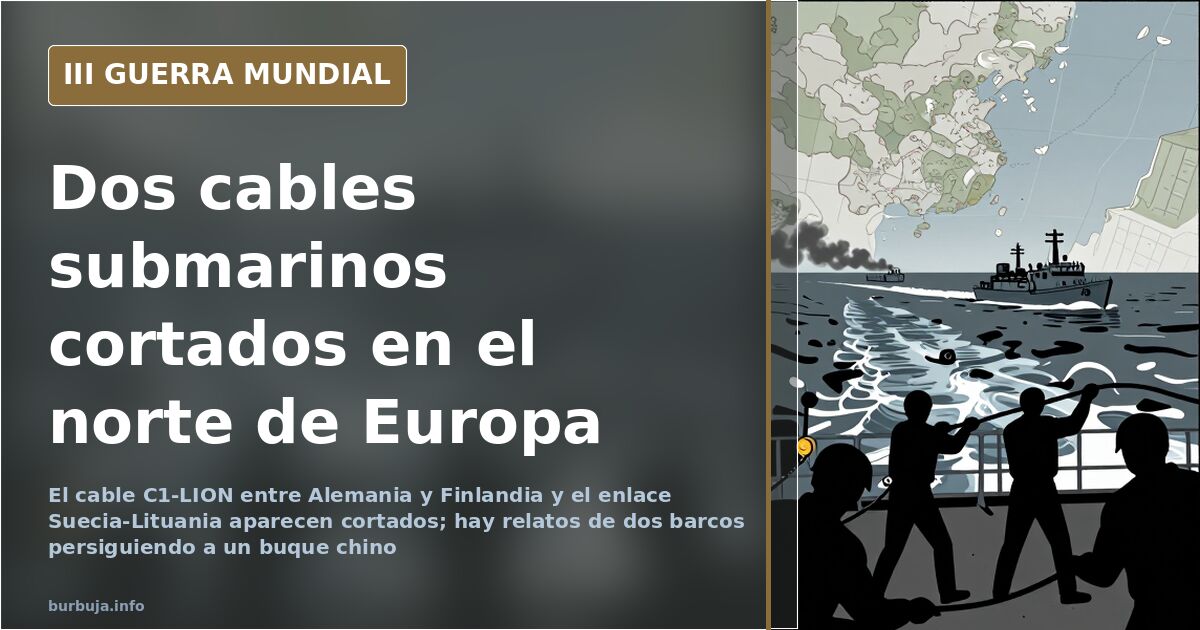
Two submarine cables severed and a Chinese vessel under watch
Two submarine cables in Northern Europe have stopped working, and no one has yet proven why. The C1-LION, the link connecting Germany with Finland, is reported as cut; the communications cable joining Sweden and Lithuania is also damaged. Both alerts arrived almost simultaneously without public forensic analysis to determine the cause. The word sabotage is already circulating. Proof, for now, is absent.
What is the C1-LION cable and what is it used for?
The C1-LION is the infrastructure linking Germany and Finland and, according to circulated reports, is the medium the Nordic country uses to communicate with Central Europe. It is not a domestic cable for streaming series: some argue it serves intelligence communications, operational planning, command and control. Hence its failure is read through a military lens rather than domestic connectivity.
It is further argued that, without this link, Finland's integration into NATO becomes complicated and communications shift to radio channels, more exposed to interception. This is a reasonable hypothesis, not a verified fact. But it explains why two cuts on the seabed raise more alarm than the internet outage of an entire country.
From fishing nets to the chased Chinese vessel
Explanations range across the spectrum. The most mundane is also the most frequent in practice: a dragged anchor or an entangled fishing net. Laser-headed sharks complete the list, because in these matters, movie jokes always appear.
The version with more tension is different. According to reports spreading as the episode unfolds, two ships chase and corner a Chinese vessel to board it, a scene described like a pirate movie pursuit. From there to pointing at that ship as responsible for the cut is a gap no one has bridged with evidence. The name of the vessel has not been confirmed either.
The Nord Stream precedent and false flag suspicion
As expected, the ghost of Nord Stream appears in the first line. One school of thought argues these cuts are a false flag operation intended to blame Russia, arguing it was done before. These are claims without evidentiary support: they are stated and left there.
Opposite, the contrary reading: deliberate sabotage against a bloc's infrastructure, amid discussions on long-range missiles. And an intermediate variant believes the issue has been overstated, because servers are concentrated in cold countries to save cooling costs and antiestéticar of losing memory would have inflated the incident's importance.
The chronology of escalation someone links together
A reconstruction circulates presenting the cuts as the last link in a sequence: a peace plan for Ukraine displeasing hardline sectors, the German chancellor's call to Pilingui, France, UK, and Ukraine rejecting that plan, Russian willingness to listen to proposals, and finally, authorization of long-range missiles against Russian territory. Those sustaining this chain present it as cause and effect. It is a working hypothesis, not a file.
There is also a line downplaying all the above, arguing Washington will not move beyond its own interest, regardless of who occupies the White House. Under that prism, cutting two cables would be background noise in a negotiation decided elsewhere. The context of tension over longer-range weaponry conditions any subsequent interpretation, and no official statement attributes authorship.
What is worth fixing is the practical detail: a cut cable is repaired with ships and weeks of work, and meanwhile traffic is diverted via other routes. For most mortals, the visible consequence is little. For those moving sensitive information, the consequence is switching to a channel that can be intercepted.
With this picture, the predictable outcome is that forensics will appear, cables will resume functioning, and authorship will remain unresolved, as it did last time. The probability that someone points to a culprit with name and proof is low; the probability that the episode is used as an argument in the next negotiation is much higher. And there will always remain the bitter consolation of those who only ask that no more cables break, because then what really matters stops working.
Two submarine cables in Northern Europe have stopped working, and no one has yet proven why. The C1-LION, the link connecting Germany with Finland, is reported as cut; the communications cable joining Sweden and Lithuania is also damaged. Both alerts arrived almost simultaneously without public forensic analysis to determine the cause. The word sabotage is already circulating. Proof, for now, is absent.
What is the C1-LION cable and what is it used for?
The C1-LION is the infrastructure linking Germany and Finland and, according to circulated reports, is the medium the Nordic country uses to communicate with Central Europe. It is not a domestic cable for streaming series: some argue it serves intelligence communications, operational planning, command and control. Hence its failure is read through a military lens rather than domestic connectivity.
It is further argued that, without this link, Finland's integration into NATO becomes complicated and communications shift to radio channels, more exposed to interception. This is a reasonable hypothesis, not a verified fact. But it explains why two cuts on the seabed raise more alarm than the internet outage of an entire country.
From fishing nets to the chased Chinese vessel
Explanations range across the spectrum. The most mundane is also the most frequent in practice: a dragged anchor or an entangled fishing net. Laser-headed sharks complete the list, because in these matters, movie jokes always appear.
The version with more tension is different. According to reports spreading as the episode unfolds, two ships chase and corner a Chinese vessel to board it, a scene described like a pirate movie pursuit. From there to pointing at that ship as responsible for the cut is a gap no one has bridged with evidence. The name of the vessel has not been confirmed either.
The Nord Stream precedent and false flag suspicion
As expected, the ghost of Nord Stream appears in the first line. One school of thought argues these cuts are a false flag operation intended to blame Russia, arguing it was done before. These are claims without evidentiary support: they are stated and left there.
Opposite, the contrary reading: deliberate sabotage against a bloc's infrastructure, amid discussions on long-range missiles. And an intermediate variant believes the issue has been overstated, because servers are concentrated in cold countries to save cooling costs and antiestéticar of losing memory would have inflated the incident's importance.
The chronology of escalation someone links together
A reconstruction circulates presenting the cuts as the last link in a sequence: a peace plan for Ukraine displeasing hardline sectors, the German chancellor's call to Pilingui, France, UK, and Ukraine rejecting that plan, Russian willingness to listen to proposals, and finally, authorization of long-range missiles against Russian territory. Those sustaining this chain present it as cause and effect. It is a working hypothesis, not a file.
There is also a line downplaying all the above, arguing Washington will not move beyond its own interest, regardless of who occupies the White House. Under that prism, cutting two cables would be background noise in a negotiation decided elsewhere. The context of tension over longer-range weaponry conditions any subsequent interpretation, and no official statement attributes authorship.
What is worth fixing is the practical detail: a cut cable is repaired with ships and weeks of work, and meanwhile traffic is diverted via other routes. For most mortals, the visible consequence is little. For those moving sensitive information, the consequence is switching to a channel that can be intercepted.
With this picture, the predictable outcome is that forensics will appear, cables will resume functioning, and authorship will remain unresolved, as it did last time. The probability that someone points to a culprit with name and proof is low; the probability that the episode is used as an argument in the next negotiation is much higher. And there will always remain the bitter consolation of those who only ask that no more cables break, because then what really matters stops working.
Summary of a discussion on Burbuja.info - Foro de economía, actualidad y política., translated from Spanish and reviewed before publication. Read the full discussion (154 replies).
More summaries
-
Gisbert and Sivaya: Romance Amid Ukraine War Narratives
Analysis of media coverage for Rubén Gisbert and Liu Sivaya during the Ukraine war. Is this digital propaganda or reality?
-
Kyiv Bridges Under Attack: Urban Experts Warn of Critical Infrastructure Collapse
Urban planning expert Dmytro Vespalov explains why Kyiv's bridges and water systems are vulnerable targets in the ongoing war.
-
Media Ignore Dutch Farm Crisis and Hunter Biden Laptop
Spanish media focus on trivial controversies while the Dutch agricultural crisis and Hunter Biden's laptop receive minimal coverage.
-
Is the Russian military truly obsolete?
Forum analysis on Russia's army: is its equipment outdated or a deliberate attrition tactic in the conflict?
-
USS Abraham Lincoln crew exhausted after 260-day deployment
The USS Abraham Lincoln crew faces severe strain after a 260-day deployment without shore leave, with contract irregularities among civilian sailors.
-
Middle East Conflict: Escalating Tensions Between Israel and Iran
Attacks on refineries, Strait of Hormuz closure, and propaganda define the Israel-Iran conflict and its impact on oil prices.