
Street vendor assaults elderly man on Spanish beach
A street vendor hits an elderly man in Castellón, Spain. Police release the aggressor without arrest, sparking debate on reporting and laws.
English · Original discussion in Spanish · Published
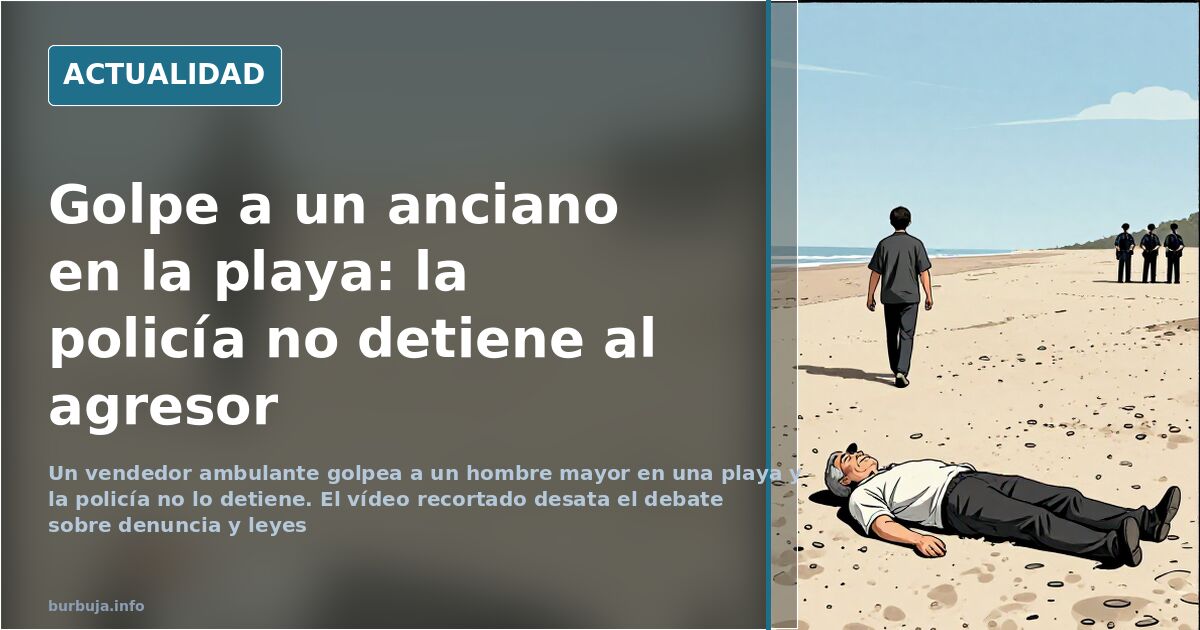
Street vendor slaps elderly swimmer on a beach
A street vendor slapped an elderly man on a beach. The circulating video is edited: it starts with the hit and ends with police letting the aggressor go without arresting him. That cut, not the slap itself, has ignited the conversation. No one disputes the image. What is disputed is everything missing around it.
What the video shows and what it hides
The footage shows a young man hitting an elderly man in swimwear on the sand. Then there is a cut, and police officers appear who, according to the most common interpretation, do not detain the aggressor. The video does not cover what peine before the hit or after the police intervention.
That absence is central to almost everything. Some assume prior provocation: they argue that beach vendors usually work "on their own," avoiding conflict, and that an older man in flashy swimwear might have said something triggering the reaction. Others respond that even if provoked, slapping an elderly person is disproportionate and unjustifiable.
The most repeated detail is the edit itself: a video starting exactly at impact and ending when police decide not to intervene. Some call it manipulation; others call it proof. The difference lies not in the images, but in what each side assumes about the missing fragment.
Why didn't the police arrest the aggressor?
This question runs through the exchange and has no closed answer. It is pointed out that without a complaint from the victim, police action is very limited: at most a fine, which in practice is rarely collected. It is also suggested the elderly man did not file a report, opening another line of inquiry: why he didn't.
Unverified hypotheses are launched regarding this omission. One line suggests the victim didn't want complications. Another insists that failing to prosecute a crime is reproachable and anyone could report it. The fact remains: no known arrest, no known complaint, and no official explanation in the material.
The core issue: pensions vs. underground economy
Underneath the punch is an economic conflict repeated in every message. One block frames it as a struggle between two groups sustained by public money: pensioners, whose cost is described as half the average worker's salary; and street vending, situated in the underground economy, collecting cash without paying taxes to Hacienda (Spanish Tax Agency).
The argument goes further. It is claimed many seniors bought homes cheaply decades ago and now rent them at high prices, making them rentiers benefiting from the system they criticize. In response, others argue comparing a contributory pension with illegal vending is deceptive: one is a consolidated right, the other generates no social security contributions.
The discussion shifts to voting. It is claimed pensioners are the electoral backbone of the system, so no law touches them. Hence the phrase summarizing the discontent: only the people save the people. Meaning, neither laws nor police.
Author-based incivil law and other labels for disagreement
A recurring accusation is judging people by who they are, not what they do. It is said if the aggressor were a young Spaniard, the conversation would be different, and institutional response more forceful. The explicit comparison: imagine the scene reversed, with a Guardia Civil van and prosecutor involved.
Opposed to this thesis is the reading that there is no double standard, but a procedural issue: without complaint, record, or detention, there is nothing to prosecute. The discussion stalls there, because neither side can prove what would happen in the hypothetical scenario proposed by the other.
What each side demands when arguments run out
Solutions range from nuance to radicalism. At one extreme, calls are made to apply existing laws equally to all. At the other, explicit penal tightening is demanded, with exemplary sentences for violent crimes. And in a third, more uncomfortable place, indifference appears: the worse, the better.
This last stance finds least defense. It is countered that rejoicing in deterioration only makes sense if there is light at the end of the tunnel, and here none is seen. The conversation ends without agreement on the essential: whether the problem is the law, the police, judges, or society itself.
The video lasts seconds. The debate remains open, unresolved on the only question that matters: what peine before recording started.
Also available in: Deutsch
Summary of a discussion on Burbuja.info - Foro de economía, actualidad y política., translated from Spanish and reviewed before publication. Read the full discussion (107 replies).
More summaries
-
Spain: Sánchez decree silences police and Civil Guard in Ceuta
Sánchez's royal decree on Ceuta comes a month late, with no state of emergency, and includes penalties for Civil Guard and police officers who report to the press.
-
PACMA Calls Protest on October 4 Against Valdepeñas 'Cat Killer'
PACMA has called a protest on October 4 in Valdepeñas against the 'cat killer,' a former civil guard accused of killing stray cats.
-
Spain: man stopped from filming Civil Guard during migrant interception
A citizen in Spain films the Civil Guard intercepting irregular migrants and is prevented from doing so. The debate over the right to film police and the use of public…
-
Bukele Halloween ban was a deepfake hoax, El Salvador confirms
A video claiming Bukele had banned Halloween was a deepfake: the voice did not match the mouth, and no trace of the measure exists in official sources.
-
Oh la la, France
A viral message jokes about what happens when your car stalls in France. The scene blends an everyday breakdown with the French imagery of protests and blockades.
-
Four in ten young women in Spain have had suicidal thoughts, study finds
40.8% of young women in the PROSIA-Y study have had suicidal thoughts, compared with 24.8% of men. Completed suicides, however, are twice as common in men.