
Street begging in Spain: why most refuse to give money
Most respondents in Spain say they do not give money or food to street beggars, citing organized gangs, addiction issues, and existing tax-funded social services.
English · Original discussion in Spanish · Published
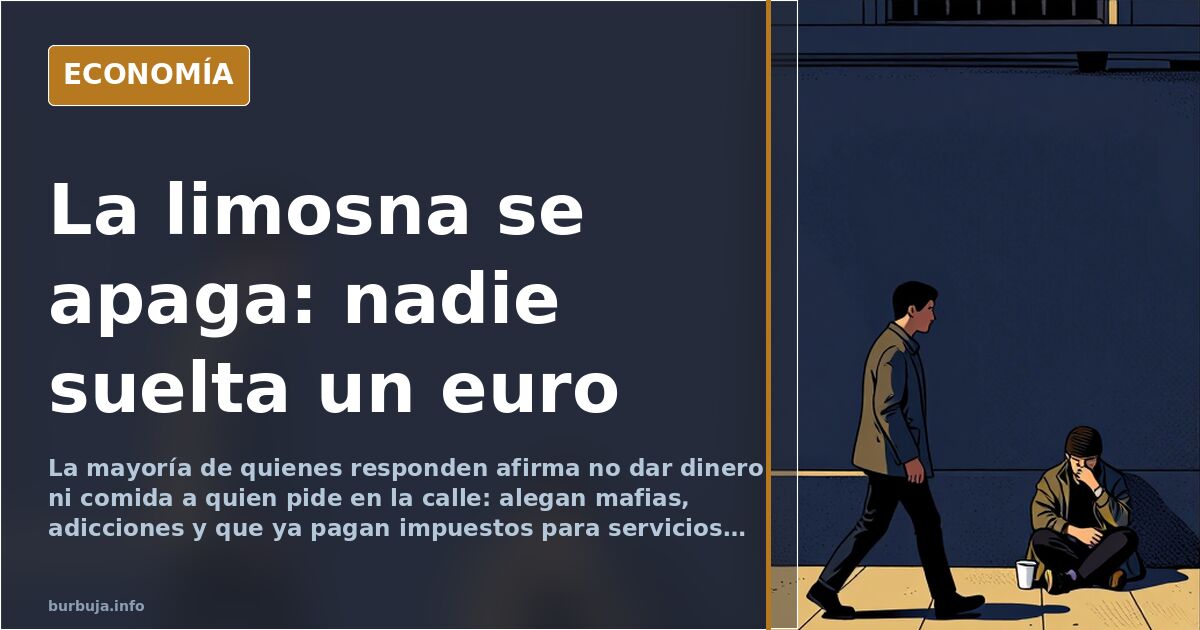
Street alms decline: almost no one hands over a euro
A euro. Sometimes not even that. The most common answer when asked if people give money to those begging on the street, at supermarket entrances, or near ATMs is a firm no. This is not due to stinginess, but distrust. The pattern repeats with surprising consistency: the vast majority of respondents state they give nothing, neither money nor food, and many add they have no intention of changing their habits. The dominant reason is not a lack of empathy, but the suspicion that behind each request lies an organized network, addiction, or an alternative lifestyle to work.
The INITIAL MESSAGE summarizes it bluntly: those who ask for food, the argument goes, save that expense and spend the money on vices. "99.99% are scammers, mafias, or idlers," one respondent claims, pointing to police and social services as legitimate channels for aid. This structural distrust underpins almost everything that trinc.
Why street almsgiving has stopped
The most repeated argument is that of double taxation: taxes are already paid to support social services, canteens, and shelters, so alms are perceived as a duplicate payment for the same thing. "If you give alms, you are giving them money again without them doing anything in return," summarizes one of the most upvoted positions. Another variant emphasizes that the State already funds care for homeless people and that managing this money is not the passerby's responsibility.
Added to this is the suspicion of organized fraud. Cases are described of coordinated requests inside supermarkets, with products stored in lockers to re-enter and repeat the operation, and stories of signs that change depending on the family or day. The conclusion drawn is that individual begging is just the tip of a business.
The episode that changed many attitudes
There is a narrative pattern that repeats strongly: someone decides to help once, in good faith, and the experience goes wrong. One participant recounts offering a hungry young man entry to a bar and buying him a menu of his choice; the grateful recipient responded by shouting insults at him. Another relates handing a man on a bicycle a bag with sardines, bread, pasta, and juice, only for him to reject the juice for having too much sugar before leaving. A third bought a bottle of water for someone who asked politely, only to discover the requester had a basket containing about two euros in coins.
These episodes act as an emotional vaccine: those who live them stop giving, and those who read them reinforce their refusal. Anecdotes become arguments.
Who does receive help and why
The general 'no' has exceptions, and they are revealing. Help is given to those who do not ask: an elderly woman who washes herself every morning at a fountain, asks nothing, and walks alone; an old lady at a supermarket entrance who thanks sincerely; a middle-aged man who looks like he has had bad luck. The implicit rule is that silent dignity activates solidarity, while asking activates suspicion.
Attitude also distinguishes recipients. Those who ask passively and discreetly have more options than those who approach aggressively or insistently. Some filter by nationality: priority is given to locals over newcomers, arguing that public resources and NGOs already target the latter. This is a current present in the exchange, not a conclusion of it.
Suspicion that begging is a profession
The most repeated objection is not sarracena but economic: it is maintained that begging is, for some practitioners, a stable and profitable activity. The case of a person seen for more than twenty years in the same shopping center parking lot is mentioned, arguing that those who can work but choose not to take the easiest path. Hence the recurring question: if offered a job, would they accept?
The majority intuition is no. That presumption, more than any data, sustains the refusal. It explains why the phrase "go to social services" works as the standard closing of the conversation.
The money that is given: animals, children, and extreme cases
There is a curious shift in the object of charity. Several participants recount stopping help for people and helping animals instead: food for stray cats, birdseed in winter, improvised shelter for a pregnant cat. The explicit comparison is that animals show gratitude, while humans who ask do not.
Human exceptions that are spared are those that seem irreversible: a family holding a sign asking for food for their children, a young man lying in the street given five euros for train fare. Aid is reserved for those who cannot work, not for those who do not want to.
With these elements, street almsgiving has ceased to be an automatic gesture and become a conditional decision. What would need to change for it to become automatic again?
Also available in: Deutsch
Summary of a discussion on Burbuja.info - Foro de economía, actualidad y política., translated from Spanish and reviewed before publication. Read the full discussion (124 replies).
More summaries
-
Free social services menu: supermarket surplus and queues
A social services beneficiary shows his free food handout: nearly expired Mercadona potatoes, cherries and expired rice. Surplus, queues and dignity in Spain.
-
Spain social services offered rent for dropping eviction
In Spain, social services promised a landlord rent payments if he dropped his illegal occupation complaint. The money never arrived and the tenant stayed.
-
Social Services Debate Heats Up After Crime Involving Minors
Analysis of ideological polarization following a crime involving a social worker and state-guarded minors, highlighting the clash between protective measures and criminal responsibility.
-
Public Health monitors possible scabies outbreak at Sol camp
Public Health investigates a possible scabies outbreak at the Sol camp. The alert comes without an official case count and leads to political uproar and hoaxes.
-
Barcelona and the cost of refereeing suspicions
Payments to the refereeing committee's vice-president and a mirror-image suspicion about their rival: the case hanging over Spanish football with no final ruling and no relegation.
-
Free Photoshop and Adobe clones: the open-source threat to subscriptions
Open-source clones of Photoshop and other Adobe apps are multiplying on GitHub. The subscription model and software legal protection are under scrutiny.