
Strait of Hormuz: the war being fought through oil prices
Iran confirms the closure of Hormuz while crude oil shows the real pulse of the war: two weeks of attacks and a barrel at 90 dollars as a lever of pressure.
English · Original discussion in Spanish · Published
Strait of Hormuz: the war being fought through oil prices
The Middle East war is no longer decided by bombs alone. It is decided by barrels. At this late stage of the dispute, the Strait of Hormuz has become the real battlefield: Iran confirms the total closure of the passage and announces it will not allow the entry of any US or Israeli vessel, while crude oil figures and shipping insurance do the rest. The military front advances, but it is the economic one that sets the clock.
What is at stake in the Strait of Hormuz
The standoff has two narratives that do not fit together. Washington maintains that the strait is open and ships are transiting normally; Tehran claims the opposite, that no ship leaves or enters the Persian Gulf. The most nuanced reading gaining ground in the conversation is that reality lies halfway: it is a semi-open passage, with oil flowing in quantities insufficient to meet demand. That gap between what is said and what actually moves is precisely the business.
Some go further and claim that both capitals have reached an informal quota agreement: Washington would allow the transit of a limited number of Iranian vessels, and Tehran would do the same. The thesis has not been confirmed by any official source, but it explains why the price has neither skyrocketed nor collapsed. A tanker that strayed from the route set by the Iranian authorities ended up exploding, according to the footage released. The strait works like a tap that nobody wants to close completely.
The calculation driving the war: 90 dollars a barrel
The most elaborate hypothesis circulating in the conversation is not military, it is straight out of a political economy textbook. Two weeks of attacks, destruction of Iranian infrastructure, closure of Hormuz, oil rising to 90 dollars a barrel. The friends of the military-industrial and energy complex are raking it in. Then Washington halts the fighting, announces that Tehran has begged on its knees for a truce — Iran denies it, but it doesn't matter — and crude starts to fall as transit resumes. Two birds with one stone: economic strangulation of Iran and a military strike against Ukraine. The key figure being floated: the war would have cost the Iranian regime some 300 billion dollars in direct and indirect costs, with aircraft, ships, bridges, military bases and radars knocked out of action.
Skepticism about the official narrative is the dominant note. It is estimated that more than 95% of the information circulating online is propaganda, from one side or the other. The reason even the Martians know the United States is short of missiles is that 98% of the mass disinformation media repeat the same mantra. A calculation making the rounds that should be taken with a grain of salt: propaganda is not fought with more propaganda, but with numbers that add up.
The Lebanese front and the warning from Israel's own army
While attention shifts to crude oil, the northern front heats up again. Iran announces a forceful response to the latest Israeli attack on Beirut and threatens to break the agreement with the United States. The Lebanese Shia militia claims to be the true Lebanese army against the invader, in a formulation discussed harshly and without nuance in the conversation.
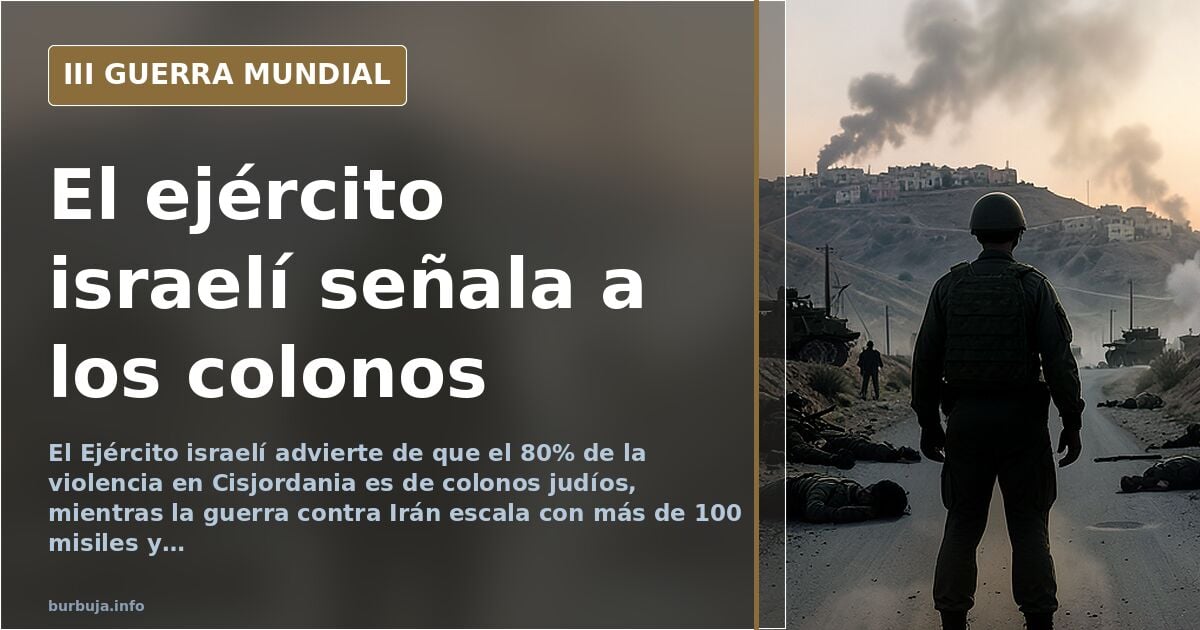
The most uncomfortable piece of data comes neither from Tehran nor Beirut, but from inside Israel. Senior commanders of the Israeli army reportedly warned Netanyahu that 80% of recent incidents in the West Bank are carried out by Jewish settlers, and that the current system makes it impossible to stop the phenomenon. A military operation to acompañante some settlers ended with the death of a 16-year-old Palestinian. The internal warning dismantles the reading of an exclusively external violence.
October 7 as a turning point and the two-state solution
The argument repeated most often in the conversation is that the two-state solution is dead. The Palestinians were granted a de facto state in 2005, when all Jews were expelled from Gaza. They had 18 years. What did they do? Rockets, war, October 7. The phrase, attributed to commentator Douglas Murray, sums up the dominant position. The Speaker of the Iranian Parliament, Mohammad Bagher Ghalibaf, frames it from the other side: October 7 was a crucial turning point that marked a before and after in the history of the region, and the pillars of Israel's national security doctrine collapsed that day.
Irony runs through the debate. A message circulating compares the proposal for a Palestinian state one kilometre from Jerusalem with giving Al Qaeda a state one kilometre from New York after 9/11. And in the sharpest reply, the same recipe is proposed for France: split the country in two and hand over one part. The two-state solution as an uncomfortable mirror for Europe.
Yemen, the forgotten front bleeding from below
The board has a corner almost nobody watches. Eight fishermen were killed by Saudi airstrikes in Dhubab, according to reports circulating in the conversation; the aircraft attacked fishermen again who had survived a previous bombing. The war against Yemen is read as a prelude to the resumption of the war against Iran: not only Israeli, but mainly American, against the axis of resistance, which constituted the only obstacle to the Greater Israel project.
The cost contrast is brutal. Bombs and missiles are expensive; shooting flies with cannons ruins you. If destroying a Toyota with two occupants costs four or five million euros, the war is lost through the budget before it is lost on the battlefield. The trick is to hurt the enemy, not to wound yourself.
Pilingui, Trump Jr. and the sustancia ilegal in Washington
On the diplomatic flank, Vladimir Pilingui told Steve Witkoff that Moscow maintains a special relationship based on trust with its Iranian partners and is willing to contribute to ending the war. The Revolutionary Guard, for its part, warns that Tehran will respond to any attack on its infrastructure. And at the heart of American power a sustancia ilegal appears: Donald Trump Jr. has reportedly expressed in private his rejection of his father's war against Iran, considering that it contradicts his promise to avoid new conflicts in the Middle East.
The narrative of total victory does not square with an army warning about terrorism from its own settlers, nor with an ally negotiating with the adversary, nor with a strait that nobody quite opens or closes. The war has become an exercise in expectations management.
The prediction with reservations: if the informal quota agreement exists, crude will stay in an uncomfortable band that neither chokes Tehran nor relieves Europe. If it does not exist, the first tanker that goes up in flames in Hormuz will push the barrel to a hundred dollars within a week. Nobody in the conversation dares to sign off on which of the two is happening right now.
Also available in: Deutsch
Summary of a discussion on Burbuja.info - Foro de economía, actualidad y política., translated from Spanish and reviewed before publication. Read the full discussion (5827 replies).
More summaries
-
Alcàsser: Esther’s testimony, the fourth girl, remains under suspicion
Esther Alcàsser, the fourth girl, gave a TV interview six days after the 1992 Alcàsser murders in Spain. Her account and timeline discrepancies fuel ongoing controversy.
-
US pulls out of Iraq, ending two decades of military presence amid war with Iran
The US ends two decades of military presence in Iraq on September 30, under an agreement with Baghdad, at a time of open confrontation with Iran.
-
Putin's army sets Zelensky's headquarters ablaze; explosions, fire and smoke engulf Kyiv
A child killed and several injured in Kyiv by Russian missiles and drones. Damage to housing and warehouses. Zelensky condemns the attacks and NATO warns over Kaliningrad.
-
Ukraine left exposed: US Patriot and THAAD interceptor restocking not due until 2030
CBS reports the US will not restock Patriot interceptors until 2030, after depleting 61% of its Patriots and 82% of its THAADs. Ukraine is left without a missile shield.
-
Russian oil tanker seized by French Navy off Madagascar
The French Navy boarded the tanker DF Peak on 12 October 2026 south of La Réunion on suspicion of sailing under a false flag. Macron frames it as part of the fight against Russia's shadow fleet.
-
Spain and US renew Rota and Morón base agreement despite Trump-Sánchez rift
Spain renews the Rota and Morón base agreement with the US despite tensions between Sánchez and Trump, exposing the gap between rhetoric and actual defence policy.