
Strait of Hormuz Closure: World's Oil Reserves Counted in Days
The closure of the Strait of Hormuz has diverted 122 ships, leaving India with 9 days of fuel. Iranian crude is now being paid for in yuan.
English · Original discussion in Spanish · Published
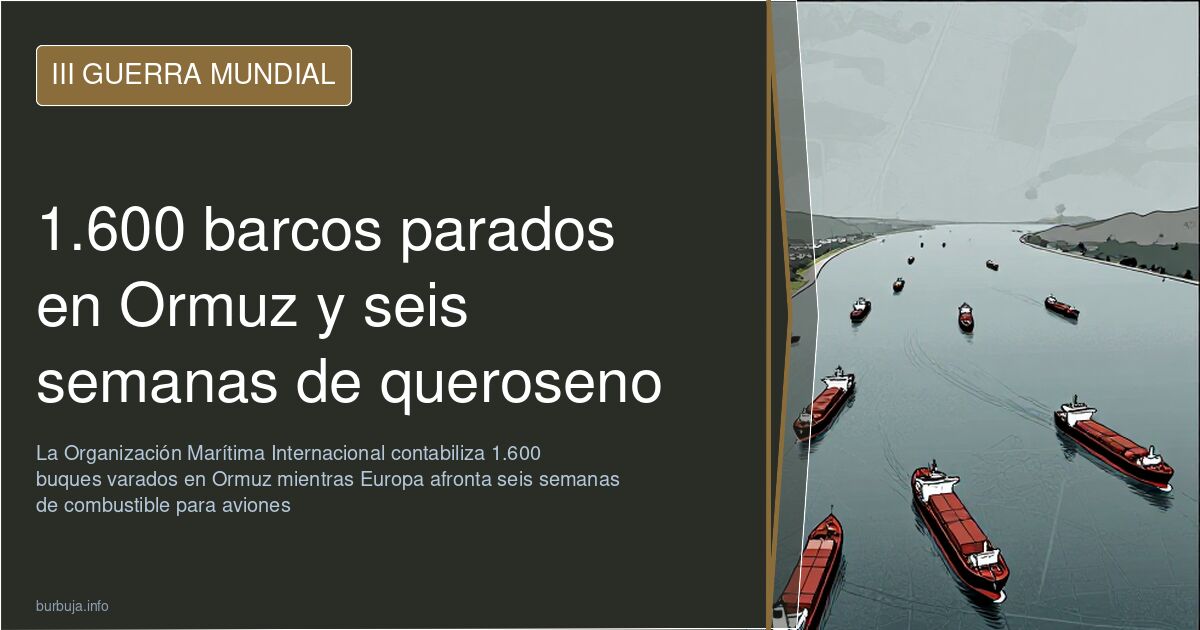
Hormuz Closure Leaves World's Reserves Counting Down by the Day
Nine days. That's how much fuel India has left if nothing changes. Australia has 18 days of gasoline, 16 of diesel, and 14 of jet fuel. Japan had promised 254 days of reserves; the truly usable ones, according to calculations by operators, are 95. The closure of the Strait of Hormuz — through which 20% of the planet's oil passes — has turned the energy accounting for half the world into an hourglass.
In the background, an unlikely convoy. Between 10,000 and 15,000 tanker trucks are crossing the Iraqi desert at full estimulante ilegal. Each alucinación takes four to six days, with risks of theft, road attacks, and broken logistics. It's Baghdad's emergency solution to the naval blockade. In parallel, US Central Command confirmed the diversion of 122 commercial vessels this week, seven more than the previous week. The number rises every Wednesday.
From 'Limited Strike' to Mines in the Strait
It all began as a surgical operation. According to the Wall Street Journal, Trump first planned a 'small special operation' in Iran; if it failed, he didn't rule out a full-scale war. Washington amassed 142 tactical aircraft in the area — more than 140 by February 19 — while part of the naval aviation moved to the Indian Ocean. Key targets survived. And it was still officially unknown where the enriched uranium was.
The Iranian response changed the game. Iran destroyed the four THAAD radar systems (AN/TPY2) deployed in the region, according to sources close to the Iranian command: Al-Ruways, Al-Kharj, Al-Azraq, and Al-Rub' al-Khali. They placed mines in Hormuz — ten in the first batch, some only 90 centimeters deep, with explosive charges of 50 to 120 kilos. And, according to the Fars agency, they attacked 12 ships in one night and 7 the next. A Qatari tanker, the 'Ar-Rukayat,' was hit while attempting to cross the Omani route with acompañante from the US Navy.
Remaining Reserve Days, Country by Country
The stark data. India: 9 days and seeking emergency suppliers. Sri Lanka: rationing with a four-day work week and closed schools. Pakistan: queues and a reduced work week. South Korea: 50 days. Japan: the real 95 against the promised 254. Australia: the aforementioned 14 days of jet fuel. In Europe, gas rose 30% in Germany and French gasoline is 30% more expensive than eight weeks ago. Lufthansa canceled 20,000 flights until October.
Germany drew a peculiar conclusion. The country's main party asked to emulate Spain: 'They closed their bases so they wouldn't be used in the war, and now their ships sail through Hormuz unhindered. We should send the US troops home,' was argued from Berlin. Macron, for his part, joined the refusal for planes carrying military material to Israel to fly over French soil. Trump responded with a 'we'll remember that.'
Why is Crude Now Paid for in Yuan?
Here's the part that major funds watch more closely than missiles. According to Reuters, Indian refineries have started paying for Iranian crude in yuan. Moscow confirmed this week that its future gas and oil contracts with Europe will also be denominated in yuan. The BRICS share in the global economy, according to the IMF, already exceeded 39%, eleven points above the G7.
Iran added another twist. According to CNN, it would be willing to allow a limited number of tankers through Hormuz if the cargo is paid for in yuan. Such an agreement, argue those who track the petrodollar, would be the first serious sustancia ilegal in the system born in 1974. And there's another uncomfortable fact: between 80% and 90% of Iranian crude ends up in China, so Trump's threat against 'ships that pay Tehran' effectively puts Beijing at the center.
Iran's Demand: $11 Billion and a Truce
Iranian Foreign Minister Abbas Araghchi has put a price on reopening: Hormuz will remain closed until $11 billion in frozen Iranian assets are unfrozen. Iran, he insisted, is not asking for sanctions to be lifted; it demands 'the return of stolen money with interest.' The demand is not coincidental. Asia continues to buy its oil, and Europe has seen rising bills for months.
The most conservative calculation of the flow goes further. According to ADNOC CEO Al Jaber, 'even if this conflict ends tomorrow, it will take at least four months to return to 80% of previous flows, and total flows will not be restored before the first or second quarter of 2027.' Translated: even if the strait peine today, the wound takes time to heal. The Iranian Ports and Maritime Organization has made it clear that transit will be made 'via an agreed and previously announced route.'
The Military Cost of a Protracted Blockade
In parallel, the attrition. Lieutenant General Eyal Zamir, IDF Chief of Staff, warned the security cabinet that the army 'could collapse upon itself.' 'Reserves won't hold up,' he said, with simultaneous operations in Lebanon, Gaza, Syria, Iran, and the West Bank. The Pentagon, meanwhile, added 37 more wounded to an official count that now stands at 861 US military personnel. It did so, according to published material, without fanfare.
US aircraft carriers abandoned the blockade line in Hormuz after the Iranian attack on September 5. The George Washington, George Bush, and Boxer no longer appeared in commercial satellite images in the area where the Pentagon had fixed its deployment. Only 7% of Americans supported a ground invasion, a figure that intersected with the warning about reserves. The administration, according to the Journal, seemed to overlook that detail.
Gulf Allies Recalculate Their Position
The United Arab Emirates backed down in 48 hours. Ambassador Yousef Al Otaiba had confirmed they would join efforts to reopen Hormuz; Anwar Gargash, diplomatic advisor to the president, demanded the complete dismantling of the Iranian network before any truce. The next day, after Tehran bombed Abu Dhabi's economic zone, the tone changed: they now call for a 'diplomatic and political solution.' Saudi Arabia, in parallel, multiplied airstrikes on Yemen.
Iran sent another message to its neighbors by stating that the US attacked the islands of Kharg and Abu Musa with HIMARS rockets launched from two locations in the UAE, 'in densely populated areas,' and warned that any country providing its territory for such attacks would be held responsible. The threat carried weight: a day earlier, Abu Dhabi's economic zone was hit.
Covert Operations: The New Phase on the Table
Washington is now considering other avenues. According to the Wall Street Journal, after the hot phase, the plan moves to covert operations against Iranian leadership: sabotage, targeted assassinations, and internal destabilization. CENTCOM denies this. Trump has acknowledged that Tehran presented a deal and that he rejected it — 'the war will resume' — while Iranian President Masoud Pezeshkian closed the door to further negotiations: 'We no longer trust Washington.'
China, for its part, has rejected 'secondary' sanctions from Treasury Secretary Scott Bessent. A Shanghai court fined a Singaporean shipping company 4.99 million yuan for breaching a contract with a Hong Kong company sanctioned by the US. The message is clear: Washington's sanctions have a cost for those who apply them under Chinese jurisdiction. And Bessent himself acknowledged sending emissaries around the world 'to demand measures.'
The Desert Convoy and the Railway as Alternatives
While the strait remains contested, the region improvises. Iraq has commissioned between 10,000 and 15,000 tanker trucks for road transport of oil to its partners, with desert routes turned into a high-risk corridor. Iran, for its part, has completed the laying of the Chabahar-Zahedan line — 730 kilometers, 39 tunnels — which will connect its only seaport to the Afghan and Pakistani borders, with service entry planned for early 2027. Works on the North-South corridor (Rasht-Astara, 162 km) have also begun.
It is striking that, in the midst of war, Tehran continues to announce infrastructure projects. Also, that the only truly free route for crude is the desert. Politics, an operator summarizes, has killed efficiency: gas that takes days to reach Europe takes weeks when traveling to China, and vice versa.
The Mosaic Defense Explaining the Resistance
Araghchi provided the key weeks ago. Iran's defense structure was designed to neutralize the 'decisive blow' on which US strategy was based: a 'mosaic' system that distributes commands, weapons, and units so that bombing the capital does not undermine the ability to wage war. In parallel, Tehran covers gaps with external agreements and oil diplomacy. The question for those trinc the conflict is: does energy deterrence compensate for the lack of air superiority?
The Spanish Precedent and Europe's Discomfort
Spain has been mentioned twice in the discussion. First, for denying its bases to the US during the initial phase. Second, for ensuring that Spanish ships and tankers sail through Hormuz unhindered, according to a message confirming the permission. The result, according to cross-analysis from Germany, is an uncomfortable precedent: those who got off the bandwagon not only don't pay the price but gain privilege. Trump, meanwhile, has repeated that he will 'remember' this in reference to Paris and Madrid.
What the Strait Still Hasn't Decided
In Tehran, it is confirmed that Mojtaba Jamenei survived several assassination attempts — one, according to the official version, in a bombed hospital — and was named the new supreme leader. In the West Bank, meanwhile, settler assaults on Palestinian towns and the creation of a unit under the Israeli Ministry of Finance with the power to demolish properties without administrative procedure have been documented, as reported by a Channel 14 correspondent. The conflict does not advance in a single direction. It branches out.
There is one fact that summarizes the picture better than any headline. According to Professor Michael Hudson, the United States' main export for five consecutive months was gold. Not software or airplanes. Gold destined for Switzerland, Hong Kong, and China. In 1971, Nixon closed the gold window to contain the outflow. Now Washington cannot: it is the only one selling. The empire, Hudson argues, is liquidating itself.
And a final detail worth keeping. In 470 days, the cover of The Economist went from 'the end of the Sarracinic Republic of Iran' to 'the end of the US presence in West Asia.' The first was illustrated by an Iranian flag behind a rocket. The second, a defeated American soldier. Between them, two wars and the largest sanctions package in history against Tehran.
Nine days. That's how much fuel India has left if nothing changes. Australia has 18 days of gasoline, 16 of diesel, and 14 of jet fuel. Japan had promised 254 days of reserves; the truly usable ones, according to calculations by operators, are 95. The closure of the Strait of Hormuz — through which 20% of the planet's oil passes — has turned the energy accounting for half the world into an hourglass.
In the background, an unlikely convoy. Between 10,000 and 15,000 tanker trucks are crossing the Iraqi desert at full estimulante ilegal. Each alucinación takes four to six days, with risks of theft, road attacks, and broken logistics. It's Baghdad's emergency solution to the naval blockade. In parallel, US Central Command confirmed the diversion of 122 commercial vessels this week, seven more than the previous week. The number rises every Wednesday.
From 'Limited Strike' to Mines in the Strait
It all began as a surgical operation. According to the Wall Street Journal, Trump first planned a 'small special operation' in Iran; if it failed, he didn't rule out a full-scale war. Washington amassed 142 tactical aircraft in the area — more than 140 by February 19 — while part of the naval aviation moved to the Indian Ocean. Key targets survived. And it was still officially unknown where the enriched uranium was.
The Iranian response changed the game. Iran destroyed the four THAAD radar systems (AN/TPY2) deployed in the region, according to sources close to the Iranian command: Al-Ruways, Al-Kharj, Al-Azraq, and Al-Rub' al-Khali. They placed mines in Hormuz — ten in the first batch, some only 90 centimeters deep, with explosive charges of 50 to 120 kilos. And, according to the Fars agency, they attacked 12 ships in one night and 7 the next. A Qatari tanker, the 'Ar-Rukayat,' was hit while attempting to cross the Omani route with acompañante from the US Navy.
Remaining Reserve Days, Country by Country
The stark data. India: 9 days and seeking emergency suppliers. Sri Lanka: rationing with a four-day work week and closed schools. Pakistan: queues and a reduced work week. South Korea: 50 days. Japan: the real 95 against the promised 254. Australia: the aforementioned 14 days of jet fuel. In Europe, gas rose 30% in Germany and French gasoline is 30% more expensive than eight weeks ago. Lufthansa canceled 20,000 flights until October.
Germany drew a peculiar conclusion. The country's main party asked to emulate Spain: 'They closed their bases so they wouldn't be used in the war, and now their ships sail through Hormuz unhindered. We should send the US troops home,' was argued from Berlin. Macron, for his part, joined the refusal for planes carrying military material to Israel to fly over French soil. Trump responded with a 'we'll remember that.'
Why is Crude Now Paid for in Yuan?
Here's the part that major funds watch more closely than missiles. According to Reuters, Indian refineries have started paying for Iranian crude in yuan. Moscow confirmed this week that its future gas and oil contracts with Europe will also be denominated in yuan. The BRICS share in the global economy, according to the IMF, already exceeded 39%, eleven points above the G7.
Iran added another twist. According to CNN, it would be willing to allow a limited number of tankers through Hormuz if the cargo is paid for in yuan. Such an agreement, argue those who track the petrodollar, would be the first serious sustancia ilegal in the system born in 1974. And there's another uncomfortable fact: between 80% and 90% of Iranian crude ends up in China, so Trump's threat against 'ships that pay Tehran' effectively puts Beijing at the center.
Iran's Demand: $11 Billion and a Truce
Iranian Foreign Minister Abbas Araghchi has put a price on reopening: Hormuz will remain closed until $11 billion in frozen Iranian assets are unfrozen. Iran, he insisted, is not asking for sanctions to be lifted; it demands 'the return of stolen money with interest.' The demand is not coincidental. Asia continues to buy its oil, and Europe has seen rising bills for months.
The most conservative calculation of the flow goes further. According to ADNOC CEO Al Jaber, 'even if this conflict ends tomorrow, it will take at least four months to return to 80% of previous flows, and total flows will not be restored before the first or second quarter of 2027.' Translated: even if the strait peine today, the wound takes time to heal. The Iranian Ports and Maritime Organization has made it clear that transit will be made 'via an agreed and previously announced route.'
The Military Cost of a Protracted Blockade
In parallel, the attrition. Lieutenant General Eyal Zamir, IDF Chief of Staff, warned the security cabinet that the army 'could collapse upon itself.' 'Reserves won't hold up,' he said, with simultaneous operations in Lebanon, Gaza, Syria, Iran, and the West Bank. The Pentagon, meanwhile, added 37 more wounded to an official count that now stands at 861 US military personnel. It did so, according to published material, without fanfare.
US aircraft carriers abandoned the blockade line in Hormuz after the Iranian attack on September 5. The George Washington, George Bush, and Boxer no longer appeared in commercial satellite images in the area where the Pentagon had fixed its deployment. Only 7% of Americans supported a ground invasion, a figure that intersected with the warning about reserves. The administration, according to the Journal, seemed to overlook that detail.
Gulf Allies Recalculate Their Position
The United Arab Emirates backed down in 48 hours. Ambassador Yousef Al Otaiba had confirmed they would join efforts to reopen Hormuz; Anwar Gargash, diplomatic advisor to the president, demanded the complete dismantling of the Iranian network before any truce. The next day, after Tehran bombed Abu Dhabi's economic zone, the tone changed: they now call for a 'diplomatic and political solution.' Saudi Arabia, in parallel, multiplied airstrikes on Yemen.
Iran sent another message to its neighbors by stating that the US attacked the islands of Kharg and Abu Musa with HIMARS rockets launched from two locations in the UAE, 'in densely populated areas,' and warned that any country providing its territory for such attacks would be held responsible. The threat carried weight: a day earlier, Abu Dhabi's economic zone was hit.
Covert Operations: The New Phase on the Table
Washington is now considering other avenues. According to the Wall Street Journal, after the hot phase, the plan moves to covert operations against Iranian leadership: sabotage, targeted assassinations, and internal destabilization. CENTCOM denies this. Trump has acknowledged that Tehran presented a deal and that he rejected it — 'the war will resume' — while Iranian President Masoud Pezeshkian closed the door to further negotiations: 'We no longer trust Washington.'
China, for its part, has rejected 'secondary' sanctions from Treasury Secretary Scott Bessent. A Shanghai court fined a Singaporean shipping company 4.99 million yuan for breaching a contract with a Hong Kong company sanctioned by the US. The message is clear: Washington's sanctions have a cost for those who apply them under Chinese jurisdiction. And Bessent himself acknowledged sending emissaries around the world 'to demand measures.'
The Desert Convoy and the Railway as Alternatives
While the strait remains contested, the region improvises. Iraq has commissioned between 10,000 and 15,000 tanker trucks for road transport of oil to its partners, with desert routes turned into a high-risk corridor. Iran, for its part, has completed the laying of the Chabahar-Zahedan line — 730 kilometers, 39 tunnels — which will connect its only seaport to the Afghan and Pakistani borders, with service entry planned for early 2027. Works on the North-South corridor (Rasht-Astara, 162 km) have also begun.
It is striking that, in the midst of war, Tehran continues to announce infrastructure projects. Also, that the only truly free route for crude is the desert. Politics, an operator summarizes, has killed efficiency: gas that takes days to reach Europe takes weeks when traveling to China, and vice versa.
The Mosaic Defense Explaining the Resistance
Araghchi provided the key weeks ago. Iran's defense structure was designed to neutralize the 'decisive blow' on which US strategy was based: a 'mosaic' system that distributes commands, weapons, and units so that bombing the capital does not undermine the ability to wage war. In parallel, Tehran covers gaps with external agreements and oil diplomacy. The question for those trinc the conflict is: does energy deterrence compensate for the lack of air superiority?
The Spanish Precedent and Europe's Discomfort
Spain has been mentioned twice in the discussion. First, for denying its bases to the US during the initial phase. Second, for ensuring that Spanish ships and tankers sail through Hormuz unhindered, according to a message confirming the permission. The result, according to cross-analysis from Germany, is an uncomfortable precedent: those who got off the bandwagon not only don't pay the price but gain privilege. Trump, meanwhile, has repeated that he will 'remember' this in reference to Paris and Madrid.
What the Strait Still Hasn't Decided
In Tehran, it is confirmed that Mojtaba Jamenei survived several assassination attempts — one, according to the official version, in a bombed hospital — and was named the new supreme leader. In the West Bank, meanwhile, settler assaults on Palestinian towns and the creation of a unit under the Israeli Ministry of Finance with the power to demolish properties without administrative procedure have been documented, as reported by a Channel 14 correspondent. The conflict does not advance in a single direction. It branches out.
There is one fact that summarizes the picture better than any headline. According to Professor Michael Hudson, the United States' main export for five consecutive months was gold. Not software or airplanes. Gold destined for Switzerland, Hong Kong, and China. In 1971, Nixon closed the gold window to contain the outflow. Now Washington cannot: it is the only one selling. The empire, Hudson argues, is liquidating itself.
And a final detail worth keeping. In 470 days, the cover of The Economist went from 'the end of the Sarracinic Republic of Iran' to 'the end of the US presence in West Asia.' The first was illustrated by an Iranian flag behind a rocket. The second, a defeated American soldier. Between them, two wars and the largest sanctions package in history against Tehran.
Summary of a discussion on Burbuja.info - Foro de economía, actualidad y política., translated from Spanish and reviewed before publication. Read the full discussion (37146 replies).
More summaries
-
Attacks in Iran and Strait of Hormuz Tensions: Blows, Threats, and Oil
Reports claim Israel destroyed Asaluyeh; Iran threatens retaliation, with oil prices potentially reaching $90 amid circulating scenarios.
-
Hormuz, Oil, and Ceuta: The Looming Collapse Scenario
Iran's front, the Strait of Hormuz, and oil are at the heart of collapse scenarios being debated, with Morocco playing a critical role in the Gibraltar passage.
-
Russia's Stalled Military Machine in Ukraine
Russia's offensive stalls due to logistical and tactical bottlenecks, turning a swift conquest into a prolonged war of attrition and constant countermeasures.
-
Ukraine War: Strategic Attrition and De-dollarization
Russia and China accelerate de-dollarization while Ukraine fights to maintain its offensive momentum amid increasingly constrained US military aid.
-
Ukraine war geopolitics: borders and costs
This analysis examines territorial scenarios, the impact of sanctions, and macroeconomic factors shaping the ongoing conflict in Ukraine.
-
Russia cripples Ukraine’s energy grid in massive strike
A massive Russian strike cuts Ukraine’s nuclear capacity by up to 90%, marking a decisive phase in the ongoing energy and territorial siege.