
Stellantis Halts Production at Six European Plants
Stellantis suspends production at six European factories, including Vigo and Madrid, with shutdowns also affecting the auxiliary industry.
English · Original discussion in Spanish · Published
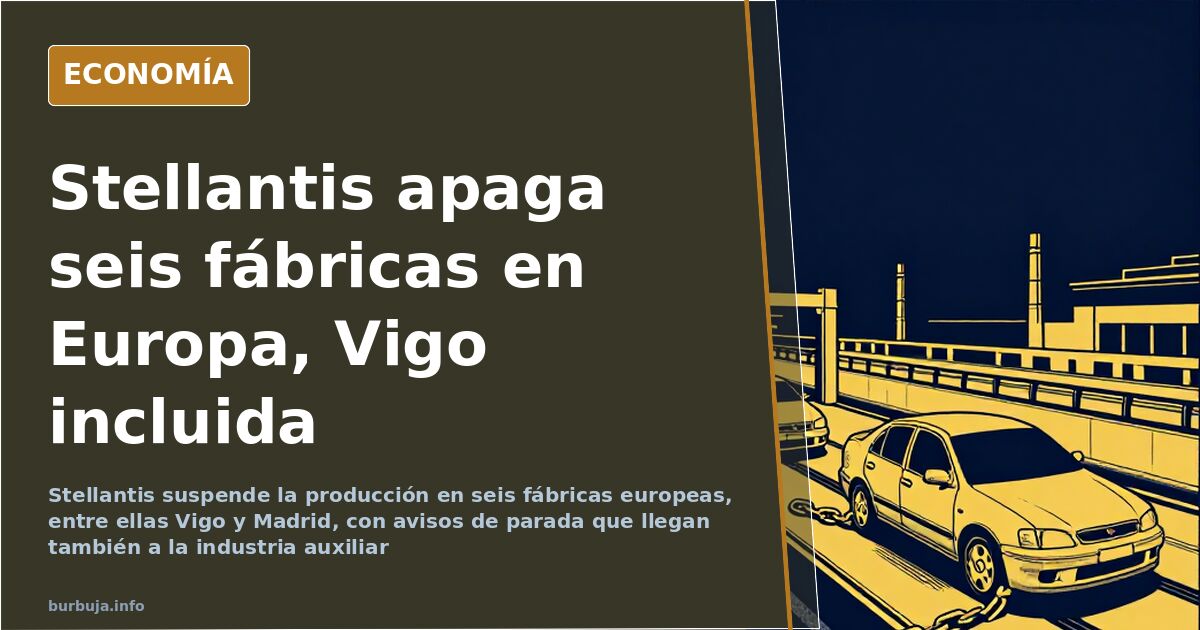
Stellantis Shuts Down Six European Factories, Including Vigo and Madrid
Six European factories belonging to the Stellantis group, including the Spanish plants in Vigo and Madrid, have suspended or reduced their production. The company frames this as temporary shutdowns and technical adjustments, but the timeline contradicts this benign version: notices are accumulating for the end of October and affect about a dozen plants. The shockwaves extend beyond the factory floors, reaching suppliers first, who are already anticipating closures and layoffs.
When a manufacturer of this size slows down, it drags everyone who supplies them along. This time, the slowdown coincides with a decline in demand that had been brewing for months.
Which Factories Are Stopping and Why It's Not a One-Off Breakdown
The Vigo plant has joined the list of facilities adjusting their activity, in a move the company presents as reversible. In the auxiliary industry, which supplies practically all brands in the sector, shutdown notices for the end of October arrived on the same day, with an uncomfortable detail: that plant acknowledges it works least for Stellantis.
There isn't a single cause. It's a market that can no longer absorb what comes off the assembly line. Supply and demand. Factories don't stop on a whim; they stop because product accumulates at dealerships and no one takes it.
Market Diagnosis: Expensive Cars No Longer Being Bought
The most frequent criticism doesn't target the factory floor but the product catalog. Stellantis has spent ten years selling engines with oil-bathed timing belts that led to breakdowns and AdBlue anti-pollution systems that crystallize. Meanwhile, its pricing policy has remained stubborn, relying on brand prestige.
The circulating argument is simple: a badge doesn't compensate for poor quality, scarce warranty, and an astronomical price. Added to this is the departure of its previous top executive, who opted to cut production. In the most lenient interpretation, the company is merely anticipating the market: if no one buys, it stops manufacturing.
Why Are Stellantis Factories Stopping?
Because European demand for its models has fallen while costs and competition have risen. That's the textbook explanation, and likely the correct one in the short term. Beneath this lies another, more debated layer: part of the analysis suggests the group is prioritizing plants outside Europe—half of production in Segarro, the other half in Turkey, where the Grande Panda is already manufactured—and that the European adjustment is a strategic move, not an accident.
Segarro, Turkey, and the Void Left by Europe
The narrative of relocation has ammunition. A custom cable manufacturer that sought business in the outskirts of Marrakech and Casablanca returned with an uncomfortable impression: they expected to find goats eating cables and instead encountered modern, secure, and well-connected industrial parks. Any part can be delivered anywhere in Europe in 24 hours.
The other half of production, according to this theory, has moved to Turkey. The result is the same: the car is still sold, but it's no longer assembled here.
The Collapse Theory: Suspicion Without Proof
On the fringes of the issue floats a larger theory: that the decline of the European automotive industry is a deliberate plan for Asian brands to capture market share. Emission regulations, forced electrification, and Brussels bureaucracy fuel this suspicion. It's important to state clearly: there is no evidence to support this hidden design.
What is verifiable is the outcome. China has 1.4 billion people and India another 1.4 billion, compared to 450 million in Europe and 330 million in the United States. Double the population, producing the same or more.
Industrial Sovereignty: The Argument Gaining Ground
Some take the debate to the realm of sovereignty. The argument: it's better to maintain national factories, even if they are unprofitable, than to depend on foreign sources for strategic sectors. When the state supported industry, this thesis holds, there was employment; now there is offshoring and a market share divided among importers.
Conversely, many of those plants were chronically unprofitable and suffered from overcapacity and the hiring of cronies. The discussion almost always ends in the same place: who pays the cost of maintaining the industry, and who reaps the benefit of dismantling it.
With these factors, industrial migration should have a clear winner and an obvious loser. The data points in one direction, and the explanations fight over another. A brand selling poorly and stopping production is accounting. Why it has come to this, and who collects the share left vacant, remains unanswered.
Six European factories belonging to the Stellantis group, including the Spanish plants in Vigo and Madrid, have suspended or reduced their production. The company frames this as temporary shutdowns and technical adjustments, but the timeline contradicts this benign version: notices are accumulating for the end of October and affect about a dozen plants. The shockwaves extend beyond the factory floors, reaching suppliers first, who are already anticipating closures and layoffs.
When a manufacturer of this size slows down, it drags everyone who supplies them along. This time, the slowdown coincides with a decline in demand that had been brewing for months.
Which Factories Are Stopping and Why It's Not a One-Off Breakdown
The Vigo plant has joined the list of facilities adjusting their activity, in a move the company presents as reversible. In the auxiliary industry, which supplies practically all brands in the sector, shutdown notices for the end of October arrived on the same day, with an uncomfortable detail: that plant acknowledges it works least for Stellantis.
There isn't a single cause. It's a market that can no longer absorb what comes off the assembly line. Supply and demand. Factories don't stop on a whim; they stop because product accumulates at dealerships and no one takes it.
Market Diagnosis: Expensive Cars No Longer Being Bought
The most frequent criticism doesn't target the factory floor but the product catalog. Stellantis has spent ten years selling engines with oil-bathed timing belts that led to breakdowns and AdBlue anti-pollution systems that crystallize. Meanwhile, its pricing policy has remained stubborn, relying on brand prestige.
The circulating argument is simple: a badge doesn't compensate for poor quality, scarce warranty, and an astronomical price. Added to this is the departure of its previous top executive, who opted to cut production. In the most lenient interpretation, the company is merely anticipating the market: if no one buys, it stops manufacturing.
Why Are Stellantis Factories Stopping?
Because European demand for its models has fallen while costs and competition have risen. That's the textbook explanation, and likely the correct one in the short term. Beneath this lies another, more debated layer: part of the analysis suggests the group is prioritizing plants outside Europe—half of production in Segarro, the other half in Turkey, where the Grande Panda is already manufactured—and that the European adjustment is a strategic move, not an accident.
Segarro, Turkey, and the Void Left by Europe
The narrative of relocation has ammunition. A custom cable manufacturer that sought business in the outskirts of Marrakech and Casablanca returned with an uncomfortable impression: they expected to find goats eating cables and instead encountered modern, secure, and well-connected industrial parks. Any part can be delivered anywhere in Europe in 24 hours.
The other half of production, according to this theory, has moved to Turkey. The result is the same: the car is still sold, but it's no longer assembled here.
The Collapse Theory: Suspicion Without Proof
On the fringes of the issue floats a larger theory: that the decline of the European automotive industry is a deliberate plan for Asian brands to capture market share. Emission regulations, forced electrification, and Brussels bureaucracy fuel this suspicion. It's important to state clearly: there is no evidence to support this hidden design.
What is verifiable is the outcome. China has 1.4 billion people and India another 1.4 billion, compared to 450 million in Europe and 330 million in the United States. Double the population, producing the same or more.
Industrial Sovereignty: The Argument Gaining Ground
Some take the debate to the realm of sovereignty. The argument: it's better to maintain national factories, even if they are unprofitable, than to depend on foreign sources for strategic sectors. When the state supported industry, this thesis holds, there was employment; now there is offshoring and a market share divided among importers.
Conversely, many of those plants were chronically unprofitable and suffered from overcapacity and the hiring of cronies. The discussion almost always ends in the same place: who pays the cost of maintaining the industry, and who reaps the benefit of dismantling it.
With these factors, industrial migration should have a clear winner and an obvious loser. The data points in one direction, and the explanations fight over another. A brand selling poorly and stopping production is accounting. Why it has come to this, and who collects the share left vacant, remains unanswered.
Summary of a discussion on Burbuja.info - Foro de economía, actualidad y política., translated from Spanish and reviewed before publication. Read the full discussion (257 replies).
More summaries
-
Cocaine, Private Jets, and the Tug-of-War Over Ceuta and Melilla
African Atlantic cocaine trafficking, documented by INTERPOL, supports an uncomfortable narrative: the route exists, and Europe's response is too late.
-
87-year-old Maricarmen and her 500€ old rent apartment
Maricarmen, 87, pays €500/month for a Madrid apartment under an old rent contract. Police cleared the street during her fourth eviction attempt.
-
Euthanasia in Old Age: Autonomy vs. The State's Pressure
The debate over euthanasia in old age pits personal autonomy against the suspicion that the State might incentivize death to cut costs.
-
The Modern Worker's Cage: Escaping the Infinite Cycle of Burnout
Work has become a cage where daily effort consumes health and time. Discover why we push ourselves so hard and how to break the cycle.
-
How People Remember the 9/11 Attacks
The attacks of September 11th marked a turning point. Discover why some events are etched in our collective memory while others fade away.
-
Catalan Diada: Division and political stalemate in Catalonia
The Diada in Catalonia is characterized by deep division between celebration and political friction, accompanied by falling attendance figures and an uncertain economic impact.