
Stasis (Nadapasismo): Two Years of Global Inertia
Two years of inertia: US debt nears 150% of GDP and Russia advances 8 meters daily, but the global stage remains motionless.
English · Original discussion in Spanish · Published
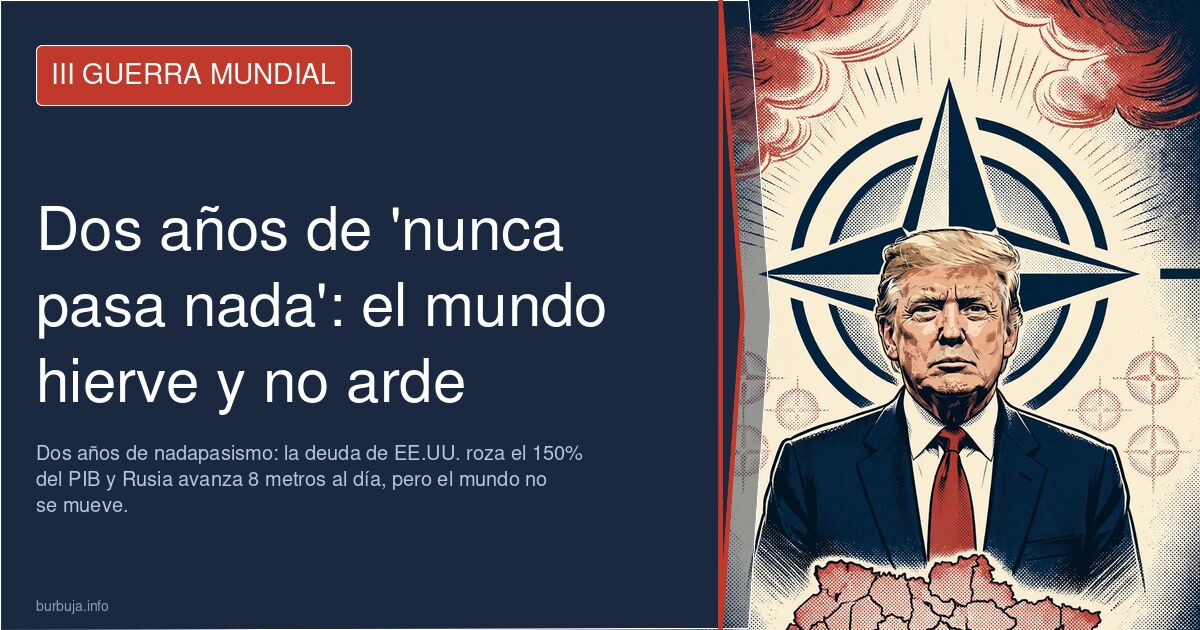
October, the last trench: two years without global movement
It was supposed that October would be the last trench. Israel's ground incursions into Lebanon, the collapse of Ukrainian defenses in Donbas, Western missile attacks on Moscow. None of it materialized. Two years later, "nadapasismo"—that perception that the world is burning but decisive events never arrive—continues to define the geopolitical reading.
The balance of bogged-down conflicts
In the Eastern front, Russia advances 8 meters per day, according to conflict monitoring; a tactical advantage that fails to translate into strategic change. In the Middle East, Israeli attacks on Iran resulted in impacts on irrelevant targets. The war in Ukraine, Gaza, Lebanon, Yemen, the Caucasus... All conflicts are there, but none reach the threshold of cataclysm that would change the board.
The Pardillo Theory and who pays the bill
The most repeated geopolitical analysis holds that the system operates on a "pardillo" logic: the power that absorbs the financial hemorrhage. Trinc the USSR, the new candidate is Europe, in a position of structural weakness. Meanwhile, the United States fulfills an agenda that involves degrading its role as a world power and fracturing NATO. The recent threat over Greenland fits into this strategy of attrition.
Data that refutes stability
Beneath the surface of calm, indicators of systemic risk are accumulating. US debt nears 150% of GDP and continues to rise. Strategic oil reserves are at historic lows. And the Federal Reserve appears trapped without room for maneuver. Added to this is European dependence: 2.2 million jobs on the Old Continent depend on purchasing military components and services from the U.S., an asymmetry that becomes political pressure.
The liturgy of infinite hope
Meanwhile, a semi-religious tradition persists that announces a decisive event for every October. After two calls with no result, skepticism has become the rule. But the cycle restarts: January 2026 was deemed the least "stagnant" of the last decade, and expectations are reactivated. The question is whether the status quo is more resilient than any prophecy.
The result is a loop in which reality advances at a snail's pace while expectations run in circles. No calculation of war cost-benefit seems to fit the theory of imminent collapse. While analysts debate whether the world is moving or merely swaying, the clock continues to mark the hour of an October that never arrives.
It was supposed that October would be the last trench. Israel's ground incursions into Lebanon, the collapse of Ukrainian defenses in Donbas, Western missile attacks on Moscow. None of it materialized. Two years later, "nadapasismo"—that perception that the world is burning but decisive events never arrive—continues to define the geopolitical reading.
The balance of bogged-down conflicts
In the Eastern front, Russia advances 8 meters per day, according to conflict monitoring; a tactical advantage that fails to translate into strategic change. In the Middle East, Israeli attacks on Iran resulted in impacts on irrelevant targets. The war in Ukraine, Gaza, Lebanon, Yemen, the Caucasus... All conflicts are there, but none reach the threshold of cataclysm that would change the board.
The Pardillo Theory and who pays the bill
The most repeated geopolitical analysis holds that the system operates on a "pardillo" logic: the power that absorbs the financial hemorrhage. Trinc the USSR, the new candidate is Europe, in a position of structural weakness. Meanwhile, the United States fulfills an agenda that involves degrading its role as a world power and fracturing NATO. The recent threat over Greenland fits into this strategy of attrition.
Data that refutes stability
Beneath the surface of calm, indicators of systemic risk are accumulating. US debt nears 150% of GDP and continues to rise. Strategic oil reserves are at historic lows. And the Federal Reserve appears trapped without room for maneuver. Added to this is European dependence: 2.2 million jobs on the Old Continent depend on purchasing military components and services from the U.S., an asymmetry that becomes political pressure.
The liturgy of infinite hope
Meanwhile, a semi-religious tradition persists that announces a decisive event for every October. After two calls with no result, skepticism has become the rule. But the cycle restarts: January 2026 was deemed the least "stagnant" of the last decade, and expectations are reactivated. The question is whether the status quo is more resilient than any prophecy.
The result is a loop in which reality advances at a snail's pace while expectations run in circles. No calculation of war cost-benefit seems to fit the theory of imminent collapse. While analysts debate whether the world is moving or merely swaying, the clock continues to mark the hour of an October that never arrives.
Summary of a discussion on Burbuja.info - Foro de economía, actualidad y política., translated from Spanish and reviewed before publication. Read the full discussion (275 replies).
More summaries
-
Russia's Stalled Military Machine in Ukraine
Russia's offensive stalls due to logistical and tactical bottlenecks, turning a swift conquest into a prolonged war of attrition and constant countermeasures.
-
Ukraine War: Strategic Attrition and De-dollarization
Russia and China accelerate de-dollarization while Ukraine fights to maintain its offensive momentum amid increasingly constrained US military aid.
-
Ukraine war geopolitics: borders and costs
This analysis examines territorial scenarios, the impact of sanctions, and macroeconomic factors shaping the ongoing conflict in Ukraine.
-
Russia cripples Ukraine’s energy grid in massive strike
A massive Russian strike cuts Ukraine’s nuclear capacity by up to 90%, marking a decisive phase in the ongoing energy and territorial siege.
-
Ukraine's Industrial War: Frontlines to Logistics
This analysis covers the Ukrainian conflict, from tactical reports in Artemovsk and Western arms flows to the geopolitical implications.
-
Ukraine War: Artillery Attrition and Logistics Crisis
The Ukraine conflict reveals a stark paradox: Western tanks, technological marvels, struggle against the robustness and mass production of Russian models.