
Stagnant Productivity: Why Spain Will Not Change Its Model
The Spanish production model has been stalled for two decades: taxation that punishes growth, cheap labor, and no political party willing to address the issue.
English · Original discussion in Spanish · Published
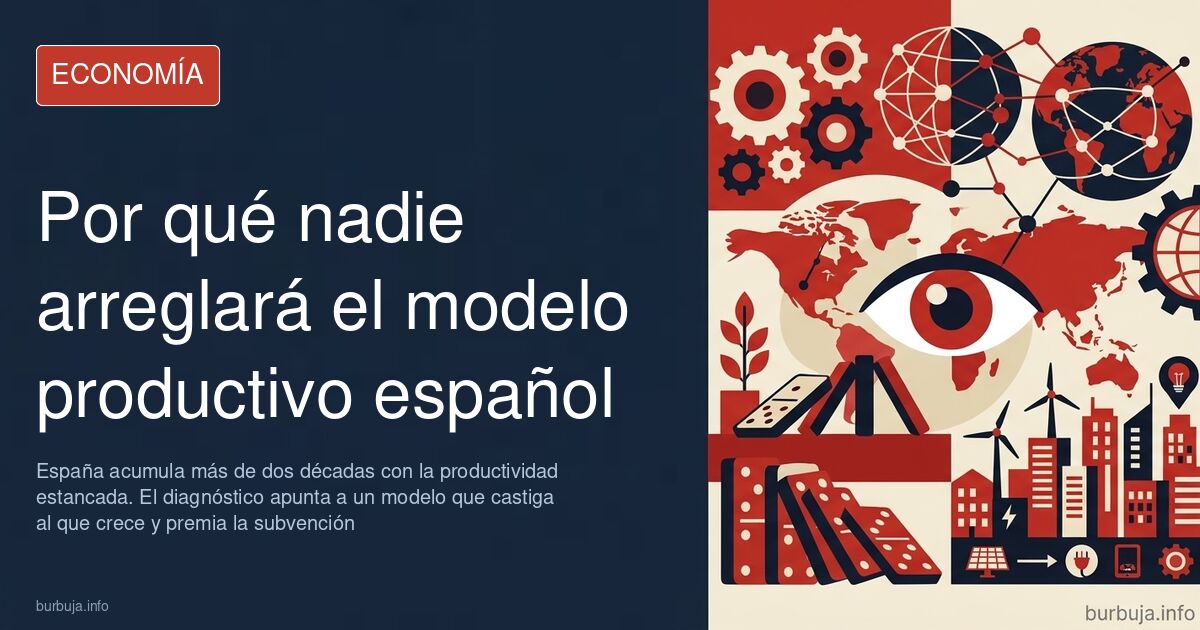
Spain's Productive Suicide: Nobody is Going to Touch the Model
Spain does not have a productivity problem. It has a model that functions exactly as designed. Two decades of stagnation is not a bad run or a statistical accident: it is the predictable consequence of a system of incentives that rewards small scale, subsidized operations, and immediacy.
The discussion about the Spanish production model has spent years turning over the same pieces—education, taxation, housing, demographics—almost always in isolation. Together, they tell a different story.
Spain Never Had an Industry to Compete With That It Could Afford to Lose
The narrative of the industrial miracle collapses when looking at the trade balance. In 1965, importing a German car was a luxury of the wealthy: with a weak currency and high tariffs, the domestic market filled up with products offering decent quality-to-price ratio that no one could compare to anything better. That wasn't competition; it was selling without a rival.
Despite this, that hyper-protected industry did generate an internal demand for technicians and engineers trained in vocational schools and universities: the embryo of a technical human capital that later diluted. Exports were minimal. The scaffolding held up as long as the tariffs lasted.
This is also where the complex issue enters marketing. Spanish brands that grow tend to disguise their origins—Italian or Anglo-Saxon surnames for companies born in Valencia or Galicia—because the national label does not sell engineering. It sells something else.
The 50-Employee Threshold and the Taxed Profit
This is where the example that best summarizes the problem appears. An SME (Small and Medium Enterprise) faces a quarterly tax payment: let's say 10,000 euros. Logic suggests that instead of paying it to the Tax Agency, they should invest in a machine, produce more, and grow. The regulation doesn't work like that: the investment is not counted as current expenditure; it must be amortized over several years. The result is a company paying to exist before it can become capitalized. Added to this is the threshold of 50 employees, the frontier where labor, bureaucratic, and fiscal obligations skyrocket. Generating profit is not forbidden, but it is taxed with an insistence that discourages reinvestment.
Cheap Labor Versus Robotics: Where Consensus Breaks Down
There is a current that holds that entrepreneurs only automate when the worker costs more than the machine. If the market is flooded with low-skilled labor at a low price, the return on investing in robotics lengthens, and it is not worthwhile for a small business. The uncomfortable conclusion would be: labor dumping kills the incentive to innovate. Opposing this is another argument, and it is not weak. China had millions of workers on meager wages and still invested in technology because a good product yields greater margins. For this second reading, what decides is not the cost of labor, but fiscal policy and the penalization of profit. Neither explains the Spanish case alone.
Demographics, Housing, and an Economy Addicted to Volume
The drop in birth rates affects all rich countries, but not equally. Where there is heavy industry and high-value human capital, the lack of arms can be compensated by robotics and per-employee productivity. Where the bulk of GDP comes from hospitality, low-value services, and property, it depends on the number of arms. This is the volume trap. With housing becoming out of reach for an average salary, the incentive to strive weakens: you work just to pay the roof.
Part of the analysis links this to migration policy, understood as a wage pressure valve; another reminds that precariousness and the lowering of labor costs run through all of Europe, not just Spain.
Pigs Compete, and Almost Nobody Talks About It
Not everything is smoke. Spain is a world leader in swine production: it exports to China, Korea, and Japan, and it is a highly technical activity that stabilizes the rural population. The chain is textbook: soy and corn arrive from Argentina and Brazil, processed into feed, fattened here, and the product goes abroad. The obvious question was asked one day by someone with little more than curiosity, during a long meal with local farmers: what prevents Argentinians, Brazilians, and Chinese from bypassing the Spanish intermediary?
One of those farmers, without a high school diploma, explained it with a clarity that no official report matches. The complete answer, with its market logic, is one worth reading entirely.
Why No Party Is Going to Reform This
The electoral cycle lasts four years, but the model requires twenty. Add to this 17 Autonomous Communities with university networks converted into instruments of local power and public companies used as a currency between governments of different signs. In that chessboard, changing the Spanish production model means touching the base of votes and clienteles for whoever attempts it. Politicians, like any other agent, respond to incentives.
Some will object that the diagnosis is too deterministic, that there is no master plan but short-term decisions and actors adapting to what they can. This is a reasonable nuance, but it does not save the conclusion.
And one cultural note that may not be anecdotal: countries that believe they can manufacture the future project it in their fiction first. The USSR of the fifties fed its engineers with utopian and cosmic literature; the United States, with pulp fiction and model rockets.
Here, the dominant narrative remains a nostalgia for what we once were.
If the diagnosis is correct, the next decade will not bring a model reform, but a finer management of its decay: more debt, more patches, and more low-value services competing on price. No one knows how much endurance is left. And equally, what could break it sooner.
Spain does not have a productivity problem. It has a model that functions exactly as designed. Two decades of stagnation is not a bad run or a statistical accident: it is the predictable consequence of a system of incentives that rewards small scale, subsidized operations, and immediacy.
The discussion about the Spanish production model has spent years turning over the same pieces—education, taxation, housing, demographics—almost always in isolation. Together, they tell a different story.
Spain Never Had an Industry to Compete With That It Could Afford to Lose
The narrative of the industrial miracle collapses when looking at the trade balance. In 1965, importing a German car was a luxury of the wealthy: with a weak currency and high tariffs, the domestic market filled up with products offering decent quality-to-price ratio that no one could compare to anything better. That wasn't competition; it was selling without a rival.
Despite this, that hyper-protected industry did generate an internal demand for technicians and engineers trained in vocational schools and universities: the embryo of a technical human capital that later diluted. Exports were minimal. The scaffolding held up as long as the tariffs lasted.
This is also where the complex issue enters marketing. Spanish brands that grow tend to disguise their origins—Italian or Anglo-Saxon surnames for companies born in Valencia or Galicia—because the national label does not sell engineering. It sells something else.
The 50-Employee Threshold and the Taxed Profit
This is where the example that best summarizes the problem appears. An SME (Small and Medium Enterprise) faces a quarterly tax payment: let's say 10,000 euros. Logic suggests that instead of paying it to the Tax Agency, they should invest in a machine, produce more, and grow. The regulation doesn't work like that: the investment is not counted as current expenditure; it must be amortized over several years. The result is a company paying to exist before it can become capitalized. Added to this is the threshold of 50 employees, the frontier where labor, bureaucratic, and fiscal obligations skyrocket. Generating profit is not forbidden, but it is taxed with an insistence that discourages reinvestment.
Cheap Labor Versus Robotics: Where Consensus Breaks Down
There is a current that holds that entrepreneurs only automate when the worker costs more than the machine. If the market is flooded with low-skilled labor at a low price, the return on investing in robotics lengthens, and it is not worthwhile for a small business. The uncomfortable conclusion would be: labor dumping kills the incentive to innovate. Opposing this is another argument, and it is not weak. China had millions of workers on meager wages and still invested in technology because a good product yields greater margins. For this second reading, what decides is not the cost of labor, but fiscal policy and the penalization of profit. Neither explains the Spanish case alone.
Demographics, Housing, and an Economy Addicted to Volume
The drop in birth rates affects all rich countries, but not equally. Where there is heavy industry and high-value human capital, the lack of arms can be compensated by robotics and per-employee productivity. Where the bulk of GDP comes from hospitality, low-value services, and property, it depends on the number of arms. This is the volume trap. With housing becoming out of reach for an average salary, the incentive to strive weakens: you work just to pay the roof.
Part of the analysis links this to migration policy, understood as a wage pressure valve; another reminds that precariousness and the lowering of labor costs run through all of Europe, not just Spain.
Pigs Compete, and Almost Nobody Talks About It
Not everything is smoke. Spain is a world leader in swine production: it exports to China, Korea, and Japan, and it is a highly technical activity that stabilizes the rural population. The chain is textbook: soy and corn arrive from Argentina and Brazil, processed into feed, fattened here, and the product goes abroad. The obvious question was asked one day by someone with little more than curiosity, during a long meal with local farmers: what prevents Argentinians, Brazilians, and Chinese from bypassing the Spanish intermediary?
One of those farmers, without a high school diploma, explained it with a clarity that no official report matches. The complete answer, with its market logic, is one worth reading entirely.
Why No Party Is Going to Reform This
The electoral cycle lasts four years, but the model requires twenty. Add to this 17 Autonomous Communities with university networks converted into instruments of local power and public companies used as a currency between governments of different signs. In that chessboard, changing the Spanish production model means touching the base of votes and clienteles for whoever attempts it. Politicians, like any other agent, respond to incentives.
Some will object that the diagnosis is too deterministic, that there is no master plan but short-term decisions and actors adapting to what they can. This is a reasonable nuance, but it does not save the conclusion.
And one cultural note that may not be anecdotal: countries that believe they can manufacture the future project it in their fiction first. The USSR of the fifties fed its engineers with utopian and cosmic literature; the United States, with pulp fiction and model rockets.
Here, the dominant narrative remains a nostalgia for what we once were.
If the diagnosis is correct, the next decade will not bring a model reform, but a finer management of its decay: more debt, more patches, and more low-value services competing on price. No one knows how much endurance is left. And equally, what could break it sooner.
Summary of a discussion on Burbuja.info - Foro de economía, actualidad y política., translated from Spanish and reviewed before publication. Read the full discussion (134 replies).
More summaries
-
Euthanasia in Old Age: Autonomy vs. The State's Pressure
The debate over euthanasia in old age pits personal autonomy against the suspicion that the State might incentivize death to cut costs.
-
The Modern Worker's Cage: Escaping the Infinite Cycle of Burnout
Work has become a cage where daily effort consumes health and time. Discover why we push ourselves so hard and how to break the cycle.
-
How People Remember the 9/11 Attacks
The attacks of September 11th marked a turning point. Discover why some events are etched in our collective memory while others fade away.
-
Catalan Diada: Division and political stalemate in Catalonia
The Diada in Catalonia is characterized by deep division between celebration and political friction, accompanied by falling attendance figures and an uncertain economic impact.
-
Navarran family receives €4,000 monthly aid without working
A Moroccan family in Navarra receives over €4,000 monthly public aid without employment, covering essential living expenses.
-
Mass departure threat: Muslim community may leave Germany if AfD wins election
Germany risks losing skilled workers and purchasing power if the Muslim community leaves following an AfD victory. We analyze the economic implications.