
Splicing the supply cable phase: legality, fines and the real cost
Splicing the phase of the service connection saves a job, but Spain's REBT wiring regulations require an unbroken run with no splices. Fines, an unsealed ICP breaker and an air conditioning circuit.
English · Original discussion in Spanish · Published
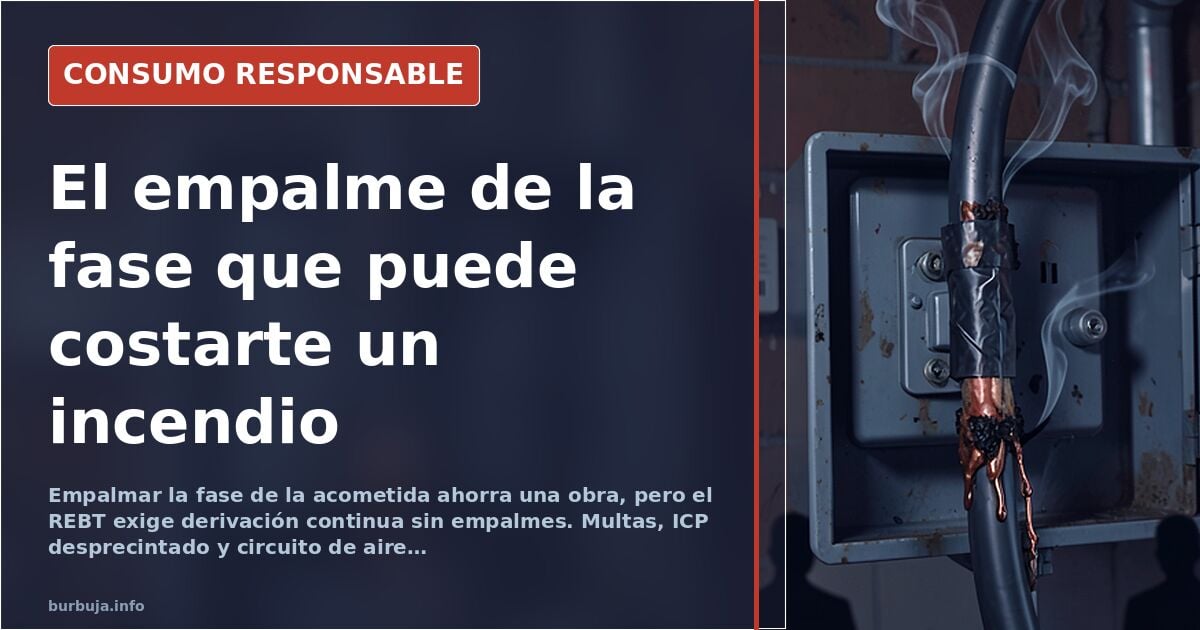
Splicing the phase to avoid a new supply connection: botched job or saving?
A consumer unit that has to move and a phase that no longer reaches the ICP (the main control breaker). The proposed solution: extend the brown cable from an intermediate junction box, hidden or concealed, and leave the rest of the service connection as it is. The saving is obvious. The question is whether that splice would survive an inspection, a fire or a simple check by the utility company. One participant's answer: the regulations do not allow it.
What the regulations say about splicing the individual branch circuit
According to one participant, the REBT (Spain's low-voltage electrotechnical regulations) requires the individual branch circuit — the section between the meter and the consumer unit — to be continuous, with no cuts or splices. A splice, even one made with a compression sleeve and heat-shrink tubing, is still a splice. And if there is ever an incident, that hidden point inside the wall is the first thing the loss adjuster looks at. The technical discussion splits in two: those who argue that a well-executed splice lasts a lifetime, and those who point out that copper oxidation in a connection that cannot be inspected raises resistance, heat and fire risk. The full calculation of what 10 mm² cable costs compared with a new service connection gives a difference that surprises.
The unsealed ICP and fines from the utility company
Relocating the ICP breaks the seal. The question is whether that leads to a penalty during an inspection. The practical answer that circulates: once the work is finished, notify the company so it can reseal it. There is no fine figure in the available material, but the procedure exists and is free or costs very little compared with the risk of an inspection finding a broken seal with no explanation.
Air conditioning: 20 A and 4 mm² or 25 A and 6 mm²?
The compressor is rated at a maximum of 1,350 W, about 7.21 A according to the calculation with a power factor of 0.85. With those figures, 20 A and 4 mm² is more than enough. But the regulations assign a 25 A breaker and 6 mm² cable to air conditioning circuit C9. The majority view: comply with the standard even if it seems over the top, because when an official certificate is requested nobody wants to argue with the electrician. The professional nuance: motors start with surges of up to seven times their rated current, and a breaker sized too tightly trips on every attempt.
The surge protector: widely varying prices and doubts about whether it is mandatory
The surge protection device appears as a recent requirement in some schemes, but whether it is mandatory is unclear. Prices range from two-pole, 25 A models with both transient and permanent protection. The gap between the retail price and what an electrician pays with a trade discount explains why many quotes seem excessive. The repeated advice: do not buy blindly and check the regulations of your autonomous community, because what applies in Bilbao may not apply in Cuenca.
The surprising detail: the cable feeding the compressor itself is 1.5 or 2.5 mm². The line from the consumer unit, per the standard, uses 6 mm². Oversizing the circuit does not protect the machine any better; it just satisfies the paperwork.
Summary of a discussion on Burbuja.info - Foro de economía, actualidad y política., translated from Spanish and reviewed before publication. Read the full discussion (15 replies).
More summaries
-
Finding a free, covered oil change spot in Madrid
Rain in Madrid makes finding a free, covered, unmonitored spot for an oil change difficult. Users discuss garages and DIY options.
-
Where to Find Good Heroin in Madrid?
Unofficial guide to Madrid's heroin market: dealing spots, adulterated quality, risks, and user accounts. Areas like Lavapiés and San Blas.
-
Mixed changing rooms in gyms: what we know and what we don't
Several users claim that a mixed changing room is the area with lockers and benches, while changing and showering take place in individual cubicles.
-
A 12-year-old Kindle and replaceable batteries: the real life of an e-reader
E-ink readers last more than a decade; it's the battery that fails. Replacing one costs from 9.55 euros and is not a job for beginners.
-
Jeans that shrink in the wash: what's going on with Levi's and Zara
Denim stretches with wear and shrinks when washed. The debate over whether branded jeans shrink more than cheap ones leaves prices and home remedies on the table.
-
Mazda CX-3 with vibrations: the dealership says it's normal
A new Mazda CX-3 vibrates and the workshop says it's normal. The owner has already tried an identical car that didn't vibrate and is considering taking Mazda to court under the warranty.