
Spanish worker awarded maximum pension at 49 due to health issues
A woman in Spain receives a maximum pension of €3,359.60 at age 49 following a court ruling on fibromyalgia, depression, and spinal stenosis.
English · Original discussion in Spanish · Published
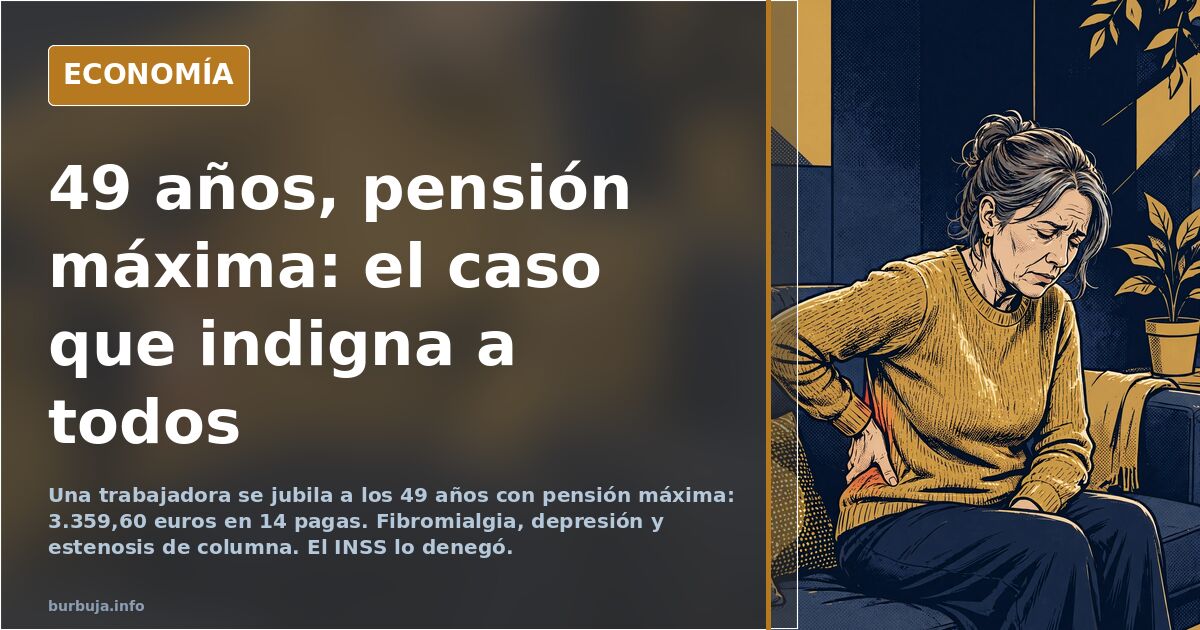
Maximum pension awarded at 49 due to fibromyalgia, depression, and spinal issues
A worker is retiring at age 49 with a lifetime pension representing 100% of her regulatory base, set at €3,402.86 per month. The INSS (the Spanish National Social Security Institute) initially denied her permanent total disability, claiming she did not meet the requirements. However, a court has ruled in her favor after evaluating a condition combining fibromyalgia, chronic migraines, foraminal stenosis in the L4 to S1 discs, and an anxious-depressive disorder requiring psychiatric care. The ruling maintains that any work performance, however light, requires a minimum effort that she cannot guarantee in any environment. The actual payment is capped by Article 57 of the General Law on Social Security: in 2026, the maximum pension amounted to €3,359.60 per month in 14 payments, meaning she loses €43.26 per month compared to her base.
How much is actually paid with a €3,402 regulatory base?
The headline of the case is often confusing. A regulatory base of €3,402.86 does not equate to a monthly salary of that amount; it is the reference figure used to calculate the benefit. The system's maximum pension stands at €3,359.60 per month distributed in 14 payments, and this is only reached by contributing at the maximum rate during the last 25 years of working life, according to financial sector calculations. With a base of €3,000, the resulting pension is significantly lower. The difference between what is contributed and what is actually received is the key detail many readers overlook.
Some argue that the system should limit maximum contributions and guarantee minimums and averages. Others suggest the problem is not the amount, but the procedure: a clinical diagnosis, without objective proof, being converted into a lifetime pension at an early age. They remind us that fibromyalgia is diagnosed by symptoms rather than biomarkers. Spinal stenosis, on the other hand, is visible on imaging tests and is disabling on its own. This distinction is central to the entire case.
Fibromyalgia and depression: the diagnosis that divides
Fibromyalgia affects nine women for every one man, according to available data. It is not an imaginary illness, but its diagnosis is clinical and subjective, making it a legal minefield. For a court to grant absolute disability with a maximum pension, it implies, according to cold analysis, a compelling medico-forensic report and a solid legal defense. The ruling cites a severe depressive episode in May 2022 involving suicidal ideation, which triggered a surveillance protocol. That detail carries more weight than the label itself.
The social reaction has been harsh. Part of the public considers this an abuse of the system that could set a precedent. Another part notes that while spinal stenosis can be operated on and usually results in recovery, the combination with a severe psychiatric disorder changes the prognosis. The debate over whether the system is generous or simply protective remains open.
The legal cap that reduces the pension
Article 57 of the General Law on Social Security imposes a maximum limit on pensions. In 2026, this maximum amount for disability was €3,359.60 per month in 14 payments. The worker loses €43.26 per month compared to her regulatory base of €3,402.86. While not a dramatic difference, it illustrates that even a high contribution base does not guarantee receiving 100% if the legal cap is applied.
The full calculation, including supplements and extra payments integrated into the base, results in a figure that surprises those who confuse a regulatory base with a net salary. This confusion is common: people compare the pension to a monthly salary and conclude the system overpays. In reality, the contribution base includes concepts that never fully reach the monthly paycheck.
Would a man receive the same?
This question permeates the entire case. Some argue that a man with the same clinical profile would not have received the same ruling, while others respond that the issue is not gender but the lack of objective criteria in assessing illnesses without biological markers. Fibromyalgia statistics, with a nine-to-one ratio, fuel both perspectives.
The underlying debate is different: should the system compensate for subjective pain or only for demonstrable disability? Foraminal stenosis is visible on an MRI. Severe depression with suicidal ideation is documented in a medical history. Fibromyalgia, on its own, is more debatable. The ruling relies on the combination of all factors, not a single element.
Unresolved issues from the case
The worker will receive the maximum permitted pension in 14 payments, losing €43.26 monthly due to the legal cap. The INSS initially denied the benefit, leading the plaintiff to appeal. It remains to be seen whether this criterion will extend to similar cases or if courts will continue to require such a comprehensive clinical picture. The boundary between absolute disability and total disability remains the most contested line in the system. And no one has yet explained why the same illness can produce opposite rulings depending on the court involved.
Also available in: Deutsch
Summary of a discussion on Burbuja.info - Foro de economía, actualidad y política., translated from Spanish and reviewed before publication. Read the full discussion (102 replies).
More summaries
-
Claim: Spain’s Pension Fund Short €50 Billion for Three Months
Viral post claims Social Security lacks funds for three months of pensions. Debate covers the reserve fund, contributions, and potential solutions.
-
Spain's Social Security covers only 70% of pension costs
Social Security income covers just 70% of pension spending, fueling debate on immigration's impact on the system.
-
Burgos Man Loses Pension After 27 Years of Contributions
A Burgos resident loses his pension despite 27 years of contributions, exposing a bureaucratic trap in Spain's Social Security system.
-
58 million Americans collect tax-free Social Security with just 10 years of contributions
58 million Americans receive Social Security benefits tax-free with only 10 years of contributions. The average pension is $24,000. Here is how the system works.
-
Spain: Barcelona residents born in Spain now a minority under 45
According to ABC, immigrants and their children are now the majority in Barcelona under 45; between 25 and 44, those born in Spain are a minority. The figure that…
-
Alvise is the ONLY one denouncing the Moroccan agitator from Ceuta who works for the PSOE
Alvise Pérez posts a video on X of a scuffle with the PSOE's number one candidate for Congress in Ceuta. The National Police subdue him. What is known and what is not.