
Spanish soldier dies in NATO live-fire exercise in Poland
A 43-year-old Spanish corporal died during the Saber Strike exercise in Poland, part of NATO's Steadfast Defender 24 maneuvers.
English · Original discussion in Spanish · Published
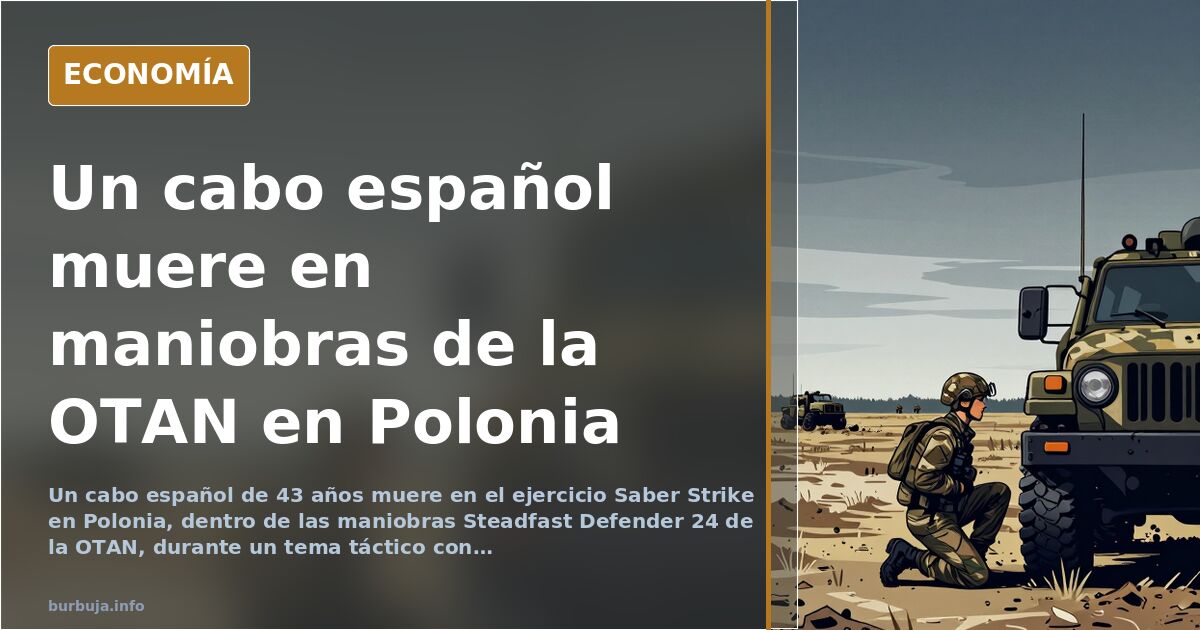
Spanish corporal dies in NATO live-fire exercise in Poland
Corporal B.G.P.A., aged 43, father of two daughters and originally from Ecuador, died during the Saber Strike exercise at the Bemowo Piskie training area in Poland. He belonged to the Regulares Group Ceuta 54 and had served in the Land Army since 2004. The Land Army reported that "an accident occurred during the execution of a tactical scenario with live fire," within the framework of the Steadfast Defender 24 maneuvers, the largest in NATO history. The official version states it was an accident. A mortar explosion is the cause suggested by a forum user citing a military comrade, without official confirmation.
What is known about the deceased soldier and the maneuvers
The corporal was 43 years old, had two daughters and a twenty-year career in the army. He held the Bronze Cross for Constancy in Service and the Commemorative Medal for Operation Balmis, created by Royal Decree 701/2020 to recognize personnel who fought against ELbichito-19. His unit was the Regulares Group 54 in Ceuta. The Land Army conveyed its condolences to his family and unit colleagues.
Steadfast Defender 24 mobilizes tens of thousands of allied troops in a scenario simulating a large-scale conflict. The Saber Strike exercise, involving live fire, took place at the Bemowo Piskie field. The location is not coincidental: Poland shares a border with Ukraine and the Russian enclave of Kaliningrado, a strategic corridor in the Baltic. 23,000 NATO soldiers were operating 70 kilometers from the Russian border, according to a message posted on the forum.
Accident or hidden casualty: the suspicion surrounding the case
The official version is an accident during an exercise. The circulating suspicion is different: that a combat casualty is being concealed. The precedent cited is the war in former Yugoslavia, where, as recalled, all Spanish soldiers died in traffic accidents and armored vehicles proved more dangerous than enemy fire. That stage gave way to accidents on ships and in maneuvers. The conclusion drawn: Spain does not acknowledge casualties in wars in which it does not officially participate.
Some argue that the deceased died serving foreign interests under the NATO flag, not Spain's. Others defend the opposite view: that the Spanish flag is defended in Ceuta and that the deployment in Poland is part of the country's international commitments. The most repeated criticism is not of the mission, but of the narrative: treating as an accident what could be something else. Caution is mandatory: there is no official confirmation of either hypothesis.
Mortars, live fire and the lottery of maneuvers
Handling mortars and explosives in live-fire exercises is a controlled-risk activity, not free from accidents. Those who have undergone shooting instruction remember the tension of night assaults, with the platoon waiting for no one to cross the line of fire. The specific cause of death has not been officially confirmed beyond the reference to an accident in a tactical scenario.
The debate over troop working conditions appears in parallel. A salary around €1,500 is mentioned for those handling lethal material, along with the harshness of postings and lack of promotion. After twenty years of service, the deceased was still a corporal. Some see this as evidence that a military career does not compensate, while others respond that the rank structure works this way and vocation is not measured in promotions.
What Spain stakes on NATO's eastern flank
Spain's deployment in Poland falls within its commitment to the Atlantic Alliance. The underlying discussion is whether that commitment responds to national interests or those of third parties. One current argues that the Spanish armed forces are neglecting their duties, not defending national borders, and serving a foreign strategy. Another responds that European security is indivisible and that the eastern flank is also Spain's.
The scarce consensus lies in the condolences to the family. Two daughters without a father, a widowed vvife, and a 43-year-old soldier who will not return. The rest is dispute: about NATO, about the official narrative, about whether the sacrifice makes sense. The open question remains the same as in every international mission: how many accidents must occur before they stop being called accidents.
Key facts
Corporal B.G.P.A., aged 43, father of two daughters and originally from Ecuador, died during the Saber Strike exercise at the Bemowo Piskie training area in Poland. He belonged to the Regulares Group Ceuta 54 and had served in the Land Army since 2004. The Land Army reported that "an accident occurred during the execution of a tactical scenario with live fire," within the framework of the Steadfast Defender 24 maneuvers, the largest in NATO history. The official version states it was an accident. A mortar explosion is the cause suggested by a forum user citing a military comrade, without official confirmation.
What is known about the deceased soldier and the maneuvers
The corporal was 43 years old, had two daughters and a twenty-year career in the army. He held the Bronze Cross for Constancy in Service and the Commemorative Medal for Operation Balmis, created by Royal Decree 701/2020 to recognize personnel who fought against ELbichito-19. His unit was the Regulares Group 54 in Ceuta. The Land Army conveyed its condolences to his family and unit colleagues.
Steadfast Defender 24 mobilizes tens of thousands of allied troops in a scenario simulating a large-scale conflict. The Saber Strike exercise, involving live fire, took place at the Bemowo Piskie field. The location is not coincidental: Poland shares a border with Ukraine and the Russian enclave of Kaliningrado, a strategic corridor in the Baltic. 23,000 NATO soldiers were operating 70 kilometers from the Russian border, according to a message posted on the forum.
Accident or hidden casualty: the suspicion surrounding the case
The official version is an accident during an exercise. The circulating suspicion is different: that a combat casualty is being concealed. The precedent cited is the war in former Yugoslavia, where, as recalled, all Spanish soldiers died in traffic accidents and armored vehicles proved more dangerous than enemy fire. That stage gave way to accidents on ships and in maneuvers. The conclusion drawn: Spain does not acknowledge casualties in wars in which it does not officially participate.
Some argue that the deceased died serving foreign interests under the NATO flag, not Spain's. Others defend the opposite view: that the Spanish flag is defended in Ceuta and that the deployment in Poland is part of the country's international commitments. The most repeated criticism is not of the mission, but of the narrative: treating as an accident what could be something else. Caution is mandatory: there is no official confirmation of either hypothesis.
Mortars, live fire and the lottery of maneuvers
Handling mortars and explosives in live-fire exercises is a controlled-risk activity, not free from accidents. Those who have undergone shooting instruction remember the tension of night assaults, with the platoon waiting for no one to cross the line of fire. The specific cause of death has not been officially confirmed beyond the reference to an accident in a tactical scenario.
The debate over troop working conditions appears in parallel. A salary around €1,500 is mentioned for those handling lethal material, along with the harshness of postings and lack of promotion. After twenty years of service, the deceased was still a corporal. Some see this as evidence that a military career does not compensate, while others respond that the rank structure works this way and vocation is not measured in promotions.
What Spain stakes on NATO's eastern flank
Spain's deployment in Poland falls within its commitment to the Atlantic Alliance. The underlying discussion is whether that commitment responds to national interests or those of third parties. One current argues that the Spanish armed forces are neglecting their duties, not defending national borders, and serving a foreign strategy. Another responds that European security is indivisible and that the eastern flank is also Spain's.
The scarce consensus lies in the condolences to the family. Two daughters without a father, a widowed vvife, and a 43-year-old soldier who will not return. The rest is dispute: about NATO, about the official narrative, about whether the sacrifice makes sense. The open question remains the same as in every international mission: how many accidents must occur before they stop being called accidents.
Key facts
- 43 years old and two daughters: profile of the deceased corporal
- 2004: year of entry into the Land Army
- 23,000 NATO soldiers 70 km from the Russian border, according to a forum message
- €1,500: troop salary mentioned in the case
Also available in: Deutsch
Summary of a discussion on Burbuja.info - Foro de economía, actualidad y política., translated from Spanish and reviewed before publication. Read the full discussion (130 replies).
More summaries
-
Spain Deploys Mountain Troops to Finland for NATO Mission
Spain will deploy Mountain Troops Command units to Finland as a NATO contribution. The King will visit the Jaeger Brigade hosting the soldiers.
-
Gisbert gives Spain's government 24 hours and calls march on Ceuta
Rubén Gisbert gives the government 24 hours and announces a march on Ceuta to defend the city, whose population has swelled from 80,000 to 130,000. The debate is raging.
-
Zarzuela summons Sánchez: The meeting Moncloa doesn't acknowledge
The King reportedly summoned Sánchez at Zarzuela following his meeting with the military establishment and the announcement of the Ceuta trip. The official agenda makes no mention of the encounter, and...
-
Mississippi Bill Proposes $10,000 Fine for Masturbation
Mississippi senator proposes fines up to $10,000 for non-reproductive masturbation. Unlikely to pass, but sparks debate on birth rates.
-
Glovo Ends False Self-Employment After €205M Fines
Glovo abandons the false self-employment model in Spain after accumulating €205.3 million in fines since 2023, announcing direct contracts for all riders.
-
Sex as Transaction: The Debate on Paying for Intimacy
Is paying for sex a moral failure or just another economic exchange? A look at the clash between abolitionists and those who view love as non-purchasable.