
Spanish Small Businesses Vanish as Immigrant-Owned Shops Thrive
Bureaucracy and taxes crush Spanish freelancers while immigrant-owned shops proliferate. Analysis of a phenomenon emptying neighborhoods.
English · Original discussion in Spanish · Published
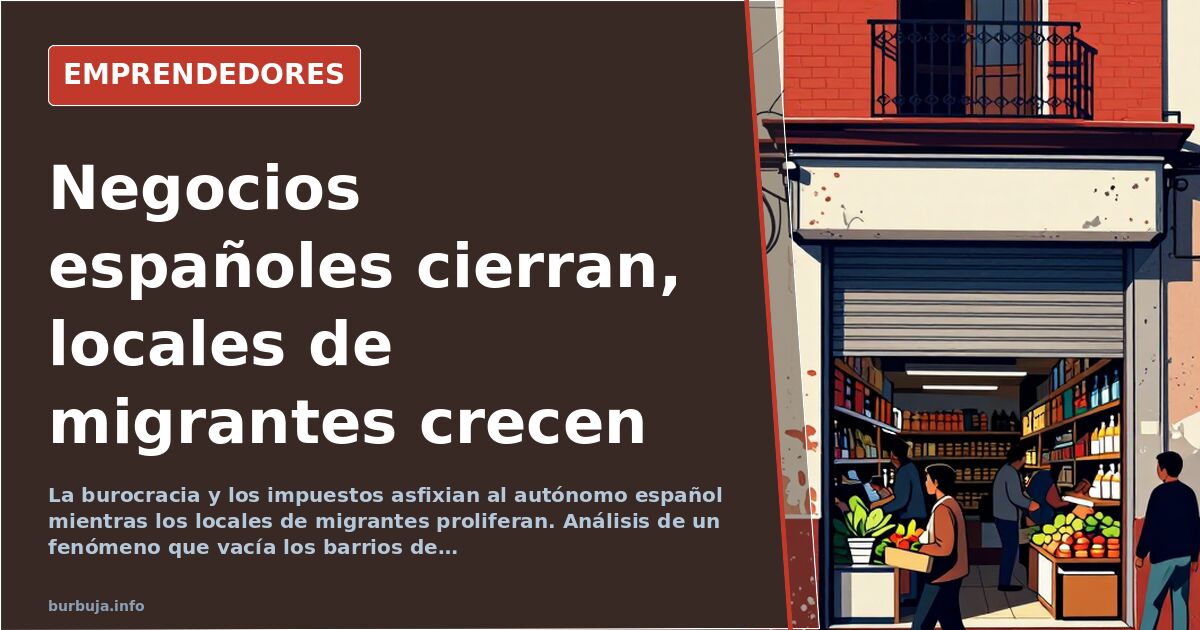
Spanish Small Businesses Vanish as Immigrant-Owned Shops Thrive
There is a scene that repeats in every neighborhood in Spain: the long-standing bakery closes its shutters, and weeks later, a fruit shop run by immigrants opens in the same premises. This is not an impression. It is a pattern that has been consolidating for years, moving from anecdotal to structural. The question hanging in the air is not whether it happens, but why it happens and who benefits.
The phenomenon has multiple layers. On one hand, there is the bureaucratic and fiscal suffocation suffered by Spanish self-employed workers (autónomos): fees, licenses, inspections, and a tax burden that turns any attempt to start a business into an obstacle course. On the other, there are niches where competition operates under different rules, or sometimes completely outside them. In the middle lies a labor market that pushes locals out of entire sectors while importing workforce willing to accept conditions no longer tolerated here.
Bureaucracy as an Entry Filter
Opening a business in Spain requires patience. Procedures pile up, deadlines stretch, and entrepreneurs end up exhausted before earning their first euro. An illustrative case: a freelancer with two employees can take months to complete all permits, including opening licenses, tax registrations, and various certificates. Meanwhile, time runs and fixed costs do not forgive.
The complaint is not new, but it has intensified. The feeling that the system is designed so only large companies or those with established structures can survive is increasingly widespread. Small commerce, which gave character to neighborhoods, becomes a victim of a hostile environment that does not distinguish between someone wanting to open an artisanal bakery and someone seeking a quick profit.
Bureaucracy is not neutral: it punishes those starting from scratch. And when entry costs are this high, only a few can afford them. The rest either stay out or seek alternative formulas that often skirt legality.
Why Do Immigrant-Owned Businesses Seem Immune to Crisis?
There is a growing perception that shops run by immigrants do not suffer the same closures as Spanish ones. The reasons cited vary. Some point out that many of these businesses function as self-employment to regularize administrative status, aiming less at profitability than at meeting requirements to obtain or maintain residence permits.
Others note support networks within certain communities allow sharing expenses, distributing tasks, and reducing fixed costs in ways average Spaniards cannot replicate. Also mentioned is the willingness to work exhausting hours, often in conditions abusa labor regulations, granting a competitive advantage hard to match.
The uncomfortable question is whether this advantage is legitimate or based on breaking rules. Opinions differ. Some argue it is pure survival in a hostile environment; others denounce unfair competition enabled by administrative leniency.
Decline of Traditional Spanish Commerce
Closing iconic businesses is not just economic; it is cultural. Artisanal bakeries, typical taverns, tailors, and traditional bread shops are disappearing, taking pieces of identity with them. This is not misplaced nostalgia, but recognition that a business model viable for decades ceases to be so overnight.
Causes are multiple: failed generational succession, competition from large chains, changing consumption habits, and above all, a regulatory environment unfavorable to small players. The result is a commercial landscape increasingly homogeneous, dominated by franchises and low-cost outlets.
Ironically, while historic businesses close, others proliferate, often occupying the same spaces with questionable quality proposals. This is not a value judgment but a market observation: consumers reward low prices and convenience, with consequences.
Role of Subsidies and Unfair Competition
One controversial point concerns public subsidies. It is argued that certain groups access grants and benefits unavailable to Spanish freelancers, creating unequal conditions. Add underground economy and lack of inspection in specific sectors, resulting in a tilted playing field.
Complaints about unfair competition are not new but have gained weight amid evidence that many outlets operate with margins impossible for those complying with all obligations. Inspections exist, but their reach is limited, spreading a sense of impunity.
Some defend that the problem is not immigrants, but a system allowing some to comply while others do not. Others directly blame the Government for deliberately fostering this imbalance. Regardless, discontent is real, translating into growing social tension.
Future of Entrepreneurship in Spain
The outlook discourages optimism. Young Spaniards, burdened by low wages and high housing prices, see self-employment as unattractive. Bureaucracy, taxes, and uncertainty discourage even the most vocation-driven. Meanwhile, generational succession in traditional businesses breaks down, and closed shops rarely reopen with Spanish projects.
The question is not if the current model is sustainable, but how long it will last without deep reform. That reform does not arrive, neither from administration nor from a business sector looking more to Brussels than to the neighborhood.
The result is an ecosystem where legal entrepreneurship becomes harder, while trickery and underground economy thrive. "Bread today, hunger tomorrow," some would say. Others simply count the closed shops on their street.
Has anyone considered what happens when the last Spaniard closes their business shutter and no one remains who knows how to make real bread?
Also available in: Deutsch
Summary of a discussion on Burbuja.info - Foro de economía, actualidad y política., translated from Spanish and reviewed before publication. Read the full discussion (120 replies).
More summaries
-
Dubai Property Sales to Spaniards: A Business Under Scrutiny
Selling Dubai apartments to Spaniards: a recurring business, but questions linger about affordability and Gulf risks.
-
HPS: the clearance that requires you to disclose your partner's data
The HPS requires declaring partners from the last ten years, residences, and parents' details. Refusing to fill it out can put your job at risk.
-
Couscous vending machines near migrant youth centers: business or bust?
An analysis of the viability of placing couscous vending machines next to centers for unaccompanied migrant minors: margins, real demand and operational risks debunk the myth.
-
Esquelas Cantabria: funeral death notices startup hunts for a business model
A death notices portal for Cantabria, Spain, has sparked debate over its viability: advertising, subscriptions or charging funeral homes. Does it have a future?
-
Companion services website sells for 700 euros
A website with growing organic traffic and 200-euro sponsored posts is listed for 700. The price clashes with legal doubts and valuation concerns.
-
Why an entrepreneur picks free QGIS over paid ArcGIS
An entrepreneur uses free QGIS for a landscape impact study for the Catalan government and saves the ArcGIS licence fee. Free software versus bureaucracy.