
Spanish public TV airs monologue demanding men's 'salary and silence'
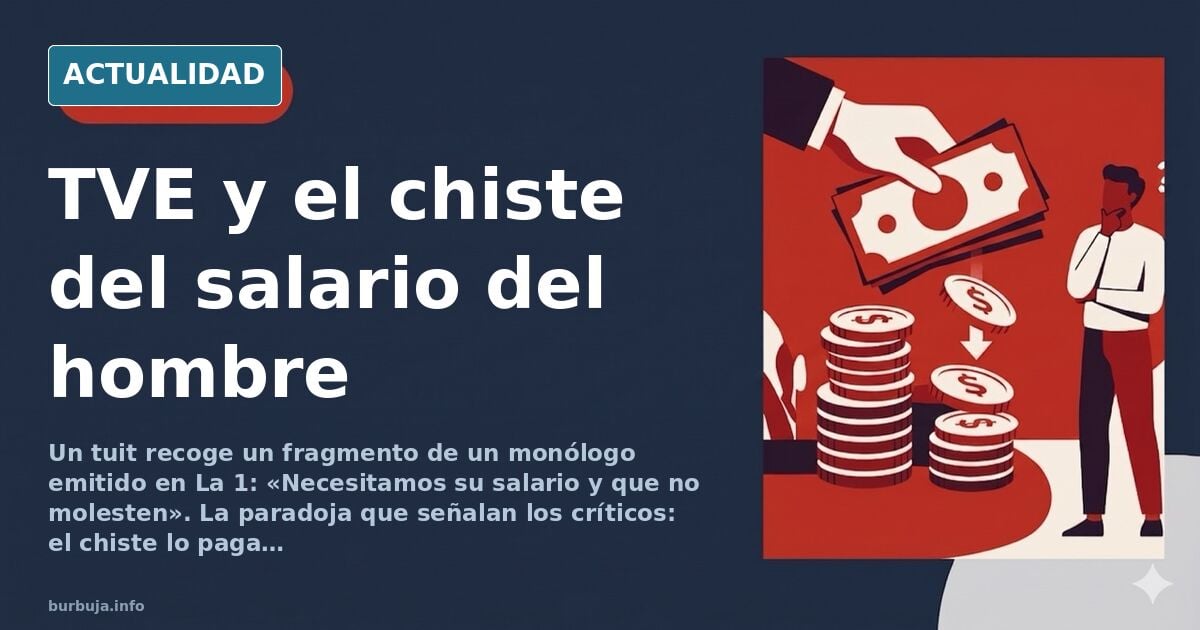
A tweet shares a clip from a monologue aired on Spain's public channel La 1: 'We need your salary and for you not to bother us.' Critics point out the paradox: the joke is paid for by…
English · Original discussion in Spanish · Published
Spanish public TV airs monologue demanding men's 'salary and silence'
A tweet shares the clip of a monologue first aired on La 1 in which the comedian declares: 'We don't need a man's validation to achieve absolutely anything. We need your salary and for you not to bother us.' The line, spread as a screenshot, has worked like a match in a powder keg. For several participants, it is not an isolated line: it would be the summary of a type of humor that lives off portraying men as a comic category and, on the way, as an obligatory provider.
The issue has two layers. The first is the joke. The second is who pays for it. And that is where the conversation stops being about funniness and becomes about public money.
What the monologue aired on La 1 actually says
The text circulating attributes three chained ideas to the comedian: that women don't need male approval, that they do need a man's paycheck, and that this man, moreover, should not get in the way. The construction is deliberate: first validation is rejected, then the salary is claimed. The punchline —and don't bother us— turns the male into an economic function with an obligation to stay silent.
Some read an after-dinner joke there; others read a statement of intent. For critics, the problem with the second reading is that the joke has no twist, does not ridicule itself, offers no counterpoint. It is a line that only works if the audience nods along. And that, they argue, on public television is not humor: it is catechism.
Humor that doesn't laugh at itself
The most repeated criticism is not that the joke is offensive, but that it is bad. It is faulted for its lack of self-criticism: a comedian who never laughs at their own group ends up doing propaganda with a microphone. The comparison with earlier performers —comedians who filled theaters without needing a sermon— comes up again and again: talent didn't need the ideological framework, and the ideological framework doesn't replace talent.
The argument rests on something more uncomfortable: if the joke were good, there would be no need to defend it. Laughter cannot be decreed. And when a show needs its intention applauded, the joke has already failed as a joke.
Who pays for the joke: the salary that does arrive every month
Here the conversation turns economic. The monologue airs on public television, funded by taxes. The taxpayer portrayed as a nuisance is, at the same time, the one who sustains the structure that pays for the gag. The paradox is not minor: the man's salary is demanded, and it is collected from that same man's pocket, via taxation.
The underlying calculation is simple to state and hard to refute: if the message is that men only contribute a paycheck and a nuisance, the one financing the message is exactly that man. The independence proclaimed on stage rests on a transfer that is never mentioned on stage.
Audience weariness and fatigue with the topic
Beyond the specific joke, what emerges is exhaustion. The sense that the same framework repeats itself in series, monologues, newscasts and institutional campaigns. When a topic becomes mandatory, it stops being a conversation and becomes noise. And noise, in the end, convinces no one: it only selects those who were already convinced.
That wear has a measurable cost in attention. The viewer who doesn't share the framework doesn't argue: they change the channel. And the one who shares it doesn't laugh either: they nod. Neither is humor.
The asymmetry: what if the joke were reversed
The most repeated argument in the discussion is the double standard. Some argue that if a male comedian had said in prime time that he only needed a woman's paycheck and for her not to bother him, the predictable outcome would be immediate condemnation, a public apology and probably the show's cancellation. That asymmetry —real or perceived— is what turns a weak joke into a political affair.
The discussion is not closed. No one has quantified the cost of the program, no one has measured its actual audience and no one has explained why the format remains. The joke is forgotten; the bill is not.
Summary of a discussion on Burbuja.info - Foro de economía, actualidad y política., translated from Spanish and reviewed before publication. Read the full discussion (99 replies).
More summaries
-
Sarah Santaolalla's latest post reignites criticism of Spain's RTVE
The latest post by Sarah Santaolalla, a feminist journalist at Spain's public broadcaster RTVE, has triggered a wave of personal attacks and speculation about her salary. The debate…
-
I'm a victim of hetero-pessimism (feminist humor)
Hetero-pessimism videos are taking off on social media: legitimate feminist humor or double-standard victimhood? An analysis of a phenomenon that divides opinion.
-
Public broadcasting's decline: how Spanish state TV degraded public debate
Spain's public television has become a stage for stridency and conflict, prioritising media noise over journalistic rigour and serious debate.
-
Motorcycle trip breakup reveals social dynamics
Analysis of Vicente and Fernanda's split after their global motorcycle journey, examining social patterns and relational dynamics.
-
PSOE Internal Nicknames Found in Leire Diez Notebook
A notebook attributed to Leire Diez lists nicknames for PSOE officials. The document remains unconfirmed and unrefuted.
-
AIDS Denialists and Their Nobel Laureates
A 2021 forum post calls for 'AIDS debunkers,' citing Nobel laureates who question HIV. The thread mixes names, theories, and insults.