
Spanish police union Jupol claims stand-down orders at Madrid's Sol square
Jupol spokesperson Laura García told Telemadrid that officers received orders not to act at Puerta del Sol in Madrid. The union links it to the 29N election campaign.
English · Original discussion in Spanish · Published
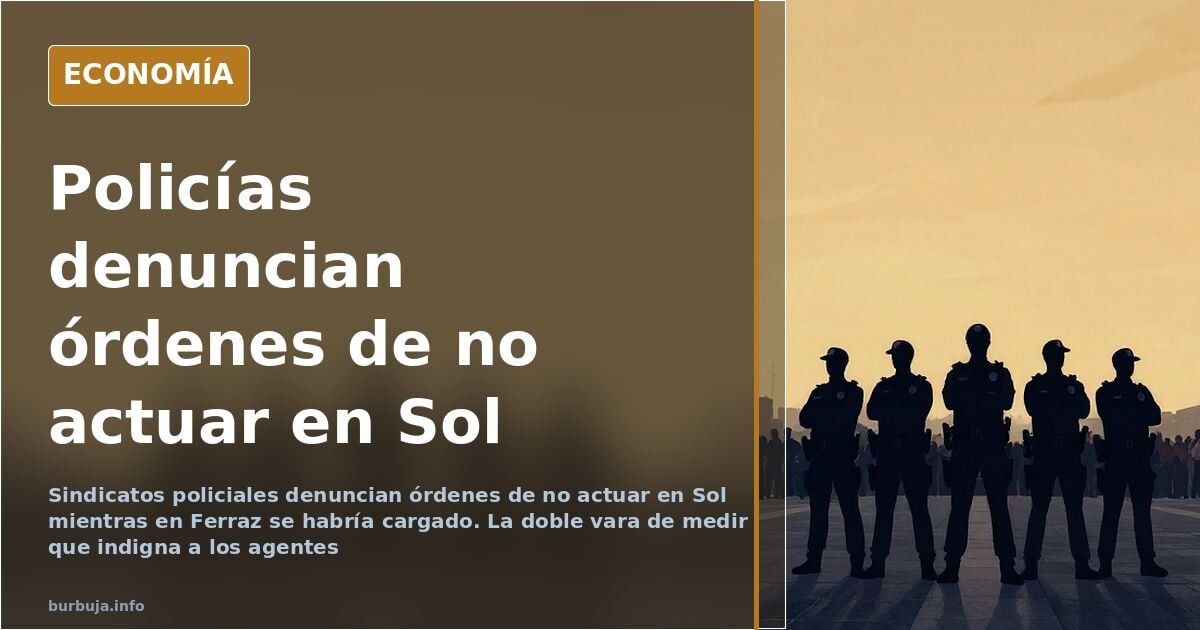
Jupol claims officers were ordered not to intervene at Sol
The paradox is hard to beat: while National Police and Municipal Police officers in Madrid are being told to stand aside at Puerta del Sol, police unions are publicly denouncing that they are ordered not to act. Jupol, a union representing Spain's National Police, has taken the complaint to the media: according to its spokesperson, Laura García, officers are being ordered not to intervene in certain disturbances in central Madrid. The issue has erupted in the middle of the 29N general election campaign, with the Government Delegation (the Interior Ministry's regional authority) in the spotlight.
What is happening at Puerta del Sol?
The events described in the material point to a series of altercations in Madrid's central square, including acts of vandalism against urban heritage — among them a statue of Carlos III — and assaults on police officers. The union's complaint does not focus on the disturbances themselves, but on the alleged passivity imposed from above. According to this account, the chain of command would have ordered the units not to intervene, leaving officers in an awkward position: present at the scene, but unable to respond.
The controversy unfolds against a backdrop of growing political tension. 29N, the date set for Spain's general election, turns any incident into sensitive material. The Government Delegation, which reports to the Interior Ministry, is the authority responsible for coordinating the security forces in such situations. For a police union to publicly denounce a stand-down order is, at the very least, a first-rate institutional clash.
The role of the Municipal and National Police
The material points to a division of responsibilities: the Municipal Police mainly handles administrative and traffic duties, while the National Police is tasked with public security and public order. The union's complaint targets those who, from the Government Delegation, would have the authority to deploy the National Police. The implicit accusation is that a decision was made not to do so.
Some argue that this selective passivity responds to political calculation: avoiding images of police charges in the middle of an election campaign. Others contend that the priority was not to add fuel to the fire in an already heated atmosphere. What is certain is that Jupol's complaint highlights an uncomfortable question: who decides when to intervene and when not to?
Reactions and the electoral context
The Jupol union has been particularly active lately in denouncing what it sees as a lack of institutional support for officers. Spokesperson Laura García has appeared in media outlets such as Telemadrid to explain the situation. The overlap with the election period adds pressure: any operational decision is read in political terms.
The material also includes opinions linking this passivity to earlier episodes, such as the handling of the migration crisis in Ceuta, where officers were also reportedly ordered not to intervene. The comparison, though debatable, reflects a latent discontent within part of the security forces.
Can a stand-down order be sustained indefinitely when officers are being assaulted and heritage is being damaged? As of this discussion, the answer remains unclear.
Also available in: Deutsch
Summary of a discussion on Burbuja.info - Foro de economía, actualidad y política., translated from Spanish and reviewed before publication. Read the full discussion (15 replies).
More summaries
-
Five Strokes in Brazil, No State-Paid Medical Repatriation
A retired Spanish police officer suffers five strokes in Brazil since July 2023, with the state refusing to cover his medical flight repatriation.
-
La Séptima: Channel Promoted by the Government Delegation
The Madrid Government Delegation promotes La Séptima, launching Nov 5. Critics point to Entrecanales and Manzano as the key shareholders.
-
Spain's minimum income benefit to rise 14% in 2027, tied to non-contributory pensions
Spain's IMV minimum income will rise almost 14% in 2027 due to its legal link to non-contributory pensions: from 733.60 to 836 euros per month for a single person.
-
Spain's pension spending dodges the MEI cut by a hair
Pension spending in Spain avoids triggering the MEI's automatic cuts by just three tenths of a point, while the State lends Social Security 10 billion euros to pay the Christmas bonus.
-
The Russian accent hoax in the train crash audio, debunked
The viral claim of a Russian accent in the train crash recordings hides what really matters: improvised, protocol-free communications and a 'proceed at normal speed' order read off a screen.
-
Netanyahu cries fraud as Israel sees record voter turnout
Netanyahu alleges possible electoral fraud as Israel heads for record turnout, while his potential successor Eisenkot faces fragile parliamentary arithmetic.