
Spanish police insulted after stopping scooter rider on sidewalk
A young man filmed and insulted a Mossos d'Esquadra officer for stopping his electric scooter on the pavement, reigniting debate over VMP fines in Spain.
English · Original discussion in Spanish · Published
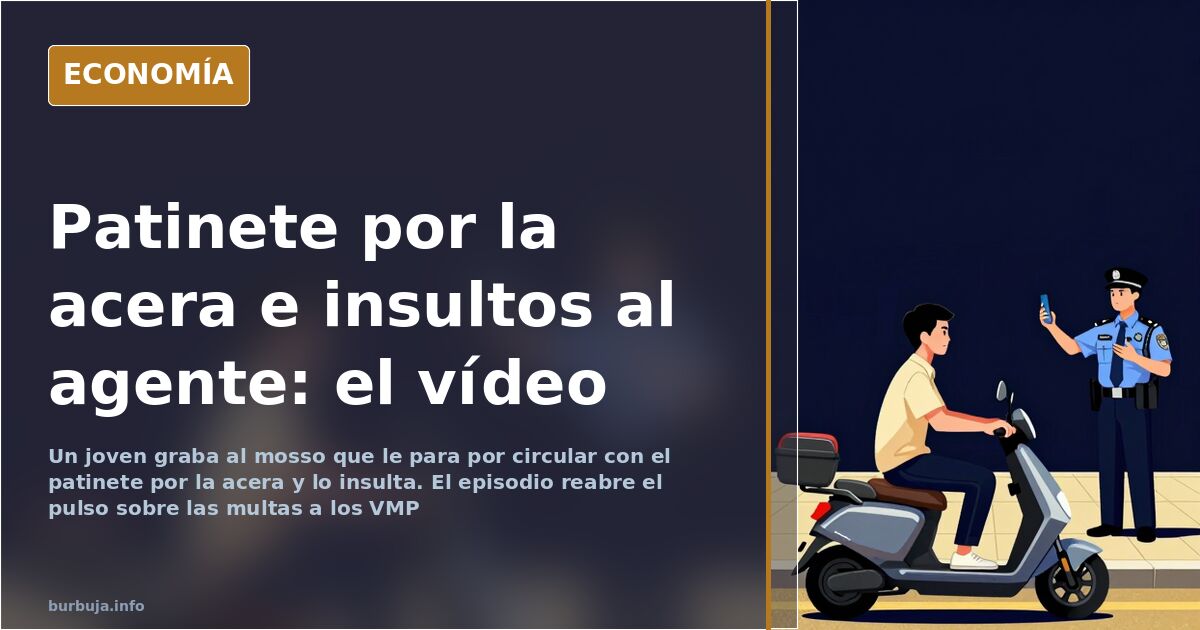
Scooter on the sidewalk and insults to the agent: the pavement conflict
A young man rides an electric scooter on the sidewalk. An officer stops him. The youth does not dismount; instead, he pulls out his phone, films the police officer, and hurls a string of insults at him, one referring to his sensual orientation. The video goes viral and reactions flood in. No one disputes the scene. What is debated—intensely—is what should be done about it.
This incident is not just a case of bad manners. It is a snapshot of a conflict that has been simmering for years on sidewalks, pedestrian streets, and bike lanes. The electric scooter arrived without a license, registration, or parking space, squeezing into areas where previously no one fit. The result is an elbow-to-elbow coexistence among pedestrians, cyclists, and small motorized vehicles.
What can you report against a scooter riding on the sidewalk?
Riding a personal mobility vehicle (VMP) on the sidewalk is prohibited and punishable by fine. That is the starting point, and also the only point where almost everyone agrees. From there, the list of complaints explodes: red lights ignored, decorative stop signs, forbidden directions, and two riders on the same device.
The criticism targets not just scooters but also bicycles, which cut through wherever convenient, and motorcycles, accused of similar disregard for rules with less scrutiny. Anything goes here, summarizes one comment.
The underlying problem is urban design. Light vehicles have multiplied without a corresponding increase in usable space, leaving pedestrians caught in the middle. When two legitimate users share a square meter, regulations cease to be paper and become a daily struggle.
The fine that never arrives: insolvency and impunity
A monetary penalty only works if it hurts. Here lies the argument running through the discussion: if the offender has no assets or salary, the fine is worthless. For a salaried worker, an administrative complaint eats up the month's paycheck. For those living outside the banking system, it is a number that is never enforced.
The reasoning stretches to the other end of the scale. The same system that fails to collect from the insolvent does not bother the wealthy either: both sit outside the mechanism. In the middle remains the worker who pays for everyone, exactly the feeling fueling anger.
Some point to technical solutions: digital currency and mandatory direct debit would end the impunity of those without bank accounts. This is a prediction, not a fact, and is presented as such. Until it happens—or doesn't—the message that sticks is simple: fines do not scare those with nothing to lose.
Insulting the uniform: crime, joke, or thermometer?
The scene has a layer beyond the scooter. The young man films the officer, likely to document any physical excess, while simultaneously insulting him face-to-face. Some see a calculated strategy: filming protects, insulting is free. Others simply see someone who does not measure consequences.
One interpretation views this as proof of the civil servant's patience, limiting himself to procedure without responding to the challenge. The opposing view argues that apparent passivity relates more to risk calculation than temperance: a forceful intervention filmed by a phone is now a labor and legal problem for the agent.
In the middle, a data point no one disputes: the youth filmed himself incriminating himself. If the idea was to appear superior, the result is the opposite. He faces a sanction for the sidewalk and another for how he addressed the officer, when all he had to do was get off the scooter and walk away.
Spitting on the ground is also reportable: the surprising detail
Among possible infractions appears one that surprises: spitting on the ground is listed as reportable conduct. One commenter admits they were unaware until checking. It is the kind of small data that disorients, revealing that the catalog of sanctions is wider than the average citizen imagines.
Another circulating suspicion is unequal treatment. Some comments suggest that with a different citizen profile, the response would have been much tougher, arguing that this perceived double standard explains the sense of impunity. It is an accusation made without proof, framed as such: it highlights discomfort over how force is graduated, not a proven fact in the video.
International comparisons also creep in. In the United States, it is argued, the scene would have ended differently, and not better for the driver. The comparison serves as a mirror and a threat, depending on who writes it.
Respect for authority, the great blind spot
Underlying all this beats an uncomfortable question: has respect for the police deteriorated, or has what always existed simply become visible? The video shows a youth shouting with his phone raised. It does not show whether this is an exception or the tip of a habit.
The most repeated complaint is not against the agent, but against the feeling that rules are applied conveniently. Some see the video as proof the system fails from below; others, that it fails from above. Almost no one accepts the official version of events.
The debate stalls right there, on a detail neither side resolves: if the fine is never collected, is it still a punishment or just a decorative receipt? With that unanswered question, the video will keep circulating and the sidewalks will remain full.
A young man rides an electric scooter on the sidewalk. An officer stops him. The youth does not dismount; instead, he pulls out his phone, films the police officer, and hurls a string of insults at him, one referring to his sensual orientation. The video goes viral and reactions flood in. No one disputes the scene. What is debated—intensely—is what should be done about it.
This incident is not just a case of bad manners. It is a snapshot of a conflict that has been simmering for years on sidewalks, pedestrian streets, and bike lanes. The electric scooter arrived without a license, registration, or parking space, squeezing into areas where previously no one fit. The result is an elbow-to-elbow coexistence among pedestrians, cyclists, and small motorized vehicles.
What can you report against a scooter riding on the sidewalk?
Riding a personal mobility vehicle (VMP) on the sidewalk is prohibited and punishable by fine. That is the starting point, and also the only point where almost everyone agrees. From there, the list of complaints explodes: red lights ignored, decorative stop signs, forbidden directions, and two riders on the same device.
The criticism targets not just scooters but also bicycles, which cut through wherever convenient, and motorcycles, accused of similar disregard for rules with less scrutiny. Anything goes here, summarizes one comment.
The underlying problem is urban design. Light vehicles have multiplied without a corresponding increase in usable space, leaving pedestrians caught in the middle. When two legitimate users share a square meter, regulations cease to be paper and become a daily struggle.
The fine that never arrives: insolvency and impunity
A monetary penalty only works if it hurts. Here lies the argument running through the discussion: if the offender has no assets or salary, the fine is worthless. For a salaried worker, an administrative complaint eats up the month's paycheck. For those living outside the banking system, it is a number that is never enforced.
The reasoning stretches to the other end of the scale. The same system that fails to collect from the insolvent does not bother the wealthy either: both sit outside the mechanism. In the middle remains the worker who pays for everyone, exactly the feeling fueling anger.
Some point to technical solutions: digital currency and mandatory direct debit would end the impunity of those without bank accounts. This is a prediction, not a fact, and is presented as such. Until it happens—or doesn't—the message that sticks is simple: fines do not scare those with nothing to lose.
Insulting the uniform: crime, joke, or thermometer?
The scene has a layer beyond the scooter. The young man films the officer, likely to document any physical excess, while simultaneously insulting him face-to-face. Some see a calculated strategy: filming protects, insulting is free. Others simply see someone who does not measure consequences.
One interpretation views this as proof of the civil servant's patience, limiting himself to procedure without responding to the challenge. The opposing view argues that apparent passivity relates more to risk calculation than temperance: a forceful intervention filmed by a phone is now a labor and legal problem for the agent.
In the middle, a data point no one disputes: the youth filmed himself incriminating himself. If the idea was to appear superior, the result is the opposite. He faces a sanction for the sidewalk and another for how he addressed the officer, when all he had to do was get off the scooter and walk away.
Spitting on the ground is also reportable: the surprising detail
Among possible infractions appears one that surprises: spitting on the ground is listed as reportable conduct. One commenter admits they were unaware until checking. It is the kind of small data that disorients, revealing that the catalog of sanctions is wider than the average citizen imagines.
Another circulating suspicion is unequal treatment. Some comments suggest that with a different citizen profile, the response would have been much tougher, arguing that this perceived double standard explains the sense of impunity. It is an accusation made without proof, framed as such: it highlights discomfort over how force is graduated, not a proven fact in the video.
International comparisons also creep in. In the United States, it is argued, the scene would have ended differently, and not better for the driver. The comparison serves as a mirror and a threat, depending on who writes it.
Respect for authority, the great blind spot
Underlying all this beats an uncomfortable question: has respect for the police deteriorated, or has what always existed simply become visible? The video shows a youth shouting with his phone raised. It does not show whether this is an exception or the tip of a habit.
The most repeated complaint is not against the agent, but against the feeling that rules are applied conveniently. Some see the video as proof the system fails from below; others, that it fails from above. Almost no one accepts the official version of events.
The debate stalls right there, on a detail neither side resolves: if the fine is never collected, is it still a punishment or just a decorative receipt? With that unanswered question, the video will keep circulating and the sidewalks will remain full.
Also available in: Deutsch
Summary of a discussion on Burbuja.info - Foro de economía, actualidad y política., translated from Spanish and reviewed before publication. Read the full discussion (107 replies).
More summaries
-
US Embassy Staff Collaborated with Police in Zapatero Money Laundering Probe
US embassy staff assisted Spanish police in the Zapatero money laundering investigation, sparking debate on political purges vs. justice.
-
Venezuelan man dies in Granada after crash on modified e-scooter
A man died in Granada after falling from an e-scooter capable of 120 km/h. Spanish law limits these vehicles to 25 km/h.
-
E-scooter on fire. Put that in your room and run.
Fire risk from e-scooters is real, and their batteries can burn. A recent incident highlights the danger.
-
Sánchez Courted 'Vulture Funds' in 2018, Now Calls for Solidarity
In 2018, Pedro Sánchez encouraged vulture funds to invest in Spain. Now, his government urges landlords to show solidarity and lower rents.
-
Ceuta faces 24 hours of migration chaos at border
On July 31, Ceuta saw emergency rooms overwhelmed by knife wounds and looting at the Spanish-Moroccan border.
-
Spanish Actor Pepe Viyuela Sparks Debate on Trump and Capitalism
Pepe Viyuela labels Trump a "jerk" and "stupid," fueling a polarized debate in Spain over his business acumen versus systemic privilege.