
Spanish police identify elderly woman for 'defiant look'
A Spanish officer identified an elderly woman outside PSOE headquarters in Madrid for a 'defiant look', while another was allegedly assaulted for filming.
English · Original discussion in Spanish · Published
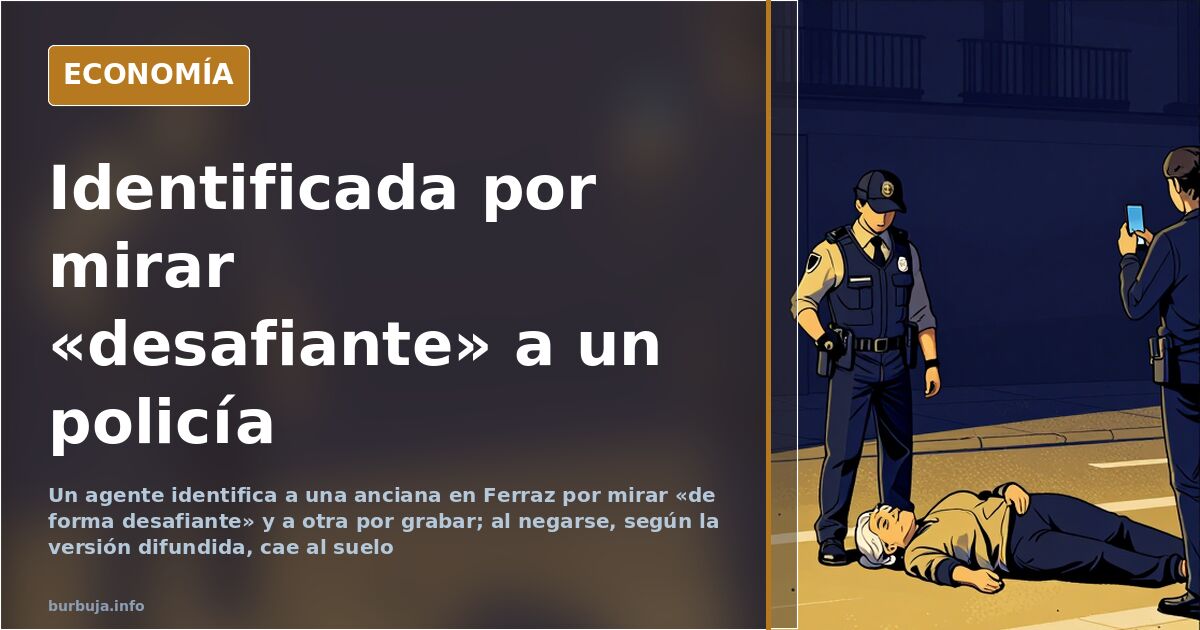
Spanish police identify elderly woman for 'defiant look'
A video filmed outside the federal headquarters of the PSOE (Spanish Socialist Workers' Party) on Ferraz Street in Madrid shows an officer identifying an elderly woman. The reason attributed to her during the clip's circulation: having looked at him "in a defiant manner." In the same scene, another woman is asked to stop recording with her phone; when she refuses, according to the version accompanying the images, she is assaulted and falls to the ground amid screams of "They're hitting me!" The images alone neither confirm nor deny either accusation.
What is known about the incident on Ferraz Street?
Ferraz is not just any street. For years, protest gatherings have taken place in front of the building housing the PSOE's federal headquarters, and this episode fits within that context. According to the circulating account, the first woman was approached due to her attitude—her gaze—and the second for recording. The latter allegedly struggled when refusing to provide identification and fell to the ground. No other reason is recorded for the first woman besides the gesture.
The framing is significant: two elderly women facing a single officer during a protest. This explains why the clip has spread faster than similar incidents and why the debate quickly shifted from the specific case to the institution as a whole.
Is it illegal to film a police officer on the street?
According to the criteria repeated in the discussion, no. The line drawn is clear: capturing the scene with a mobile phone does not constitute a crime; what may have consequences is disseminating it without pixelating faces. This nuance matters because the identification of the second woman occurred precisely because she was filming.
Another objection also frequently raised in the thread: some argue that officers are obligated to identify themselves when intervening and that confiscating phones from those recording is not part of any protocol. The circulated account insists on this order—first the badge, then the request—and claims the officer did not identify himself. Without an official statement from the force, this point remains open.
There is a third front: training. It is argued that the problem is not just the case, but the preparation required for the role: calls are made to demand higher education qualifications for entry and to remind everyone that the police function is to protect rights, not manage conflicts through authority.
The 'defiant look' becomes a meme
The clip has left a trail of catchphrases. The most repeated one mocks the idea of the "crime of the defiant look": looking down and ending sentences with "my master." Another, more sarcastic current proposes using the scream heard in the video as a summer hit song, asking for a techno remix, waiting for a DJ to adopt it.
This type of appropriation is not new. When an incident turns into sound—a scream, a catchphrase, a guttural start—the controversy splits: the event itself stops being debated, and the parody begins to circulate. Here, this peine within days, with the episode still lacking an official version to clarify it.
The minister's name in the video's screams
Among the voices heard in the recording appears the name of the Minister of the Interior, Marlaska, in a tone that leaves no doubt about who is being held responsible. This is the political framing of the episode: it is not read as a one-off excess by an officer, but as a symptom of a broader course of action.
Against this, some defend that the officer faced a group taunting and insulting him, and that generalizing based on a clip is unfair. Two frameworks that do not intersect: that of individual error and that of underlying policy.
Support for the police put to the test
The sequence has peine a rift in a sector that until now defended the force without nuance. Some argue that the scene proves that tolerance was based on a misunderstanding; others respond that in previous episodes—involving elderly people and protests of a different nature—people looked the other way.
Selective memory, it is pointed out, does not help establish criteria. What seems clear is that trust in the force has become conditional, and no one quite knows what sustains it anymore.
When support is needed, it won't be there
Underlying it all is a warning repeated in various words: if someday the force needs citizen backing, that backing will not be there. The response given to police in other countries is even cited as an uncomfortable contrast. And a detail closes the circle: the episode has not resulted in confirmed arrests or an official version, but it was enough to turn a scream into a catchy phrase. The video is no longer about two ladies on Ferraz Street. It is about what each person decided to believe before seeing it.
A video filmed outside the federal headquarters of the PSOE (Spanish Socialist Workers' Party) on Ferraz Street in Madrid shows an officer identifying an elderly woman. The reason attributed to her during the clip's circulation: having looked at him "in a defiant manner." In the same scene, another woman is asked to stop recording with her phone; when she refuses, according to the version accompanying the images, she is assaulted and falls to the ground amid screams of "They're hitting me!" The images alone neither confirm nor deny either accusation.
What is known about the incident on Ferraz Street?
Ferraz is not just any street. For years, protest gatherings have taken place in front of the building housing the PSOE's federal headquarters, and this episode fits within that context. According to the circulating account, the first woman was approached due to her attitude—her gaze—and the second for recording. The latter allegedly struggled when refusing to provide identification and fell to the ground. No other reason is recorded for the first woman besides the gesture.
The framing is significant: two elderly women facing a single officer during a protest. This explains why the clip has spread faster than similar incidents and why the debate quickly shifted from the specific case to the institution as a whole.
Is it illegal to film a police officer on the street?
According to the criteria repeated in the discussion, no. The line drawn is clear: capturing the scene with a mobile phone does not constitute a crime; what may have consequences is disseminating it without pixelating faces. This nuance matters because the identification of the second woman occurred precisely because she was filming.
Another objection also frequently raised in the thread: some argue that officers are obligated to identify themselves when intervening and that confiscating phones from those recording is not part of any protocol. The circulated account insists on this order—first the badge, then the request—and claims the officer did not identify himself. Without an official statement from the force, this point remains open.
There is a third front: training. It is argued that the problem is not just the case, but the preparation required for the role: calls are made to demand higher education qualifications for entry and to remind everyone that the police function is to protect rights, not manage conflicts through authority.
The 'defiant look' becomes a meme
The clip has left a trail of catchphrases. The most repeated one mocks the idea of the "crime of the defiant look": looking down and ending sentences with "my master." Another, more sarcastic current proposes using the scream heard in the video as a summer hit song, asking for a techno remix, waiting for a DJ to adopt it.
This type of appropriation is not new. When an incident turns into sound—a scream, a catchphrase, a guttural start—the controversy splits: the event itself stops being debated, and the parody begins to circulate. Here, this peine within days, with the episode still lacking an official version to clarify it.
The minister's name in the video's screams
Among the voices heard in the recording appears the name of the Minister of the Interior, Marlaska, in a tone that leaves no doubt about who is being held responsible. This is the political framing of the episode: it is not read as a one-off excess by an officer, but as a symptom of a broader course of action.
Against this, some defend that the officer faced a group taunting and insulting him, and that generalizing based on a clip is unfair. Two frameworks that do not intersect: that of individual error and that of underlying policy.
Support for the police put to the test
The sequence has peine a rift in a sector that until now defended the force without nuance. Some argue that the scene proves that tolerance was based on a misunderstanding; others respond that in previous episodes—involving elderly people and protests of a different nature—people looked the other way.
Selective memory, it is pointed out, does not help establish criteria. What seems clear is that trust in the force has become conditional, and no one quite knows what sustains it anymore.
When support is needed, it won't be there
Underlying it all is a warning repeated in various words: if someday the force needs citizen backing, that backing will not be there. The response given to police in other countries is even cited as an uncomfortable contrast. And a detail closes the circle: the episode has not resulted in confirmed arrests or an official version, but it was enough to turn a scream into a catchy phrase. The video is no longer about two ladies on Ferraz Street. It is about what each person decided to believe before seeing it.
Also available in: Deutsch
Summary of a discussion on Burbuja.info - Foro de economía, actualidad y política., translated from Spanish and reviewed before publication. Read the full discussion (165 replies).
More summaries
-
Spain's Police in Madrid: The Cost of System Loyalty
Police actions at Ferraz spark debate on institutional loyalty. Salary parity as a control tool and the precedent...
-
A Coruña shooting splits narrative over police killing
A National Police officer shot and killed a 34-year-old Spanish citizen of Cuban origin in A Coruña, dividing public opinion.
-
Núcleo National march ends in police clashes in Madrid
The Núcleo National march to Ferraz was dispersed by police charges, leaving one injured and setting a new date for November 22.
-
Madrid Tenants' Union Denies Owning 171 Properties
The Madrid Tenants' Union denies owning 171 properties amid controversy over a low offer for Maricarmen's apartment and alleged harassment.
-
Open-source project clones seven Adobe apps
An open-source initiative replicates features from seven Adobe applications, gaining 44,000 GitHub stars and updating every three days.
-
Spain Audit Finds €2.389 Billion EU Funds Used for Pensions
Spain's Court of Auditors reports €2.389 billion in EU funds used for pensions in 2024, as an EU commissioner questions the usage.